
Welcome back to another week here at BCB After Dark: the hippest hangout for night owls, early risers, new parents and Cubs fans abroad. Come on in out of the cold. We can check your coat for you, gratis.
We still have a couple of tables available. There’s no cover charge. Bring your own beverage.
BCB After Dark is the place for you to talk baseball, music, movies, or anything else you need to get off your chest, as long as it is within the rules of the site. The late-nighters are encouraged to get the party started, but everyone else is invited to join in as you wake up the next morning and into the afternoon.
Last week, I asked you if you’d prefer the Cubs to land Michael King or Tatsuya Imai. The vote was rather close, as 55 percent of you said Imai and 45 percent said King. Honestly, I’d take either one. I’d probably prefer King just because I think he’ll be available for fewer years and less money. But either works.
Here’s the part with the music and the movies. The BCB Winter Science Fiction Classic is getting into the home stretch of the first round. But you’re free to skip that if you want. You won’t hurt my feelings.
I figured that since we’re featuring a Jeff Goldblum movie in the tournament tonight, we could feature some Jeff Goldblum Christmas music. This is Goldblum and Veronica Swift, alongside the Mildred Snitzer Orchestra playing “Let it Snow.”
This is from just last year.
You voted in the BCB Winter Science Fiction Classic in the “horror sci-fi” matchup between Alien and The Thing. Many of you thought that was a tough choice and implied I was mean for facing these two classics off against each other. Those who said or thought that were right. But you had to choose, and Alien advanced to the second round.
Tonight, we’re featuring our second-straight Veronica Cartwright film and our second Leonard Nimoy film in two weeks. But it’s also going up against the one film that changed everything. Yet it still only managed to be the number-two seed in the tournament.
2. Star Wars (1977) Directed by George Lucas.Starring Mark Hamill, Harrison Ford and Carrie Fisher.
What am I supposed to write about the original Star Wars? How is one supposed to separate the first film in the franchise from . . .all that which surrounds it? I’m also sure that many of you can tell me a lot more about Star Wars than I can.
Coming fresh off the shocking success of of American Graffiti, director George Lucas could pretty much write his own ticket for his next film. Lucas wanted to do something in the Flash Gordon serials of his youth. He also threw in some ideas borrowed from samurai films, in particular director Akira Kurosawa’s The Hidden Fortress.
The second bracket in our tournament was officially called (by me) the “New Hollywood” bracket, but I nicknamed it the “No Fun” bracket because science fiction was very dark and depressing in that period. Dystopias ruled the day and even films with an arguably positive (or at least ambiguous) ending like 2001: A Space Odyssey had a murderous AI gone mad. There were many other films that didn’t make the tournament—Logan’s Run, Soylent Green, The Omega Man that all dealt with a planet earth doomed by overpopulation or war. Some kind of apocalypse.
The first Star Wars film struck a much more upbeat tone with clear heroes and villains. Even though the universe was under the control of an evil empire, there is no reason the think anytime during the film that the good guys are not going to come out on top in the end. Even the title that Lucas has stuck on the film in retrospect—A New Hope—just reinforces that idea.
American Graffiti was clearly a product of the “New Hollywood” era of American filmmaking. It was small, character-driven and clearly a film that reflected the director as auteur concept. Lucas’ Star Wars was the film that would eventually lead to the death of that movement. Star Wars made more box office money than any film, adjusted for inflation, than any other film save Gone With The Wind. (And in the age before television and home video, Gone With the Wind had several releases over many years to amass that total.) When you consider all the other money—home video, streaming, novelizations, merchandising, etc—I’m sure Star Wars has made more money than any other film. While it was still very much still a personal auteur work by Lucas, it is big, expensive and plot-driven. Rather than employing the themes and techniques that emerged out of the death of the Production Code, Star Wars harkened back to the adventure serials that ran during the forties and fifties. Director Steven Spielberg’s Jaws provided the prelude, but Star Wars ushered in the era when the box office was dominated by the summer blockbuster: big action/adventure films that relied more on spectacle than characterization.
From my memory, the special effects of the film were revolutionary in 1977. It’s hard to know how much they are today because Lucas has fiddled with the film many times since it was released (Han shot first, right?) and has updated the effects so Star Wars just looks different today. Unless you’ve got a copy of the original VHS tape, you’re stuck watching the updated versions. But you can go back and read all of the contemporary reviews and everyone was similarly awestruck by the look of the film in a way that no other film, save 2001: A Space Odyssey, has ever accomplished.
Lucas also wanted unknowns as the leads to capture that low-budget feel of the serials, even if Star Wars was anything but low budget. He compromised on Ford, who wasn’t a big name but had been in American Graffiti, simply because Lucas couldn’t find anyone he liked better. He also cast Alec Guinness and Peter Cushing in supporting roles to at least have a couple recognizable names to put on the poster. But the acting was sort of beside the point, as summed up Ford’s famous behind-the-scenes line to Hammill “It ain’t that kind of movie, kid.”
Star Wars is a feel-good fairy tale with swashbuckling knights who slay evil dragons. Sometimes if a film carries out those elements well enough, that’s all you need.
Here’s the official trailer for Star Wars. I’d say it’s the original trailer, but even this trailer has been updated with the modern special effects.
7. Invasion of the Body Snatchers (1978). Directed by Philip Kaufman. Starring Donald Sutherland, Brooke Adams, Leonard Nimoy, Jeff Goldblum and Veronica Cartwright.
If Star Wars declared that science fiction should be fun again, the remake of Invasion of the Body Snatchers didn’t get the memo. Invasion of the Body Snatchers is a holdover from the dystopian science fiction of the five to ten years earlier. The film also smartly updates the 1956 original to something that is more fitting to the seventies. There’s a reason that this version of Invasion of the Body Snatchers is often listed among the greatest film remakes ever.
The basic plot of Invasion of the Body Snatchers remains essentially the same from the first film. An alien plant comes to earth. That plant kills human beings and replaces them with an exact duplicate, except that the duplicate lacks all human emotions. One by one, the main characters fall and are replaced by these doppelgängers. There’s a little more explanation this time around, but this film is going after a different audience. The first version was aimed at the kids who were looking for a Saturday afternoon matinee thrill. This version was made for adults.
The original version of Invasion of the Body Snatchers was considered to be a commentary on the Red Scare of the 1950s or maybe just the oppressive conformity of the Eisenhower era. The 1978 version is a broadside against the “me generation” and the way that the counterculture of the sixties became subsumed into consumerism and empty platitudes in the seventies.
Sutherland stars as Matthew Bennell, a San Francisco health inspector who appears to be quite the workaholic who takes his job very seriously. Adams is Elizabeth Driscoll, a lab tech who works in Matthew’s office and for whom Matthew is secretly in love with, but she already has a live-in boyfriend. However, after Elizabeth brings home a strange flower from the park, she notices the personality of her boyfriend (Art Hindle) has changed. In fact, it’s gone. And he just gets up to go to meetings with strange people at strange times.
Matthew thinks Elizabeth is just imagining things as a result of a bad relationship (that he wouldn’t mind breaking up) and takes her to a party to meet Dr. David Kibner (Nimoy), a “pop” psychologist and self-help guru. They’re joined there by two of their more “hippie” friends, Jack (Goldblum) and Nancy (Cartwright). Jack is a wannabe poet who hates Kibner as a phony, but needs to network at the party. His wife Nancy runs a new-age mud bath spa and believes in UFOs. Unsurprisingly, Nancy is the first one to figure out what’s going on.
Kibner isn’t a big part, but it’s kind of an ingenious addition to the movie. As a self-help guru, he writes about how to get rid of negative emotions like “anxiety, fear and hate.” It’s exactly the same thing that the Pod People promise to the four friends before turning them into pod people. Kibner doesn’t seem like he’s already a pod person early in the film, but he might as well be for the advice he gives out. It’s not hard to catch the point Kaufman is making here.
The Kaufman of Body Snatchers is fits into the seventies tradition of “paranoid thrillers.” Matthew and Elizabeth are low-level government employees, but their pleas to their bosses for help are met with scorn. That’s a break from the 1956 Don Siegel-directed version, where the government comes in at the last minute to save the day. Admittedly that was an ending forced upon Siegel against his wishes by the studio, but it does reflect the 1950s attitude of greater trust towards authorities. In this version, the government quickly becomes part of the conspiracy.
Speaking of Siegel, both he and original star Kevin McCarthy make small but important cameo appearances in the 1978 version. McCarthy plays a random person on the street whom jumps on Matthew and Elizabeth’s car and screams “They’re coming!” When he shows up dead shortly thereafter, Matthew and Elizabeth, consumed in their own lives, figure it’s someone else’s problem and pay it no mind. This is just one example of how obsessed these people are with their own lives and how that means they’re already lacking some humanity when the pods come for them.
Obviously, this is a terrific cast that elevate the script. Nimoy should get special mention playing a kind of nefarious version of Mr. Spock, but all of the leads are quite good.
Here’s the trailer for the 1978 version of Invasion of the Body Snatchers. It’s quite good.
Now it’s time to vote:
Star Wars is on Disney Plus. Invasion of the Body Snatchers can be seen on Amazon Prime.
Welcome back to everyone who skips the music and movies.
So far, the Winter Meetings have been a bust. Not just for the Cubs, but for everyone. There just isn’t any news to talk about yet.
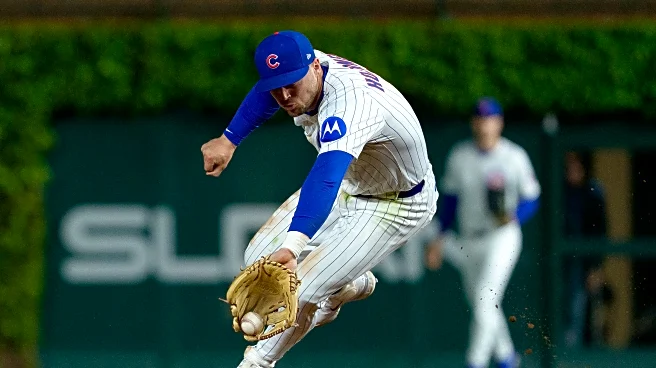
So let’s talk about Nico Hoerner, who is a free agent at the end of the 2026 season. Hoerner has been one of the best second baseman in the majors over the past three seasons, although much of that is dependent on how much you love his defense. To be clear, I love his defense and so do the Gold Glove voters, who gave him the award in two of the past three seasons.
On offense, Hoerner is a throwback to an old school second baseman. His power is below average, but he hits for a high average, finishing second in the National League batting title race behind Trea Turner. Hoerner doesn’t walk a lot, but he walks enough to put up a solid on-base percentage. Hoerner also rarely strikes out, so he is constantly putting the ball into play.
Hoerner is also a very good baserunner and has stolen 103 bases with just 19 caught stealings over the past three years.
So should the Cubs try to lock Hoerner up to an extension before he becomes a free agent? Hoerner has already signed one extension before he reached free agent eligibility and he’s going to be a bargain at $12 million this upcoming season. So what would it take to lock up Hoerner long term?
The best comparison that I can make to Hoerner is Diamondbacks second baseman Ketel Marte, who signed a six-year, $114 million deal before this past season, right after he finished third in National League MVP voting in 2024. To be clear, Marte and Hoerner are two very different kinds of second basemen. On offense, about the only thing they have in common is their career batting average—.282 for Hoerner and .280 for Marte. But Marte draws a few more walks and hits a ton more home runs. Over the past three years, Hoerner has 23 home runs total and Marte has 89. Hoerner has more speed, which leads to more doubles and more stolen bases. On defense, Marte is pretty average. Not bad. Good enough that the Diamondbacks tried him out in center field for a couple of years, but he was below average out there are has returned to mostly playing second base since 2022. Marte is probably the slightly-better player, but Hoerner is also a year younger than Marte was when he signed that extension last year.
Now Marte’s contract extension is complicated, to say the least. When he signed that six-year, $114 million deal last offseason, it was tearing up a previous five-year deal that Marte had signed before the 2022 season. There are also a bunch of incentives that could bring the total value up to as much as $149.5 million.
So I’m going to estimate a contract extension for Hoerner at five years, $100 million. That’s more annually than Marte gets (with the caveat of all the incentives that could drive Marte’s deal higher) but one fewer year. But Marte’s deal actually only added on four years, since he was already under contract for two more years when he signed it.
Would you sign Hoerner for five years, $100 million? Would the Cubs? Would Hoerner?
Thanks for stopping by tonight. It’s always nice to spend time with a familiar face. Sorry you didn’t make it to Orlando where it’s warmer. Please get home safely, Don’t forget your coat. Recycle any cans and bottles. Tip your waitstaff. And join us again tomorrow evening for more BCB After Dark.