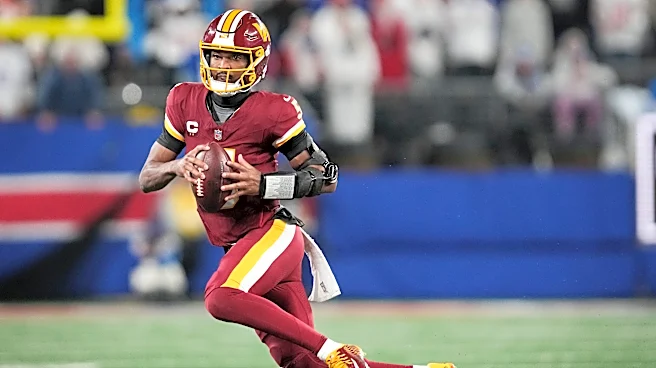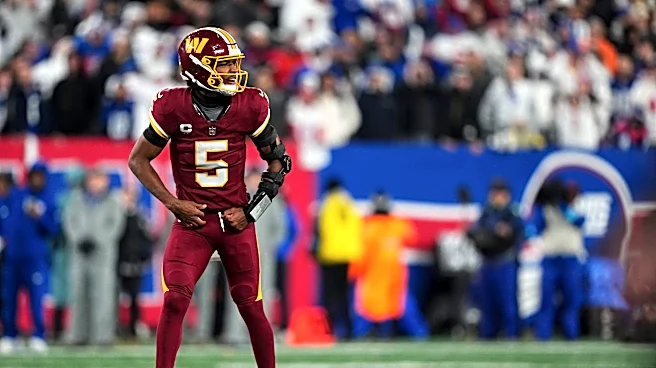


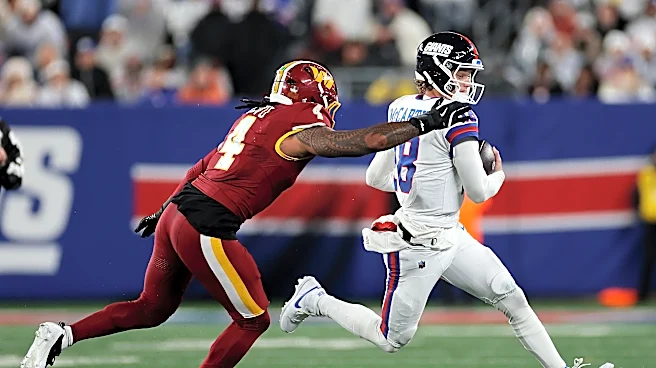
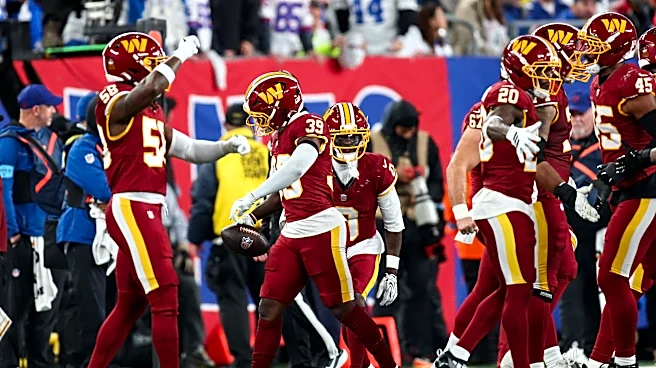
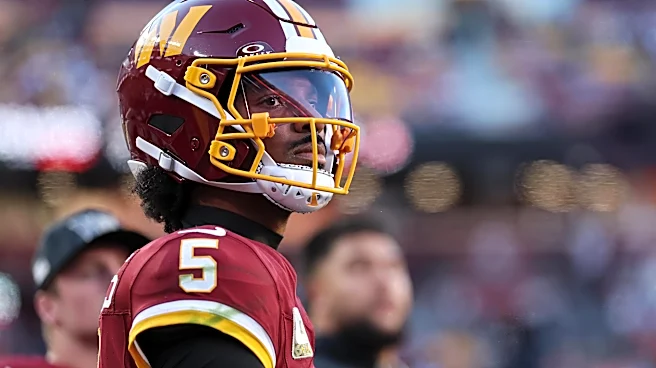
The Washington Commanders handled the New York Giants’ pressure packages significantly better than they did in their first matchup in Week 5, and the improvement stemmed from several areas. Offensive coordinator David Blough was more willing to move the pocket, particularly in down-and-distance situations where Giants defensive coordinator Dennard Wilson typically dialed up pressure. Jayden Daniels and Nick Allegretti did an excellent job setting protections, but perhaps most importantly, Daniels consistently
identified answers pre-snap and delivered the football within the timing of the offense. According to SumerSports, Washington’s pressure rate dropped from 46 percent (seventh-worst in the NFL) in its Week 5 matchup against New York to 23 percent in Week 10, the third-best mark in the NFL that week.
However, Washington’s offensive performance against the Giants was about more than its ability to handle pressure. For an offense that has struggled with consistency throughout the season, Thursday night offered some indication that Washington may finally be developing an identity through the strengths of its personnel.
In the film session above, I detail how and why tight end Ben Sinnott was so impactful against the Giants and explore whether his breakout performance is a sign of things to come as a receiving threat in Washington’s offense.
Commanders pass protection drastically improved
Although the pass was off-target, the protection on this particular rep is exactly what you want to see from Washington in a critical down-and-distance situation.
New York presents a double A-gap threat with linebacker Arvell Reese aligned to the offensive left. Given the tendencies of the Giants’ pressure schemes, Daniels and Allegretti have seven potential rush threats to account for. The two set the protection toward the more athletic side of New York’s defensive front, implementing a three-man slide to the offensive right. Running back Rachaad White does an excellent job scanning from the inside out before ultimately picking up the seventh potential rusher, a cornerback coming off the edge.
The result of the play doesn’t reflect the quality of the execution up front, but Washington’s ability to identify, communicate, and account for New York’s pressure is an encouraging development for an offense that has struggled in those situations throughout the season.
Treylon Burks has established himself as a serious deep threat
It feels more like a matter of when, not if, Daniels and Treylon Burks connect on an explosive play downfield this season. Hopefully, it begins Monday night against the Cincinnati Bengals.
The Giants rotate into a single-high shell pre-snap, allowing Daniels to recognize the opportunity he has with Burks downfield. Aligned in the slot, Burks does an excellent job accelerating off the snap, quickly closing the cushion between himself and the defender before blowing past him with pure foot speed.
What stands out about this rep is that both Daniels and Burks appear to recognize the touchdown opportunity before Burks even gets level with the defender. Post-snap, the Giants settle into Cover 3, and with the middle-of-the-field safety positioned toward the opposite hash, there is little opportunity for him to recover had Daniels delivered a more accurate pass.
The connection hasn’t consistently materialized yet, but Burks’ ability to threaten defenses vertically is becoming an increasingly valuable element of Washington’s offense.
Stefon Diggs mental processing is creating trust between him and Daniels
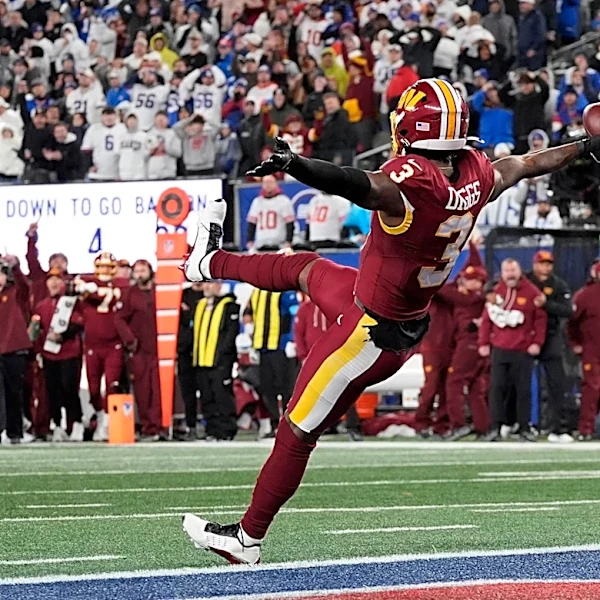
Stefon Diggs’ savviness consistently shows up on film, and the chemistry between him and Daniels appears to be developing at a critical juncture in Washington’s season.
The Commanders initially align in a 4×1 formation before motioning Diggs across the formation to create a 3×2 look. In response, the Giants rotate into a two-high shell, with their safeties gaining additional depth. Recognizing another zone coverage, Daniels knows he has an opportunity to target Diggs on a slant for a quick gain.
What makes this rep impressive, however, is how Diggs creates his separation. Rather than immediately breaking inside, Diggs recognizes the cornerback’s technique while also understanding the timing constraints of his route. He sells the vertical threat by working into the cornerback’s blind spot before suddenly breaking inside on the slant. His ability to manipulate the defender creates both the separation and the sizable throwing window Daniels needs to deliver the football.
The play ultimately fell a yard short of the first down, but it illustrates how Diggs’ understanding of leverage, coverage, and route timing can make life easier for his quarterback.
Washington has an opportunity to build on its offensive performance against the Giants. It wasn’t all pretty. The run game remains a season-long concern, and Daniels’ two interceptions left a blemish on what was otherwise an efficient night. However, between the improved protection and the intentionality behind incorporating Washington’s playmakers, the Commanders may be beginning to show how the individual strengths of their skilled players can complement one another.
In the film session below, I dive into the elements of Washington’s offensive performance that must become staples moving forward if the Commanders hope to make a legitimate postseason push over their final eight games.
Comment and let us know what you are seeing from Commanders Offense. Don’t forget to also subscribe to the Trap or Dive Podcast.