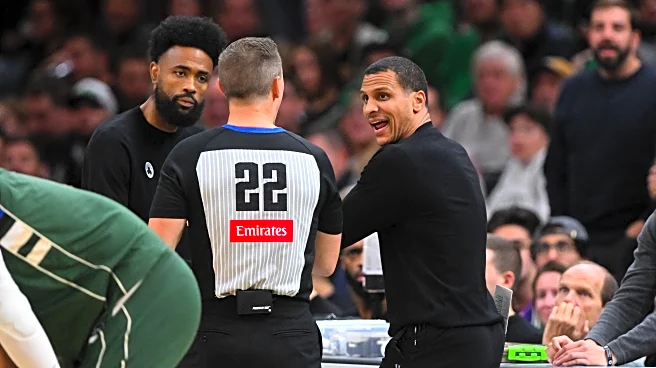


The NBA, whether they wish to admit it or not, has an officiating problem. The problem is deep, it’s structural, and the NBA is either oblivious to it, or worse, they consider it to be a feature instead of a bug.
It’s a problem that Jaylen Brown has been highlighting for quite some time now, and it’s worth a deeper dive.
To start with, officiating in the NBA is incredibly difficult. This is a fast-paced game with a lot of close contact, all of which has to be judged as incidental or illegal in, literally,
a split second of time.
There are fouls that are blindingly obvious, ones which we can see from a thousand miles away through bird’s eye views of the court on our television screens, and then there are fouls that literally occur in only a few tenths of a second, real time, and officials have to identify those fouls without the benefit of slow-motion replay.
That this is a difficult task that is done well by many officials is a positive reflection on those officials who approach their job with a professional disposition and a deep-seated desire to get things right.
Unfortunately for them, it’s probably harder to get things right in the NBA than in any other major professional sport here in the states.
The fastest paced game among the top four professional leagues has the fewest number of officials, both in absolute terms and as a ratio to participating players.
I believe this is directly, although not entirely, responsible for the plague of flopping. Players learn at a very early age that they need to exaggerate the effect of contact to catch the attention of officials who are trying to monitor the actions of multiple players. From there it’s a short step to outright faking contact. Mind you, the NBA does have a flopping penalty, but they’ve apparently put it in a box out in the garage and have forgotten about it. Jaylen Brown called it foul baiting after Thurdsay’s game against the Thunder during a postgame press conference that might net him another $35,000 hit to his wallet.
Lack of an extra official, I believe, is also responsible for wildly inconsistent treatment of off-ball fouls like illegal screens. Performing an illegal screen becomes very much about making sure that you’re in an official’s blind spot before you step into a defender or move sideways to keep him out of the way. In last night’s game against the Thunder, there were a pair of illegal screens called that were done out in wide open space and were so obviously illegal that it was impossible for them not to be called, unless you happen to watch the game more closely and see screens like that being set in traffic all the time. An extra official means more eyes on the court, and closer attention to off-ball action.
Then there’s the star system.
Rasheed Wallace tells a story about an NBA official who approached him after a game and asked him for autographs for his kids.
Now first of all, in CONCACAF, the federation that administers soccer in the Americas, requesting autographs is a violation of policy and will land you a suspension. One of these sports is soccer. Think about that… As corrupt as CONCACAF has been, they still recognize that officials seeking autographs is a problem.
But here you have an official requesting autographs for his kids, who showed up to a Lakers game wearing Kobe jerseys.
Of course, nobody is saying that officials’ kids can’t have favorite teams and favorite players, but it’s a really bad look when you bring your kids to the game wearing jerseys for one of the teams that’s playing in it—or at least it’s a bad look when you subsequently take those kids out to meet the players.
NBA officials have a job to do out there on the court, and in order to do it fairly, they need to avoid giving even the appearance of being star-struck.
Yes, great players are great, in part, because they are harder to stop by legal means, and this undoubtedly leads to more fouls being called on their defenders, but this should only happen when these are calls that would be made regardless of who’s holding the ball.
This is another thing that Jaylen Brown has an issue with, and it’s hard to argue with him.
There is a double standard in what my dad called ‘ticky-tack’ fouls, and I think that it’s reflective of a measure of unprofessionalism within the NBA officiating body as a whole.
Essentially, I think that star players tend to draw more attention from officials than non-star players.
I don’t think it’s intentional. These guys are stars. When they touch the ball, the whole dang arena pays attention.
Officials, unless trained otherwise, can hardly be immune to the electricity that comes onto the court when a special player starts to do special things. They can hardly avoid being caught up in the moment—unless they’re trained to focus on the job at hand. And I don’t think they are adequately prepared for that responsibility.
Finally, you’ve got the NBA’s ‘celebrity’ refs. Guys whose reputation precedes them, and who are, if we’re being honest with ourselves, a definite problem because they deviate from accepted officiating standards.
The best officials are the officials that are invisible. You should never have cause to remember the name of a game official. They should be competent, professional, and anonymous.
But that’s not how the NBA does it. In the NBA, you have guys who are known to call things tight, who are known to ‘let players play’ and so on and so forth. Refs are known to have feuds with certain players and coaches, and the NBA is apparently fine with all of this.
They’re also fine with star system officiating and inconsistent application of rules.
How do we know this?
Because every minute of every game is subject to review by the NBA’s officiating staff, and officials are graded based on their performance. Do your job well and you’ll get playoff assignments and maybe even a chance to appear on the big stage—yet the playoffs are often filled with celebrity refs and questionable officiating.
The only possible conclusion is that the NBA is fine with a game that is understaffed by officials who are evidently star-struck at times. They’re fine with celebrity refs who are know for their deviations from standard officiating practices, and they’re fine with inconsistent rule enforcement.
Much as I admire Jaylen Brown for being willing to take it on the chin—or in the wallet—and consistently make noise about bad officiating, I’m afraid he’s going to be waiting a long time for real change to occur.
And he might want to choose better methods for expressing his disappointment in the officiating during games.
But he’s right. There is a problem with officiating in the NBA.