



Between the sign stealing scheme of recent years, the steroid/PED news cycles of the past couple decades, and the many other scandals through the history of the sport, cheating has always been a hot topic in baseball. Very few of the scandals are as amusing as the “spitball.”
For one, the spitball was legal for quite a while, and even when it was made illegal, some guys were still allowed to use it. While altering the baseball clearly can benefit a starter, the idea of it happening via old fashioned
saliva is just an amusing mental image.
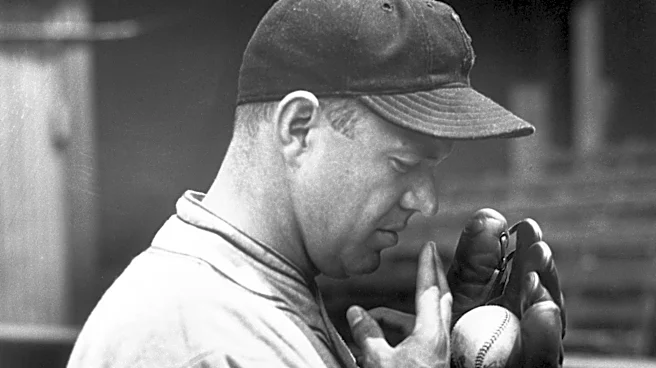
One of the fathers of the spitball was Burleigh Grimes, who did have a very brief Yankees’ stint. With today being his birthday, let’s look back at the life and times of “Ol’ Stubblebeard.”
Burleigh Arland Grimes
Born: August 18, 1893 (Emerald, WI)
Died: December 6, 1985 (Clear Lake, WI)
Yankees Tenure: 1934
Grimes was born in Wisconsin in 1893. When the pitcher was still quite young, Grimes’ father passed away, leaving his mother struggling to try and support their family. Eventually, Grimes himself had to help and got a long and strenuous job at a lumber camp. He very nearly died when one stack of logs fell on him, but through good fortune he survived without major injury.
However, Grimes’ love was for baseball, and he developed an affinity for one particular aspect early. Before his early death, Grimes’ father, who had played for several local teams himself, taught young Burleigh how to play. He also had a formative experience while attending a minor league game in neighboring Minnesota. He was dazzled by pitcher Hank Gehring, who was a proponent of the spitball, which was then still legal. Grimes went home and began to practice and tinker with using the spitball in his own game.
Eventually, Grimes became good enough that professional teams began to take notice. When he was 18, he signed his first deal with a Class D minor league team in Eau Claire, Wisconsin. Over the next couple years, he worked his way up, playing for a variety of minor league teams, and generally impressing on the mound. The Tigers held his rights at one point, but they were eventually sold to the Pittsburgh Pirates, who called him up in late 1916.
Grimes spent his first two major league seasons in Pittsburgh. He was a bit up and down and walk happy, so after the 1917 season, the Pirates included him in a trade to the then-Brooklyn Robins. The headliner at the time was the other pitcher Pittsburgh sent to Brooklyn, Al Mamaux, and included future Yankees’ manager Casey Stengel going the other way. But Grimes ended up being the biggest piece of the deal when things were all said and done.
In 1918, Grimes hit the ground running in Brooklyn, posting a 2.13 ERA (130 ERA+) in 270 innings. He took a bit of a step back the following year, but did spend a bit of time away from baseball, serving in the Navy during World War II. He then responded with dominant campaigns in 1920 and ‘21. He would’ve been a Cy Young contender in both seasons had the award existed then.
Grimes soon became a master of the spitball, which he accentuated by chewing slippery elm, saying:
I used to chew slippery elm – the bark, right off the tree. Come spring the bark would get nice and loose and you could slice it free without any trouble. What I checked was the fiber from inside, and that’s what I put on the ball. The ball would break like hell, away from right-handers and in on lefties.
MLB did actually officially ban the spitball following the 1919 season, but a group of pitchers were grandfathered in and could continue using it until their careers ended. Originally, the spitball was set to be banned outright, but Grimes was among those to lead a campaign against this, leading to the grandfathering in. Grimes would be the longest lasting of that group, not retiring until 1934.
Besides the spitball, Grimes could also be a bit ornery on the mound. He was known to throw brush back pitches at opposing batters and purportedly once threw at a hitter who was in the on deck circle. While some disputed this, he could also be somewhat aloof, and had a bad relationship with Dodgers’ manager Wilbur Robinson, who would send others over to talk to the pitcher.
Grimes helped the Dodgers to the 1920 World Series, where they lost with the pitcher struggling a bit in his three starts. While Grimes himself remained mostly good, Brooklyn didn’t get back to the Fall Classic in the next couple years. The team and the player also regularly bickered over salary, and Brooklyn eventually decided to move him to the cross-town New York Giants.
Over the next couple years, despite success in the meantime, Grimes became a bit of a journeyman. He spent just one year with the Giants before going back to the Pirates, where he had two of his career best years in 1928 and ’29. However, more salary disputes led to Pittsburgh trading him to the Boston Braves. He had a bad run there, leading to the Braves trading him to the St. Louis Cardinals. In St. Louis, Grimes got back on track and helped them to the 1930 World Series. Grimes performed much better in that World Series, but his team fell to the Athletics. However, the Cardinals won the NL pennant again the following season, and Grimes put in an arguable MVP performance in the 1931 Fall Classic. He had a 2.02 ERA in his two starts, including allowing just two runs in a Game 7 victory, winning his first and only World Series title.
Despite that, the Cardinals had a loaded rotation and ended up trading Grimes to the Cubs. In Chicago, he helped the Cubs topple the Cardinals in the NL in 1932, but they fell in the World Series to the Yankees in the series that featured the Babe Ruth “called shot.”
Partway through the 1933 season, Grimes was released and returned to the Cardinals. Partway through the following season, he was again released and this time signed with the Yankees. Grimes’ Yankee stint wasn’t particularly notable, as he had a 5.50 ERA in 10 appearances out of the bullpen. His signing was almost certainly just an attempt to see if “Ol’ Stubblebeard” — a nickname gained from Grimes’ habit of not shaving on days he was pitching — still had anything left in the tank. The Yankees also released him, and Grimes returned back to the Pirates, where his MLB career ended following the 1934 season.
After ending his playing career, Grimes remained in baseball. He had a successful run as a minor league manager, earning him the big job with his old Brooklyn Dodgers team in 1937. His Brooklyn teams finished well under .500 in both seasons before they let him go. After further minors managing jobs, he became a scout and a coach for several teams, including back with the Yankees from 1947-52.
Grimes eventually retired back to his native Wisconsin, where he resided until his death in 1985. Before that, he got the honor of being inducted into the Baseball Hall of Fame in 1964 via the Veterans Committee. You can definitely debate whether his Hall status is warranted, but there’s no doubt that he was a very big figure in baseball for many years.