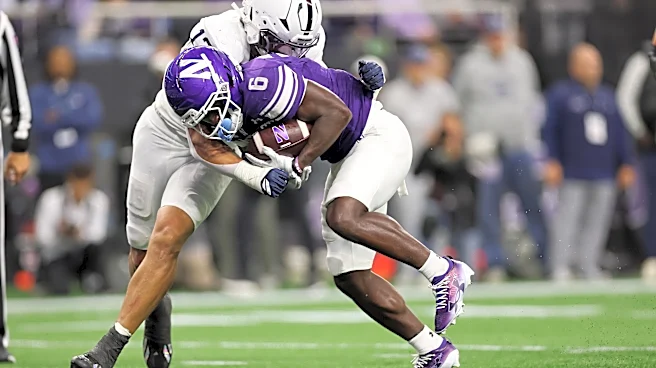

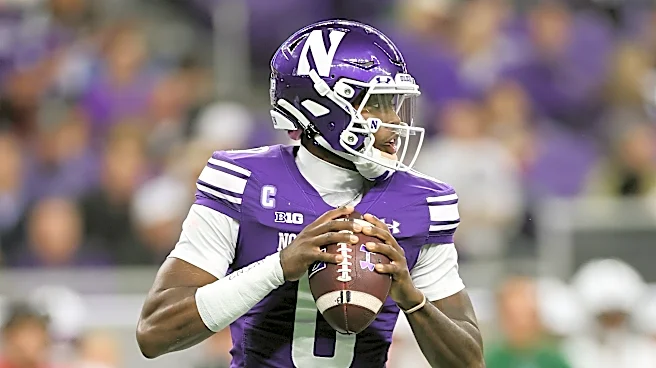
Systematic overload. That’s what this game was. Northwestern overpowered Penn State, rushing for 413 total yards. 413! The Wildcats feel like a different team following the loss to Indiana, with a newfound energy taking over the team alongside the new Ryan Field. Northwestern experimented with offensive line positioning, as well as looking like a team that has no problems whatsoever with injuries. Chip Kelly called plays that were innovative in today’s college football world, and showed the country
why he’s still among the best offensive minds that has ever impacted this game. One more note: the All-22 film looks a little better at the new Ryan Field compared to that of Martin Stadium, so nice to see that.
Pistol Pete Willie
Northwestern in this game operated primarily out of the pistol and out of some old-fashioned formations like Wing-T. On a lot of these plays, the end zone angle is the better look at seeing the blocking. Patrick Schaller got the start at left tackle. Dennis Rahouski started at left guard but got a bit banged up, so Idrys Cotton took his place at times. Jackson Carsello remained at center and Grant Seagren moved to right tackle, bumping Deuce McGuire inside to play right guard. This shifted offensive line paved the way for over 400 rushing yards.
Alex Honig is in on the left side for the first play of this cutup. Northwestern’s O-line runs a zone blocking scheme to the right side, which opens up a massive running lane for Caleb Komolafe to take after a quick juke in the backfield. The second play is another zone run concept, only this time Komolafe stays on the weak side and runs through the B-gap for extra yardage. Joseph Himon II is the running back in the third play here, and he runs through the right-side B-gap in this zone concept for a massive gain. Aidan Chiles’ rushing ability also draws defenders at times to help open up rushing lanes for Northwestern’s backs. On this fourth play, Himon II attacks the A-gap between Carsello and McGuire, with the Wildcats running more of a man-blocking concept against a three-down front. Simon II cuts back once he gets to the second level and uses Honig’s block to break free for the touchdown.
Plays five and six are fairly similar to play three, with Northwestern breaking off big runs by attacking the B-gap between McGuire and Seagren on the right side. The seventh play is similar to the fourth play, with Komolafe attacking that right-side A-gap between Carsello and McGuire, plus using his speed to prevent being taken down from behind. The eighth play is interesting because Honig doesn’t immediately block the defender in front of him, yet Northwestern is still able to attack the C-gap on the right side. Chiles keeps it here and follows behind Komolafe; plus, Honig is upfield blocking. The final play in this cutup is a great example of Himon II’s vision between the tackles and not just a showcase of his speed on the outside. He’s able to weave his way through the O-line and Penn State’s D-line without being touched, which is very impressive for someone who is thought of as more of an outside zone running back.
The Olden Days
This cutup is a combination of under-center runs, with it primarily being the Wing-T or some variation. While Northwestern is only in 11-personnel, it feels like 13-personnel with the way Drew Wagner and Griffin Wilde line up. Kelly brings his innovation as an offensive play caller by incorporating more traditional football tactics, just with a modern spin. Wagner runs a jet motion fake, Schaller, Seagren and Honig are able to pick up blockers downfield, and Himon II runs through the massive gap that springs open from the pull blocks by McGuire and Cotton, as well as Seagren’s downfield block. The second play, Northwestern is in a strong formation with both Honig and Robby Preckel lined up inline on the right and with Gavin Sawchuk and Komolafe in the backfield, with Komolafe lined up in a fullback spot toward the strong side. Chiles keeps it on this one, and uses his strength to power into the end zone.
The third play is similar to the first, except Honig and Wilde are lined up on the left while Wagner is on the right because the Wildcats wanted the two inline players to be on the wide-side of the field. Wagner goes in motion like the first play, and Chiles hands off to Himon II who runs up the middle. He bounces off the O-line and defenders. McGuire pulls from right to left, and Himon II follows that block patiently. On the fourth play, Wagner lines up on the outside to the short side of the field while Wilde lines up to the wide side. Preckel and Honig both line up inline, one guy on each side. Wagner motions from outside on the right to the left side of the O-line to block, then Chiles hands off to Komolafe who stays patient and weaves his way between Carsello and Rahouski.
In the final play of this cutup, Northwestern is in 31 personnel but only has one RB in the backfield. Himon II lines up next to Honig inline on the left, Sawchuk lines up inline on the right next to Seagren and Komolafe is lined up in the backfield. Sawchuk goes in motion like Wagner had done on earlier plays, Chiles fakes to Komolafe and Himon II cuts inside from his starting position to receive the handoff from Chiles. Himon II is able to attack the A-gap because of the motion pre snap and the movement post snap that confuses the defense.
Setting up the Pass
This here is only one play, but it speaks volumes with what this offense can do. Play-action passing is that much more effective when a team is running the ball well. In this case, that’s what 413 yards will get you. It is interesting that Northwestern primarily ran plays out of the pistol or in a variation of the Wing-T, and here the ‘Cats go with a traditional shingleback under-center look. Penn State has six players keeping an eye on the run and biting at it with the fake handoff and the zone drops the Nittany Lions run allow for Wilde to spring open in a 1-on-1 situation. Chiles throws it up to his guy, and Wilde makes the grab for a 31-yard gain.