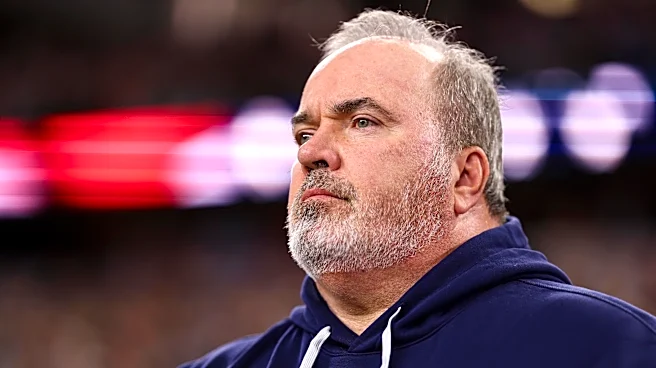



Heading into the 2026 season, no change or storyline holds more prominence for the Black and Gold than the switch made at head coach. After Mike Tomlin announced his resignation, the Steelers named Mike McCarthy as their new top man on January 24. McCarthy is just the third different head coach the Steelers have employed during the 21st century, and only the fourth since legendary coach Chuck Noll assumed the mantle in January of 1969.
A case could be made that McCarthy’s hiring was the same old same old for
the Steelers – namely, a risk-averse team making the “safest” hire by tabbing a known commodity with local ties – but that certainly isn’t the only point of view. One could similarly argue that this hiring is the single biggest attempt at a philosophical shift in over half a century.
For the past 57 years, the Steelers’ identity has been rooted in defensive football. Sure, the offense may have outperformed the defense in any given year, especially during the “Killer B” era of the mid-2010s, but the organizational vision of what makes for “Steelers football” has stuck to a familiar blueprint. At their best, at least in the front office’s eyes, the Steelers aim to be a hard-nosed, suffocating defense. As beloved as Steelers legends like Franco Harris, Lynn Swann, John Stallworth, Mike Webster, and Terry Bradshaw are among the fanbase, there is a reason why the team’s nickname was The Steel Curtain during its golden era. The same was true during the Blitzburg era in the 90s, and it certainly wasn’t the Pittsburgh offense featured on magazine covers when the team was winning Super Bowls again in the early 2000s.
McCarthy, then, represents a significant shift. He’s the first truly offensive-minded coach the Steelers have employed during the Super Bowl era, at least in reputation. Noll was primarily a guard as a pro for the Browns, but he was also a linebacker in college, and he cut his coaching teeth coaching defensive lines and backfields while climbing the ranks. Likewise, Bill Cowher played linebacker and coached defensive backs before working his way up to coordinator and then head coach. Tomlin was a receiver at William & Mary, but he too found himself coaching defensive backs and coordinating defense before landing the gig in Pittsburgh.
So it’s no surprise that during his introductory press conference, McCarthy expressed his intention not to meddle too much with the defense. While some changes may occur, McCarthy is entrusting that oversight to new defensive coordinator Patrick Graham and the supporting coaching staff. Where McCarthy’s impact will be felt most – and the reason he was hired – is to overhaul an offense that has been largely stagnant and uninspiring this decade.
But how will he do so? What can Steelers fans expect to see from their new coach?
Finding that out is the goal of this series. In our previous entry, we took a look at some of the raw historical numbers of McCarthy offenses. That’s a good way to get a snapshot of the end result, but doesn’t really give us the “why” or “how” of how the offense functions. I’ve begun my charting of the 2023 Cowboys – the last time a McCarthy offense finished No.1 in league scoring, and the last time he had a full season with a healthy starting quarterback – and will fully dive into a visual representation with our next entry.
But for today, we’ll be examining McCarthy’s coaching journey, who his influences/mentors are, and what principles and concepts shaped him.
McCarthy’s journey

As Steelers fans should be well aware of by now, McCarthy’s football life begins in Pittsburgh. McCarthy was one of five siblings who grew up in the Greenfield neighborhood, with McCarthy eventually attending Bishop Boyle High School. McCarthy’s college career took him to small schools in West Virginia, Arizona, and finally Kansas, during which time McCarthy played tight end. When his college days were over, he took a graduate assistant gig at Fort Hays College in Hays, Kansas. McCarthy would work that job for two seasons.
Homesick, McCarthy moved back to Pittsburgh in 1989. He reached out to the University of Pittsburgh about a coaching job, and was eventually able to secure an unpaid position. That’s where McCarthy met his mentor, Paul Hackett, then the offensive quarterback. Hackett would take over head coaching duties a year later and gave McCarthy his first real job in football when he hired him as the Panthers’ wide receivers coach in 1992. This origin story helped shape McCarthy. It was under Hackett’s tutelage that McCarthy would become one of the many coaching branches that trace back to the legendary coach Bill Walsh and his West Coast offense.
“Paul Hackett was my mentor,” McCarthy said while being introduced to the Pittsburgh media. “Paul taught me the quarterback position.”
Hackett was himself a direct disciple of Walsh, working as a quarterbacks, receivers, and tight ends coach between 1983 and 1985, winning one Super Bowl with the team. In 1993, Hackett accepted the offensive coordinator role in Kansas City under Marty Schottenheimer, and helped facilitate a trade that would reunite him with Joe Montana. Hackett brought McCarthy with him, with McCarthy serving as an offensive quality control coach for two years, and then as quarterbacks coach from 1995 through 1998.
Hackett would leave the Chiefs for USC following the 1997 season. After Schottenheimer was let go from the Chiefs a year later, McCarthy made a one-year stop as the quarterbacks coach in Green Bay. Another Walsh disciple, Mike Holmgren, had just departed the team for the Seattle Seahawks, but Holmgren’s offensive coordinator, Sherman Lewis, remained on with the team, giving McCarthy further exposure to a unique evolution of Walsh’s offense.
McCarthy would then get his first offensive coordinator gig with the New Orleans Saints, joining former Steelers defensive coordinator Jim Haslett. He remained there for five seasons, then joined the San Francisco 49ers for a single season before finally earning the head coaching job in Green Bay in 2006. After 13 years on the job, and one Super Bowl victory, McCarthy would take a gap year before joining the Dallas Cowboys.
Notable offensive players McCarthy has coached over the years include:
- KC – Joe Montana, Marcus Allen, Joe Horn, Tony Gonzalez, Will Shields
- NO – Ricky Williams, Joe Horn, Willie Roaf, Deuce McAllister, LeCharles Bentley
- SF – Alex Smith, Frank Gore
- GB – Brett Favre, Aaron Rodgers, Greg Jennings, Ahman Green, Donald Driver, Jordy Nelson, Josh Sitton, T.J. Lang, Bryan Bulaga, Randall Cobb, Eddie Lacy, David Bakhtiari, Davante Adams, Corey Linsley, Aaron Jones
- DAL – Dak Prescott, Amari Cooper, CeeDee Lamb, Ezekiel Elliott, Tyron Smith, Zach Martin, Tyler Biadasz, Tony Pollard, Dalton Schultz, Michael Gallup, Rico Dowdle, Tyler Smith
But what is the West Coast offense?

The West Coast offense has been around long enough that many of its core tenets should be recognizable to modern football fans. In fact, the scheme has grown so core to the league, and been adapted and tweaked by so many coaches, that what was once new and innovative has become standard practices in modern offense.
The name “West Coast” is a bit of a misnomer. While it grew in notoriety with Walsh’s 49er teams – and Walsh himself was a Stanford man, so perhaps it refers more to his roots – the offense was actually created out of necessity in Ohio in 1969. At the time, Walsh was the offensive coordinator for Paul Brown’s Bengals. The Bengals couldn’t run the ball to save their life, and a devastating elbow injury to the Bengals big-armed passer Greg Cook thrust Cincinnati’s backup, Virgil Carter, into the starting role. Carter didn’t possess the same big arm that Cook did, but he was mobile and capable of making decisions quickly. With those as his template, Walsh got to scheming. The result was a quick, timing-based passing attack.
Traditionally, offensive schemes had looked to create explosive plays with a vertical passing game. Walsh himself spent time with Al Davis and the Raiders, huge proponents of this style of passing attack. However, throws downfield are harder to complete at a high rate and require a stout offensive line to hold up for a longer period of time. Those were luxuries not afforded to Walsh and the Bengals.
Walsh realized that if his quarterback couldn’t win vertically, and his running game couldn’t consistently overpower opposing defenses, his best chance was to exploit the space and slower defenders in the underneath portions of the field. He devised an offense that would exploit defenses horizontally, and allow running backs to become more involved in the passing game than was typical at that time. The route concepts he drew up were based on timing and rhythm, with quarterbacks ideally able to get the ball out on either a three-step or five-step drop depending on the play call.
Other innovations of Walsh’s offense that have become more standard:
- Variable formations
- Throwing on early downs
- Receivers adjusting their routes mid-play based on what looks the defense gave them
- Making the play-action pass, initially introduced by George Halas and the Bears, a staple of the offense
- “Multiple” offensive looks, ie showing formations that might indicate one style of play, and then using concepts traditionally not associated with that formation
Some elements of Walsh’s West Coast offense have fallen out of favor. Most notably, Walsh deployed split backfields because they allowed running backs to access the flats and other short routes more easily. Additionally, so many coaches have taken Walsh’s original West Coast principles and merged them with other concepts to the point that no team truly runs a textbook “West Coast” offense anymore. Traditionally a power running scheme, other coaches have injected zone-running schemes into it. Others have experimented with adding multiple tight ends, and with flexing tight ends out. Still others have added elements of Spread and Air Raid offenses, as McCarthy did in Dallas with an updated version that was dubbed the “Texas Coast” offense.
McCarthy himself will admit that he doesn’t limit himself to the offense originally molded by Walsh, or the version he learned from his mentor Hackett.
“I’m a believer in the tradition of the West Coast offense,” McCarthy said at one point of his introductory presser, but he later also expressed the importance of adjusting the scheme to the talents of the players on the roster. “At the end of the day, I would never say we run the ‘West Coast’ offense. If your system of football cannot take in every player that Omar (Khan) and Art (Rooney II) want to bring to the Pittsburgh Steelers, then you need to take a look at your system. So we need to make sure we can accommodate the variety of players that are available to us.”
A big part of that will be dictated by quarterback Aaron Rodgers. Rodgers ran McCarthy’s offense for years, and even has spent time with Hackett’s son, Nathaniel. You might know him from his disastrous season as the Broncos head coach, or for his clips on Hard Knocks with the Jets. It suffices to say that I’m glad the younger Hackett is in Arizona this year and not part of the Steelers’ staff, but it does highlight Rodgers’ prolonged exposure to this style of offense. The real question this season will be whether Rodgers will feel comfortable accessing the more vertical elements of McCarthy’s latest version of it, or whether McCarthy will once again need to find new wrinkles to fit his roster.
Let us know what you think in the comments and keep your eyes peeled for the next installment of this series, where we’ll examine some of the X’s and O’s behind McCarthy’s “Texas Coast” offense he ran in Dallas. Be sure to bookmark Behind the Steel Curtain for all the latest news, breakdowns, and more!