

Happy 2026 Battery Power Player Review season to all who… celebrate?
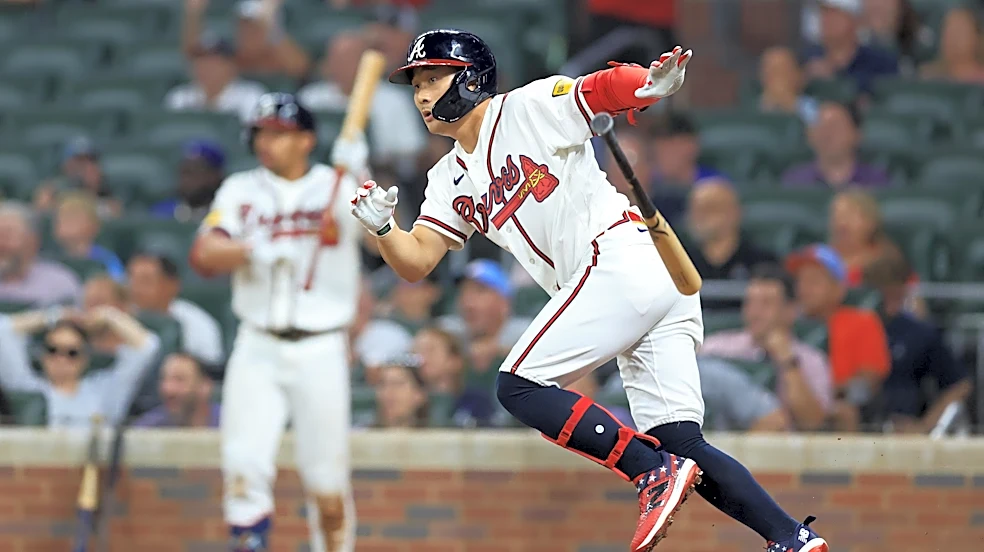
This particular season was ripe with weirdness and what-ifs. It seems only fitting that we will kick off this year’s series with one of the most polarizing of players to don a Braves uniform this year: infielder and presumed Opening Day shortstop Ha-Seong Kim.
How acquired
In a low-risk waiver claim for the final month of 2025, Kim played 24 games with the Braves and seemed to be trending upward offensively from his injury-plagued time with the Rays
(.253/.316/.368 with a .301 wOBA/92 wRC+ with three homers). Emboldened by that improvement and a dire shortstop market, he declined the $16 million player option to test the waters of free agency.
But the faith in Kim in his “trial period” and mutual interest paid off, as he and the Braves reunited to the tune of a one-year, $20 million deal in mid-December.
What were the expectations?
The South Korean infielder was given a pretty penny to shore up a premium position in place of glove-first players like Orlando Arcia and Nick Allen in years past. At minimum, it was an exciting short-term upgrade if Kim’s production was even close what it was in his time with the San Diego Padres. In the longer term, this could have paid off in an extension that got us closer to bridging to our potential shortstop of the future in Tate Southisene.
Kim was tabbed to be the primary shortshop with earlier offseason acquisiton, infielder Mauricio Dubón, serving as a versatile utility man.
At the time of the signing, we were pretty excited about the upgrade to our infield and looking forward to what Kim could bring to the Braves in a full season. The projections were fairly solid despite his poor 2025, with Steamer seeing a 1.4 WAR, league-average bat with subpart shortstop defense in a half-season, and ZiPS more sanguine at 2.1 WAR over about two-thirds of a campaign. Both projection systems saw him as a league-average bat, which makes sense given that he had a 99 wRC+ coming into the 2026 campaign.
2026 Results
Kim played in 51 games with Atlanta, racking up single-digit wRC+ (7) negative fWAR (-1.2) with a .116/.219/.140 slash line. Defensively, his Statcast-based value was also negative (-3, as in, three runs below average despite playing in less than a third of a season).
What went right?
Once reactivated from the injured list on August 3, he stayed up with the big club for good and was available through the end of the season, even making a couple starts in the postseason.
Can a walk-off single be worth $20 million if it’s against the two-time World Series Champion Los Angeles Dodgers? In a series full of unreal scenes (and second only to Chris Sale’s complete game shutout), he entered with two on and two out in a tie game to pinch-hit for pitcher Victor Mederos. Kim saw seven pitches before lacing a ball to left field to win the game and the series for the Braves in electric fashion.
That was part of a brief stretch of unexpected heroics from Kim: he had that huge hit, had a three-hit game against the Nationals a few days later, and then played a critical role in one of the division-defending wins against the Phillies in September, singling with two outs to tie the game in the 11th and then madly dashing around the bases to score the walkoff run a few minutes later.
What went wrong?
Basically the whole thing, but you knew that. We seemed to run out of synonyms for “nightmare” when talking about Kim’s 2026 season. You almost couldn’t have drawn it up any worse. It was historically terrible.
A dastardly patch of ice derailed things early. A month after signing with the Braves, the news broke that he’d sustained a hand injury while slipping and tore a tendon in his right middle finger and putting him on the shelf for at least four months. Once activated in May, he was Not Right. He struggled and he hit the Injured List again for inflammation in that same finger in early July. He largely lost out on the starting shortstop job, getting the occasional rep as matchups allowed or entering games late as a pinch-runner. He earned a little more regular playing time after the walk off hit above and showed some signs of life, but still never put it all together.
All in all, Kim finished with the lowest wRC+ among anyone with 140 or more PAs this season, as well as the lowest xwOBA. Somehow, he was only bottom five in value (thanks, Jorge Polanco and Noelvi Marte!). Nor did anything really get better in the postseason, as Kim managed just a 20 wRC+ in eight PAs. It’s also not like the Braves were able to bury him in a way that kept his struggles from leading to losses, either. Or, at least, not soon enough for it to matter. One of his most damaging games came in his fifth contest of the year: he went 0-for-4 with two strikeouts, and up with two out and the bases loaded in a one-run game, hit a measly groundout to Aroldis Chapman to end the game.
Even his defense graded out poorly, though this was a case where most of the damage was done early, as he was a positive defender after May (though not enough to counterbalance how poorly he played in the field in May).
2027 Outlook
Kim headlines another thin shortstop class in this uncertain offseason, and it’s anybody’s guess as to who might take a chance on him if baseball is played in 2027. On one hand, that’s two truly terrible years in a row (albeit with some bad luck of the injury persuasion in there). On the other, there is a chance he can get back to being a ~2 WAR player, as he was projected to be in 2026… though the path as to how he gets there is a bit unclear given that it will have been at least three years since he was last productive by the time he next takes the field.
Walt Weiss lauded Kim for his hard work and team-player attitude amidst his struggles this season. With no real internal options and Dubón also hitting free agency, there may be an opportunity for a return to the Braves. If he does, there’s truly nowhere to go but up. At least it won’t be for $20 million this time — it’s hard to see a team guaranteeing him more than $5 million at this point, even if the spending situation associated with the new Collective Bargaining Agreement is relatively unchanged. The Braves, though, will probably want to move on from this specific sense of failure.