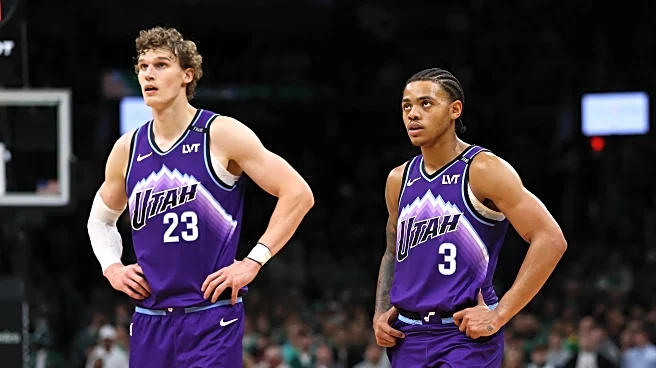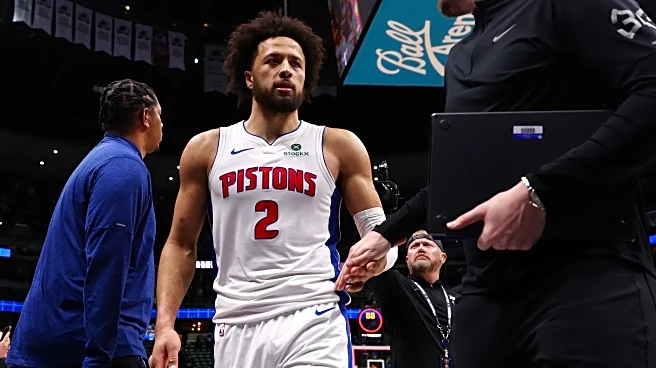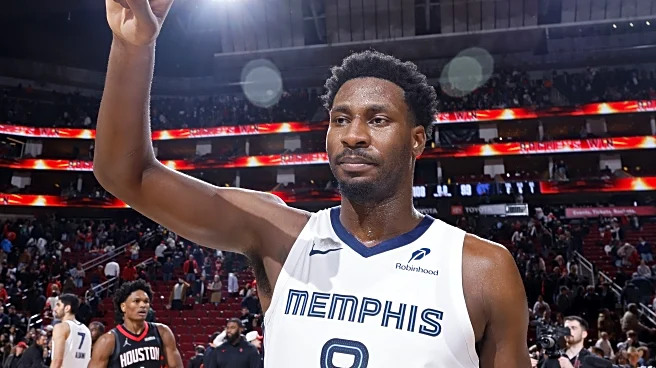

After weeks of reports saying that the Jazz were likely not going to make any big moves at the trade deadline, Utah’s front office dropped a nuke on the NBA landscape that nobody — Jazz fan or not — saw
coming.
On Tuesday morning, the Memphis Grizzlies agreed to send former defensive player of the year Jaren Jackson Jr. to Utah along with Jock Landale, Vince Williams Jr. and John Konchar. In return, Memphis received rookie Walter Clayton Jr., Taylor Hendricks, George Niang, Kyle Anderson and three future first-round picks.
This trade left Jazz fans with a lot of excitement, confusion, frustration and seemingly every possible feeling in between.
Let’s take an in-depth look at what this trade means for the Jazz this season, and for the years to come.
JJJ analysis
Jackson is listed at 6-foot-10 and 242 pounds, making him a really big power forward — which is the position that he should play.
Statistically speaking, he is not having his best season, but to his defense, it’s hard to put up great performances when your franchise cornerstone never plays and there is no plan in place for the future. He’s averaging three less points than he did in his all-star season last year (19.2 ppg) in similar minutes, and he didn’t even sniff the all-star ballot.
But we’ve seen Jackson be great in the NBA before. He’s made the all-star team twice in his eight-year career, which is impressive since he was only the second-best player on his own team. He’s never made an all-NBA team, but he has made the first-team all-defense twice and the second-team just last season. In 2023, he led the league in blocks and took home his first and only defensive player of the year award.
Jackson has two very glaring weaknesses:
- He can’t rebound.
- He fouls a lot.

For a guy his size, his rebounding numbers are pretty atrocious, only averaging 5.6 in his career. This season, he is averaging a career-worst 0.9 offensive boards a game. He is one of the worst rebounding big men the league has to offer.
And for as good of a rim protector as he is, he fouls a lot. This season, he is fourth in the league in fouls per game with 3.8. This has been a problem his whole career, and the numbers are pretty consistently bad. There’s no sign of it going down anytime soon.
But even with his flaws, Jackson is one of the premier shot blockers in the league, and his offensive skill set is as good as any Jazz big man in recent memory.
How does JJJ fit in with the Utah Jazz?
The vision seems to be pretty clear for the Utah Jazz: It’s all about size.
The Jazz could run a lineup of 7-foot-1 Lauri Markkanen at the small forward, 6-foot-10 Jackson at the four and 7-foot-2 Walker Kessler at center. That would be one of the biggest front courts in the NBA, and all three of those guys are top 100 players in the league.

The pairing of Jackson and Kessler actually really makes sense. Kessler’s stellar rebounding abilities could nullify Jackson’s lack thereof. Plus, I don’t think many people are going to want to try to finish at the rim with Kessler and Jackson awaiting them. Together, the two will average about 4 blocks a game.
One issue with this grouping is that none of the three players mentioned are known for their playmaking and ball movement abilities. Between Markkanen, Jackson and Kessler, the three only have a career average of 4.2 assists per game. That’s not nothing, and I think people are valid to have a concern about the team’s ability to create.
This is where the glorious hypotheticals come in.
Let’s say the Jazz get lucky in the lottery in May and wind up with the No. 1 selection. As of today, I think the obvious choice would be Kansas’ Darryn Peterson, who could really help on the playmaking side of things for the Jazz.
Utah could see a lineup of Keyonte George, Peterson, Markkanen, Jackson and Kessler, plus Ace Bailey coming off the bench. That’s a really talented starting five and one that has a clear direction and chance to make the playoffs.
But make no mistake, the Jazz could still make moves before the start of next year. They’re going to have to pay to keep Kessler around, they already are paying Markkanen over $40 million, Jackson will make $50 million a year for four years starting next season and George will be looking at a deserved sizable extension next year too. It’ll be an expensive starting unit.
I don’t love Jackson at the five, which is why I think pairing him with Kessler is so vital, but will such a unique lineup work? I wouldn’t be surprised if more trades happen over the next eight months.
What about the other pieces in the trade?
The Jazz aren’t losing sleep over giving up Kyle Anderson and Georges Niang. The big “loss” was cutting ties with former No. 9 pick Taylor Hendricks and last year’s No. 18 selection Walter Clayton Jr.
Hendricks has not impressed in his first season coming off of a gruesome leg injury and was struggling to get minutes for a team that could desperately use anyone to step up. He logged zero minutes in four of the Jazz’s last six games. Clayton didn’t show much for the Jazz to be sad that he is no longer on the team, but I am still curious to see how he pans out in the league.
The three picks given up are as follows:
- The most favorable 2027 pick between the Jazz, Timberwolves and Cavaliers.
- The Lakers 2027 first-round pick, top-four protected.
- The Suns’ 2031 first-round pick, unprotected.
Giving up the Suns’ 2031 pick is rough. All signs point to that pick being pretty valuable, but to do big trades you have to give up big assets.
Two of the three other players that the Jazz got in the deal really intrigue me: Vince Williams Jr. and Jock Landale.

Williams is going to really help with the playmaking concerns if he is also on the team next year. In only 20 minutes a game he averages 8.0 points, 4.0 rebounds and 4.4 assists per game. He doesn’t shoot as well as one would hope, shooting only 32.0% from deep, but it’s not deplorable by any means. He also immediately becomes one of the Jazz’s best on-ball defenders, a skill that Utah desperately needs.
Landale is having a career year, — albeit on a bad team — averaging 11.3 points per game on 38.3% 3-point shooting. Anybody that can shoot that well from deep will always be welcome on an NBA roster.
Conclusion
I see what the Jazz are doing. It is the first time since the Mitchell-Gobert era that Utah seems to now have a clear direction, which is refreshing.
Even with the concerns about fit or style of play, I think Will Hardy has shown that he is a good enough coach to make things work. I expect the Jazz to be a playoff team next season.
But even with this newfound faith that has been instilled in the Jazz, they still need to get a top-three pick in this year’s draft. The whole purpose of this rebuild has been to build a championship-level team, and the Jazz are not one without Peterson, AJ Dybantsa or Cam Boozer.