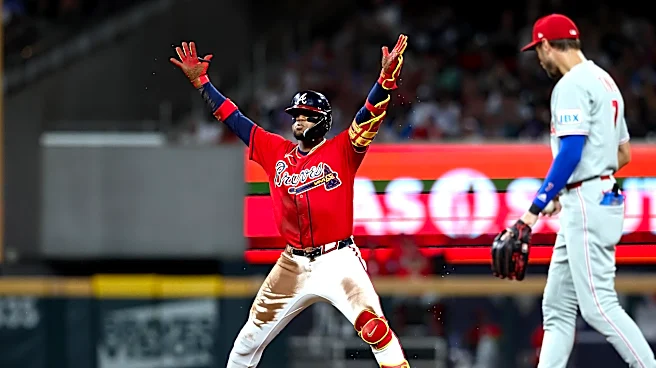


Ronald Acuña Jr. isn’t going anywhere. If you took anything away from the General Managers meetings in Las Vegas earlier this month, that was the headline.
When asked point-blank if the Atlanta Braves would trade Acuña this offseason, General Manager Alex Anthopoulos responded, “Absolutely not. Put it in bold.”
It was not that long ago that many, if not most, believed an Acuña trade was an unthinkable outcome for the Atlanta Braves. So, how did a former MVP and franchise fixture on a club-friendly
contract for an annual contender go from untouchable to the subject of trade rumors?
Whether it be print, television, or radio interviews, Anthopoulos will continue to discuss the roster and keep an open mind about potential moves this winter. But putting an end to speculation about Acuña’s future was an important step for the club.
Opposing general managers remain free to call about anyone and everyone on the Braves roster and Anthopoulos maintains he is always willing to listen. Some conversations will be longer than others, however, and it just so happens that inquiring about Acuña is a non-starter.
Rumors come with the territory but aren’t all created equal. Many originate with a game of connect-the-dots from baseball reporters and personalities. Others are simply born out of boredom and a natural predilection for fans to speculate about what could happen.
There’s nothing inherently wrong with either exercise, but if managing expectations is the objective, then hearing a GM declare that a certain player won’t move is enlightening.
“Normally, if there’s noise, it’s because there’s been a conversation, (but) there have been zero conversations,” Anthopoulos said regarding Acuña. “And I don’t mind saying that on the record. There have been zero. None. No phone calls incoming, outgoing. Zero.”

With Acuña’s immediate future addressed, Anthopoulos hopes to effectively put an end to that speculation and instead shift the focus to adding pieces to the roster. Even if Acuña is coming off arguably the worst season of his career, all the reasons another club would be looking to pry him away are the exact same ones fueling the Braves’ desire to hold onto him.
“He’s a huge part of the club,” Anthopoulos said, noting that the best version of the Braves includes Acuña. “We need right-handed bats. He was an integral part of our lineup… We need him. We need to add to him. Obviously, we need more than just him, but I have no idea where that stuff came from. There’s not even a hint of smoke to it. There’s zero.”
So, how exactly did Acuña become expendable in the minds of some?
The answer to that question is tied directly to his health, which has impacted Acuña’s ability to produce and maintain his place among the best players in the game. The three seasons that followed his incredible 2023 MVP campaign were filled with injuries and inconsistency, causing Acuña to miss roughly half of Atlanta’s games over that stretch. That equates to roughly a season and a half of lost time for Acuña in a three-year span.
While common sentiment is that availability is the best ability, the injury setbacks Acuña dealt with across those three seasons do not mean he’s somehow become a complete liability and that the club would be better off without him.
Given all he’s accomplished, Acuña has set the bar high when it comes to expectations. This is a player who’s slashed .285/.379/.516 in his career. Among players with at least 900 games played since Acuña debuted in 2018, only New York Yankees superstar slugger Aaron Judge exceeded or even matched Acuña in all three of the triple-slash categories.
There simply aren’t many hitters in the game who can do all of the things Acuña can do.
He’s averaged 36 homers, 90 RBIs, 126 runs scored, 40 stolen bases and 5.9 fWAR per 162 games played. While a litany of injuries caused Acuña to play far less than a full season more times than anyone would like, not having him on the field makes the Braves’ lineup less potent.
Watching Acuña miss significant time and then struggle to recapture his previous superstar form for multiple years does cast some doubt on his ability to do so in the future. A healthy amount skepticism is allowed, even welcomed in most cases, but the Braves’ focus on building a championship contender still hinges on Acuña playing a significant role.
Acuña turns 29 years old in December, still very much in the midst of what should traditionally be the prime years of a player’s career. Given his talent and the fact that he would be due just $17 million per season on a pair of club options for 2027 and 2028, keeping Acuña always felt like the best-case scenario for Atlanta.
The alternative of trading Acuña now feels a lot like selling a stock at its lowest point rather than holding onto the investment. Ultimately, that’s what he represents on multiple fronts. While another injury-plagued season could further diminish his future trade value, the return simply may not match the talent that would be heading out the door in an Acuña trade.
While there may be a contingent of Braves fans growing impatient with Acuña after three injury-plagued seasons, cashing out on the final two years of club control represents a slippery slope from a roster construction standpoint. So, let’s explore Atlanta’s case against trading Acuña.
Contenders rarely trade stars with years of club control remaining
Let’s start with something simple: the counterintuitive nature of trading a player like Acuña with no clear replacement. Baseball history is full of examples of trading away star players, but most originate from a club that no longer finds itself able to contend.
Yes, Washington turned two years of control of Juan Soto into a strong return from the San Diego Padres. The Nationals acquired All-Stars James Wood and CJ Abrams along with lefty Mackenzie Gore in the package, but they were in the midst of dismantling their previous core and traded Soto away while going through a rebuild they’ve yet to emerge from.
Additionally, Soto was dealt away at 23 years old. Acuña is heading into his age-29 season in 2027. In this comparison, the return for a player six years older is further affected by Acuña’s injury history. Any trade offer would likely reflect the amount of time he’s missed.

The Braves’ risk in retaining Acuña is largely contractual – two years and $34 million. There are very likely 29 other clubs in baseball willing to assume that payroll risk in exchange for the potential reward of Acuña returning to anything approaching his career norms.
However, any club choosing to acquire Acuña would have to consider the prospect or player capital they’d be parting with as well. So, not only are they assuming the risk of their return – in this case, Acuña – not panning out for whatever reason, but also the potential long-term success of any talent they’d be willing to part with to complete a trade. It complicates matters.
Not every return is a good return
I cannot count how many times I’ve heard the phrase “something is better than nothing” with regard to several of the Braves’ past high-profile free agents departing to join other teams without yielding a return beyond a compensatory draft pick. It’s neither an ideal situation nor a great feeling and Braves fans have dealt with it on several occasions. In almost every notable case, trading those players while Atlanta is actively trying to win during the final season of that player’s contract made such deals a practical impossibility.
Had the Braves traded Freddie Freeman in 2021, Dansby Swanson in 2022, or Max Fried in 2024, each of those seasons would’ve been impacted in no small way. Atlanta was willing to roll the dice on a trip to October in all three instances rather than trade a key player in his walk year. In the case of Freeman, it paid off with a World Series title. The other two resulted in first-round exits, an unfortunate trend that followed Atlanta’s championship but was snapped this year.
With the benefit of hindsight, we can relitigate the strategy for all three players. If anything, it probably brings more attention to the Braves’ inability to make more impactful acquisitions at the trade deadline – or before – in the case of both Swanson and Fried. It also underscores Atlanta’s hesitance to hand out large free-agent contracts once their players hit the open market.
That confluence of events brings us to Acuña, who is under contract for the next two seasons through club options. Atlanta is once again poised to contend in the National League and hoping to find its way back to the World Series. Trading Acuña ahead of free agency presupposes any return is a good return if Acuña does indeed walk after 2028.
Perhaps the most similar recent example of a franchise hitter being dealt away for what we’ll refer to as “future signability” in this case was Boston’s decision to trade Mookie Betts to the Dodgers after the 2019 season. Betts was coming off another monster season and was just two years removed from an MVP season that saw the Red Sox win the World Series. When the two sides could not agree on an extension, Boston put its franchise star on the trade block.
Betts was heading into his age-27 season at the time, which is two years younger than Acuña will be heading into 2027. It must be noted that Betts also managed to avoid the major injury issues that plagued Acuña. But even with one of the best players in baseball in his prime years, the Red Sox failed to garner a significant return when they decided to trade Betts to the Los Angeles Dodgers. Part of that was due to attaching David Price’s contract to the deal.
The Red Sox ended up with a return of Jeter Downs, Alex Verdugo and Connor Wong. While Verdugo and Wong were contributors for a few seasons, neither became stars. Downs had a brief cup of coffee in Boston before being waived in 2022. Boston posted a winning record just one time in the five seasons following Betts’ departure. All three players acquired for Betts are now gone as the return for a superstar player failed to move the needle or even meet expectations. That brings me to the next and perhaps most difficult truth.
Replacing Acuña’s production would be difficult
Acuña is a fascinating paradox when it comes to assessing his trade value. As we’ve discussed, the things that make Acuña attractive to a potential buyer are the same things that make him indispensable to Atlanta.
With no Acuña replacement in-house, there is no guarantee that the trade return would fill that rather sizeable void. So, the question becomes, can you trade perhaps your best player if it negatively impacts the lineup and forces additional moves and assets to be diverted in order to cover for the loss? It could cause an unintended ripple effect on the roster.
Even if the Braves and a would-be suitor manage to line up on a prospect return, it could leave Atlanta without the one thing it arguably needs the most – proven right-handed power to balance a lineup that features several lefty sluggers and produced a meager 91 wRC+ against left-handed pitchers, which ranked 25th in MLB last season.
Acuña is easily the club’s best right-handed hitter, producing an .873 OPS in 1,001 career plate appearances against lefties. Dealing him away would create an imbalance in the lineup unless Atlanta acquired his replacement in the trade. If another team has an Acuña-level replacement to offer, why would they put him in a trade for Acuña? It’s an unlikely outcome.

As was the case with other key Braves players heading into free agency, Atlanta isn’t just looking to accept anything as a return. It’s also worth asking the question: If there were another player with Acuña’s pedigree, set to make $17 million each of the next two seasons, wouldn’t that be the kind of player the Braves should be attempting to acquire?
While Acuña is still a star in what should be his prime years, injury history and how it’s impacted his production in recent years would probably categorize him as a bit of a buy-low candidate at this point. I’d liken the outlook to the one the Braves had when they acquired Chris Sale from the Red Sox prior to 2024. Yes, there is an undeniable apples-to-oranges comparison factor between position player and pitcher, but the opportunity is not dissimilar.
Which version of Acuña will show up in 2027?
It’s certainly fair to ask what version of Acuña will show up next season. Since the historic 40/70 season in 2023 that earned him unanimous MVP honors, Acuña has played in just 251 of Atlanta’s 486 games over the past three years. He tore the ACL in his left knee in late May of 2024 and returned roughly one year later. Last season, Acuña was on the injured list on two separate occasions for a recurring hamstring strain.
While his overall numbers were down as he missed roughly 50 games due to the hamstring issues in 2026, a red-hot September provided a reminder of just how potent Acuña’s bat can be when he’s on, as it was when he returned from the ACL injury to post strong numbers in 2025.
“In the games in September that mattered, against all playoff teams, even knowing that he wasn’t his best self, he still was a good player,” Anthopoulos said. “It’s just that he’s built this expectation of being great at all times. We’re going to look to support him and obviously make the club better (this winter). That’s the challenge we have each year.”
The knees will remain a concern for Acuña and the Braves as evidenced by their most recent trip to the postseason. A feetfirst slide in Game 2 of the NLDS against the Dodgers saw Acuña re-aggravate his right knee, an issue that caused Atlanta to alter its lineup plans for the remainder of the series. Though Acuña was unwilling to simply sit out, the effects of the knee injury hampered his ability to contribute the way he and the club were hoping for.
“He doesn’t normally slide with his feet (first) and he aggravated his knee,” Anthopoulos said. “I can tell you, in the postseason, he was playing through an unbelievable amount of pain. But he absolutely wanted to play and he absolutely wanted to stay in the lineup. He was doing whatever he could to stay out there, but he was very, very compromised.”
“We asked him how he felt (and) tried to get a pain rating to see how we end up getting him out there. I think when he loaded up on his backside (to swing), it may have been a 5-on-10 (scale) and when he was running it was an 8-on-10, or the other way around. It wasn’t good, but he said, ‘I can still go. I can still play.’”
Acuña did play through the issue but had a forgettable series against the Dodgers. He went just 2-for-15 and was one of several Braves hitters who struggled to come through with runners on base. In a key spot late in Game 4, Acuña grounded out with the tying run in scoring position and the Truist Park crowd voiced its frustration with a chorus of boos directed toward the team’s star outfielder.
Following Atlanta’s elimination from the postseason, an emotional Acuña didn’t deflect any of the blame for the season-ending loss.
“They’re well within their rights to boo and to say what they think and feel,” Acuña said. “I didn’t do anything, so they’re well within their rights to do that… I know the talent that I have [and] it’s frustrating when you know you have that potential (but) not doing anything with it.”

Lack of production on baseball’s biggest stage has been a recurrent theme for the Atlanta offense, with Acuña just one part of a larger issue that spans the club’s past four trips to October. He just happens to be the Braves’ most accomplished and impactful hitter.
“To say I’m disappointed would be an understatement,” Acuña added. “I’m particularly frustrated with myself. I feel like I did nothing to help the team this series. I’m supposed to be a spark plug for my team out there, and I never lit that fire.”
While Acuña downplayed the condition of his right knee in the immediate aftermath of the NLDS loss, the fact that he was playing through pain cannot be discounted. Even though their season did not end the way they wanted, Acuña’s teammates remain supportive and appreciative of his efforts as they embraced in a muted and emotional Atlanta clubhouse after the series loss to Los Angeles.
“I’m not making excuses for him,” Anthopoulos said. “He didn’t make excuses. I thought he was really accountable. I thought his comments at the end of the year showed a lot of maturity. ‘I wasn’t good, didn’t get the job done.’ And he wasn’t the only one who didn’t get the job done… The postseason is tough. You’re facing elite stuff, but [Acuña] showed it to us. He showed it to us in 2025. He showed it to us when we gave him proper rest and got him healthy [last year].”
The Braves are once again betting on Ronald Acuña Jr. to return to form. It’s a familiar refrain. While there is some risk in doing so, the greater risk would be discounting his abilities, writing him off, counting him out, or shipping him to another team.
For Atlanta to do what it wants to do in 2027, a tremendous amount of responsibility will be on Acuña to reestablish himself as one of the game’s best players. That responsibility may only be outweighed by the expectations that will be placed firmly on Acuña’s shoulders by himself, the club, and Braves fans eager to be the last team standing in October.