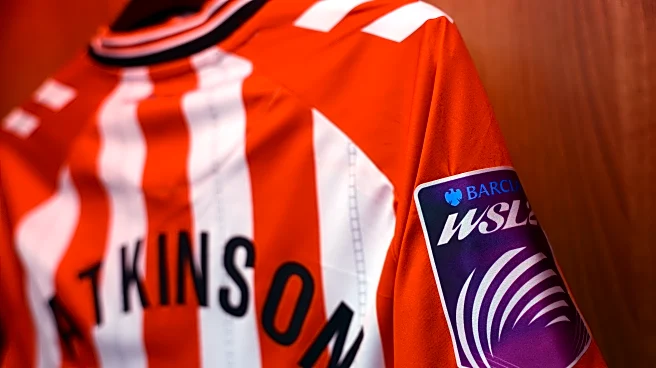

Given the Lasses’ limited attacking output, there’s a sense that Sunderland haven’t quite reached their full creative potential.
Injuries have disrupted their rhythm, limited options, and forced tactical
reshuffles, and among the players whose absences have been felt most keenly are Izzy Atkinson and Reanna Blades — two wide players who offer something different.
Although supporters have only seen glimpses of their quality due to injury setbacks, those brief appearances have been enough to spark excitement. Both players bring pace, directness and a willingness to take risks in the final third — qualities that can elevate a good attacking unit into a great one.
As Sunderland look ahead to the second half of the season — and particularly as we prepare for the potential departure of Keira Barry when her loan from Manchester United ends in January — the returns of Atkinson and Blades could prove decisive.
Their availability would not only restore depth but also unlock new tactical possibilities, giving the team fresh ways to break down stubborn defences.
Here, we’ll explores their journeys, their styles of play, and how they fit into Sunderland’s evolving identity, as well as considering why their returns from injury could be perfectly timed and offer them a chance to rise to the occasion at a pivotal moment in the campaign.

Izzy Atkinson: A player of promise, versatility and untapped potential
Atkinson’s footballing journey has already taken her across leagues, countries, and positions, yet she’s still only in her early twenties.
Her career began in Ireland, where she emerged as one of the brightest young talents in the Women’s National League. Her performances for Shelbourne quickly led to international recognition and she became one of the youngest players to represent the Republic of Ireland at senior level. That early exposure to high‑pressure football shaped her into a player with confidence on the ball and a maturity beyond her years.
A move to Celtic followed, where she continued to develop her attacking instincts. Although often deployed as a full back or wing back, Atkinson’s natural inclination was always to drive forward, take players on, and create overloads in wide areas.
Her time in Scotland showcased her versatility but also highlighted her potential as an out‑and‑out winger.
West Ham recognised that and brought her into the WSL, where she gained valuable experience against some of the strongest defenders in the country. Even during limited minutes, she demonstrated flashes of the dynamism that had defined her earlier career — and the same could be said about her time with Crystal Palace.
Her arrival at Sunderland felt like the perfect match: a club committed to developing young talent and a player eager for consistent minutes in her preferred attacking role.
Unfortunately, injuries have restricted her involvement this season, preventing her from building rhythm or fully integrating into the team’s patterns of play. Yet during the short spells she’s featured in, Atkinson has shown exactly why the coaching staff were so keen to bring her in.
Her style of play is built around direct running and intelligent movement.
She wants to commit defenders, force mistakes, and open up space for teammates. Her left foot is a real asset, allowing her to deliver dangerous crosses or cut inside to shoot. She also has a strong work ethic off the ball, pressing aggressively and tracking back when needed. This blend of creativity and industry makes her a natural fit for Sunderland’s high‑energy approach.
Where she fits into the team is an intriguing question, because her versatility gives the manager multiple options. She can play on either wing, though she’s arguably most effective on the left, where she can stretch the pitch and isolate full backs.
Her ability to beat players one‑on‑one adds a dimension Sunderland have occasionally lacked when facing deep defensive blocks. With Barry’s potential departure looming, Atkinson could become a key figure in maintaining the team’s attacking threat from wide areas.
Barry’s pace and directness have been crucial this season and while no two players are identical, Atkinson offers many of the same qualities with the added benefit of experience at higher levels.
If she can stay fit, Atkinson has the potential to become one of Sunderland’s most influential players in the second half of the campaign. Her return would not only strengthen the starting eleven but also provide the squad with greater tactical flexibility, allowing the manager to rotate, adapt, and respond to different challenges.

Reanna Blades: A rising star with fearless intent
Blades represents a different type of story; that of a young player on the cusp of a breakthrough whose progress has been interrupted by injury but whose ceiling remains incredibly high.
A product of Chelsea’s academy, Blades grew up in one of the most competitive youth environments in the country. Her development there shaped her into a modern winger: fast, technically sharp, and unafraid to take risks in possession.
She’s long been regarded as one of the most exciting prospects within her age group, and her move to Sunderland was seen as a chance for her to gain senior experience in a team that values youth and ambition.
Like Atkinson, Blades’ season has been disrupted by injury, limiting her opportunities to build momentum, yet during in the minutes she has played, she made an immediate impression.
Her acceleration over short distances is exceptional, allowing her to burst past defenders and create separation in tight spaces. She plays with a confidence that belies her age, always looking to drive forward, combine with teammates, or cut inside to shoot.
Blades’ style of play is defined by explosive pace and sharp decision‑making. She thrives in transitional moments, where her ability to carry the ball at speed can turn defence into attack in seconds. Her dribbling is direct and purposeful, and she has a knack for finding pockets of space between the lines.
What makes her particularly valuable is her unpredictability. Defenders can’t easily anticipate whether she’ll go wide, cut inside, or slip a pass through. This unpredictability is something Sunderland have occasionally lacked when forced to break down organised defences.
Her role within the team is clear.
Sunderland’s attacking structure relies heavily on wide players who can stretch the pitch, create overloads, and provide service to the forwards. Blades offers all of that but she also brings a level of individual creativity that allows her to unlock games on her own.
With the team’s current reliance on Barry for pace and penetration, Blades’ return would ease the burden and give Sunderland multiple outlets in wide areas.
If Barry does return to Manchester United in January, Blades will become even more important. Her profile is one of the closest matches to Barry’s within the squad, and her ability to replicate that direct threat could be crucial in maintaining Sunderland’s attacking balance.
There’s also a psychological element to her return.
Young players often grow rapidly after recovering from injury, using the setback as motivation to push themselves further. Blades has the talent and the mentality to seize this moment — and Sunderland could be the perfect environment for her to flourish.

Unlocking Sunderland’s attack, and why their returns matter
Whilst accolades and metrics have been impressive for Sunderland’s attackers on an individual scale, the attacking output hasn’t consistently resulted in goals. The Lasses find themselves with -4 GD — more for the amount of goals they concede rather the goals they score — yet both areas are in need of improvement.
We’re currently averaging 0.9 points per game, 1.5 goals per game and 1.9 goals conceded per game.
Injuries, rotation, and the demands of the WSL2 have tested the squad’s depth and the potential loss of Barry in January adds another layer of uncertainty. Barry has been one of the team’s most influential players, offering pace, creativity, and a constant threat in behind. Replacing that output won’t be straightforward, but the returns of Atkinson and Blades will provide a realistic pathway towards maintaining and potentially enhancing the team’s attacking potency.
Both players bring qualities that Sunderland have missed during their absences. Atkinson offers composure, experience, and a cultured left foot, while Blades brings raw pace, unpredictability, and youthful energy.
Together, they give the team more variety in wide areas, allowing the manager to tailor the attack to suit different opponents. Their presence also reduces the physical and tactical load on other attackers, enabling more rotation and the introduction of fresher legs late in games.
Perhaps most importantly, their returns will inject a sense of renewed competition and opportunity.
When talented players come back from injury, it lifts the entire squad. Training becomes sharper, tactical options expand, and the team gains a psychological boost.
For the players themselves, this is a chance to make a statement and with Barry potentially leaving, the door is open for one or both to step into a more prominent role.
Sunderland have built a reputation for developing young talent and giving players the platform to grow — and Atkinson and Blades fit that mould perfectly.
Their returns could mark the beginning of a new phase in the team’s attacking evolution, one defined by pace, creativity, and a willingness to take risks. If they can stay fit and find rhythm, they have the potential to transform Sunderland’s attack from “dangerous” to “devastating”.

A moment to rise to the occasion?
Football seasons often hinge on moments of opportunity. Departures and tactical shifts can lead to unexpected chances for players to step forward, and for Atkinson and Blades, the coming months represent such an opening.
Their talent is undeniable; their potential is significant, and their impact when fit is already visible.
Whether they become key to unlocking Sunderland’s attack remains to be seen, but the ingredients are certainly there. What’s clear is that their presence gives the team more depth, more creativity and more unpredictability. In a league as competitive as the WSL2, those qualities can make all the difference.
If Sunderland are to find themselves on an upward trajectory, they’ll need players who can change games, stretch defences, and provide moments of inspiration — and Atkinson and Blades have shown they can do exactly that.
With the second half of the season approaching and the possibility of Barry’s departure on the horizon, the stage is set for them to rise to the occasion.