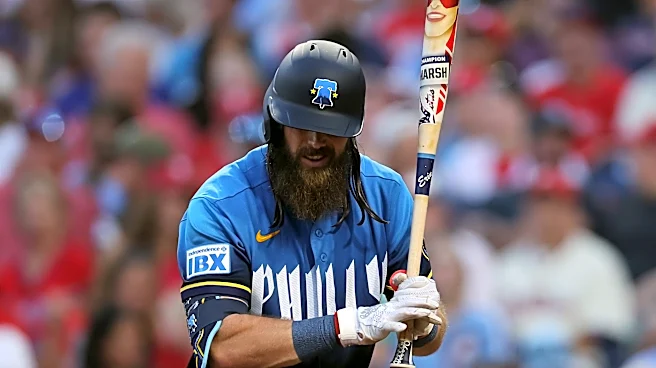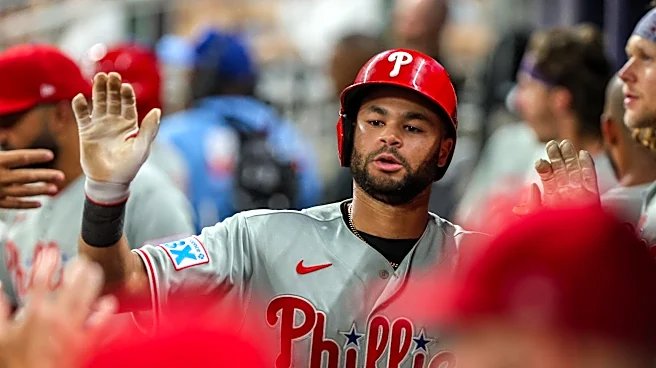

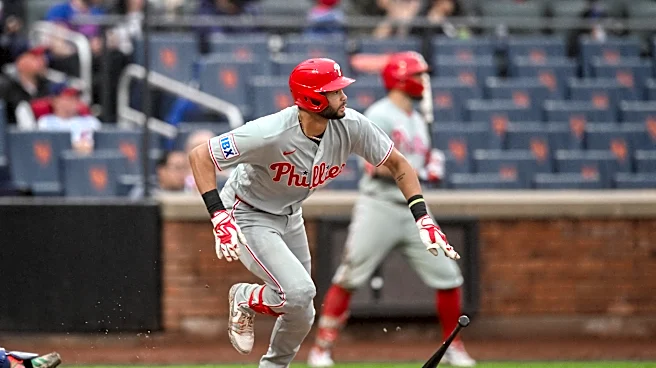
Sunday afternoon’s Phillies game offered a glimpse into just what Justin Crawford can become. The 22-year-old rookie stepped to the plate with the bases loaded and one out in the top of the eighth inning of a 4-2 game. The Phillies desperately needed to add on to their lead to give their beleaguered bullpen more cushion in a game they needed to win as they continue to fight for a postseason berth.
Crawford took the first pitch way outside for a ball before fouling off a 95 MPH fastball in the lower
third of the zone. Then he ripped a center cut fastball to the opposite field gap, a 93 MPH line drive that split the outfielders and went to the wall. Crawford was able to use his speed to get all the way to third, driving in three critical insurance runs and putting himself in position to be yet another. It was a nice, compact swing on a pitch Crawford allowed to get deep enough in the zone in order to drive it the opposite way.
It was the exact type of swing that Crawford’s believers believe that he can master to fully unlock his potential. However, just one day prior, Crawford also gave his detractors reason to continue to not believe he can ever reach said potential.
The Mets had the bases loaded with one out in the sixth inning of a 4-3 game with Brooks Raley on the mound for the Phillies. Brett Baty hit the first pitch to center field, smashing a 110 MPH liner towards Crawford. Despite how hard the ball was hit, it was extremely catchable. But Crawford took a poor route to the ball and got himself out of position, resulting in the ball falling to the ground in front of him and a run scoring.
That’s a play a center fielder has to make. The Phillies and Crawford were lucky that only one run scored, as the baserunners had to hold up to see if the ball was caught. A catch likely would have allowed a run to score on a sacrifice fly anyway, but it also would have recorded a much needed out and may have forced the runners to hold at first and second. Two batters later, another run scored with two outs when Chase Shugart walked in a run.
On the whole, Crawford’s numbers in his rookie season are not particularly inspiring. He’s slashing .265/.312/.358 through the first 143 games of his major league career. The ground ball rate that was so talked about in his minor league career continues to be an issue, as his 57.5% GB rate would be the second highest in baseball behind Chandler Simpson of the Rays if Crawford qualified. He’s also not hitting the ball particularly hard, as his average exit velocity of 87.1% is in the 18th percentile of all MLB hitters. Defensively, he’s graded out as one of the five worst defenders in the sport at any position with -10 defensive runs saved.
However, Crawford has done just enough to leave the believers with some hope that he can possibly improve. He had two months so far this season where he hit over .300 in June and August, with the latter being his best month in the majors to date with a .761 OPS. He’s cooled off in September but still has the second-best monthly OPS of his young career (.704). Besides his latter season improvement, Crawford has also found a way to collect some clutch hits this season, including two walk-offs back in April. He’s even flashed defensively despite his poor metrics, with catches like this one in San Diego when he ran full speed into the wall to rob Manny Machado of at least an extra base hit during Cristopher Sánchez’s scoreless streak.
No matter what you thought of Crawford before this season, he’s provided you with some evidence to prove your prior assertions correct. Both sides of the debate have some actual MLB evidence rather than theory to back up their claims. Crawford’s rookie season isn’t over yet and there’s still the possibility of the postseason, but nothing he’s done so far this season has been definitive enough to come to a consensus just yet on his viability as an MLB player.