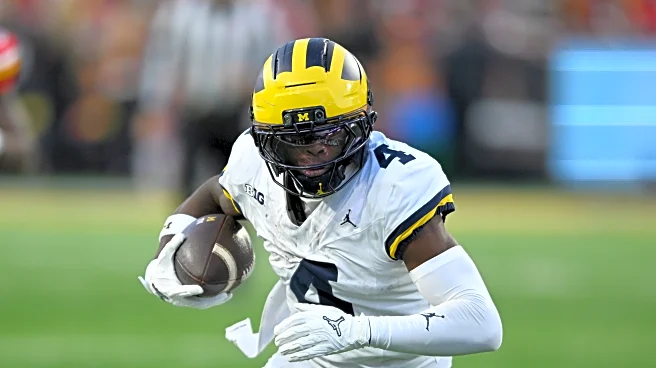




For much of the past decade, Michigan has won football games in spite of its pass attack rather than because of it. Even during the most successful stretches of the Jim Harbaugh era, the Wolverines were efficient through the air, but rarely explosive or dynamic.
All of that may finally be changing in a meaningful, sustainable way.
Less than a month into Kyle Whittingham’s tenure, the offense already looks fundamentally different, and the biggest reason for optimism centers on a passing attack that
now has a clear vision. Collectively, it’s fair to say the coaching change, quarterback development plan and revamped skill group give the Wolverines a ceiling we simply haven’t seen from this program in decades.
It all starts, unsurprisingly, with Bryce Underwood. The quarterback arrived with massive expectations and was thrown into a difficult situation as a true freshman — no dedicated quarterbacks coach, a staff that kept him on a short leash, and a head coach that was ultimately focused on other things.
Even so, the flashes were obvious. Underwood showed poise, arm talent and just enough mobility to stress defenses. He ended the year with nearly 400 rushing yards despite the coaches never truly embracing that part of his game.
Now, Underwood enters his sophomore season with something he didn’t have before: a clear developmental plan. The arrival of new offensive coordinator Jason Beck and quarterbacks coach Koy Detmer Jr. changes everything. Beck’s background is rooted in quarterback growth and confidence, and his offenses thrive when the quarterback plays fast and decisive.
Just as important, Beck’s scheme is built to make life easier on his quarterbacks. This isn’t a drop-back-and-pray system. It’s a physical, run-first offense layered with RPOs, constraint plays and coverage stressors that force defenses to defend every blade of grass.
That structure matters because Michigan finally has the receiving personnel to maximize it.
Last season, Andrew Marsh proved he could handle a featured role against top Big Ten competition as a first-year player. Retaining him was critical, but he’ll no longer be asked to carry the load by himself. The additions of Jaime Ffrench (Texas) and JJ Buchanan (Utah) dramatically change the math for opposing defenses. Together with Marsh, Michigan now has a complementary trio that can attack all levels of the field.
Depth only adds to the intrigue. Guys like Channing Goodwin, Jamar Browder, Kendrick Bell, and true freshmen Salesi Moa and Travis Johnson provide Beck some flexibility to create matchup advantages while leaning into the “everyone eats” philosophy that defined his Utah offense.
Tight end usage should also increase in the passing game, with senior Zack Marshall emerging as a reliable option in 2025. Talented junior Hogan Hansen is poised to carve out a more prominent role after spending much of last season unavailable due to injury. It’s even reasonable to assume we could see Buchanan line up here from time to time during some of Beck’s more receiver-heavy formations.
Zooming out, the most striking difference is philosophical. The identity crisis that followed Harbaugh’s departure appears to be over. This offense still appears physical without the promise of being predictable, and crucially, it’s built around a quarterback whose best football is still ahead of him.
Could this become the best passing attack Michigan has fielded since the Chad Henne era, or even beyond? The pieces are certainly in place. If Underwood takes the expected second-year leap and if the receiver room develops as projected, Michigan could be a legitimate threat through the air next season.