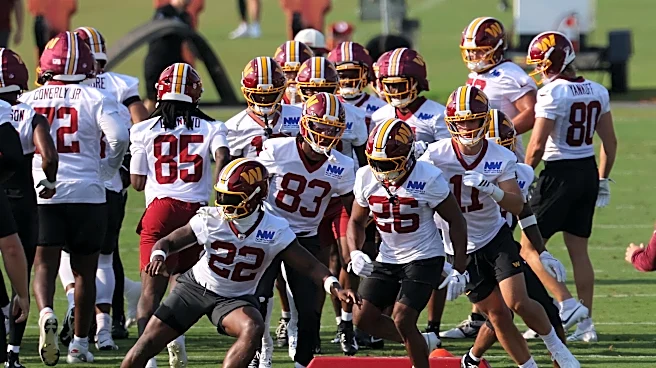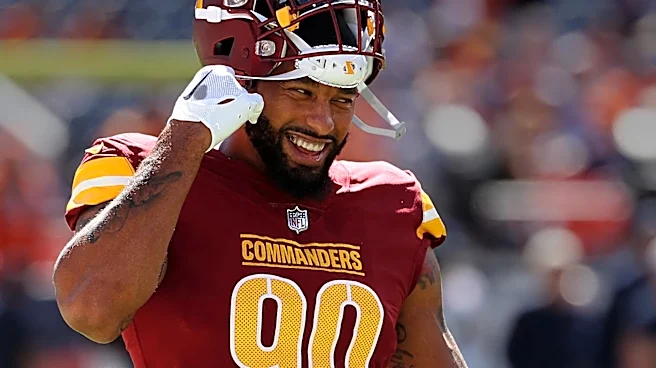


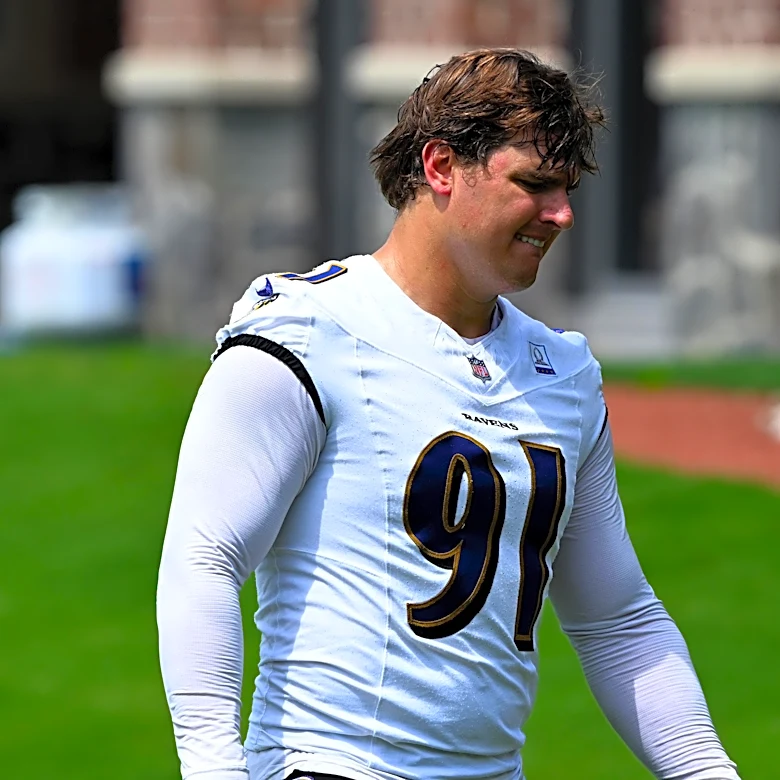

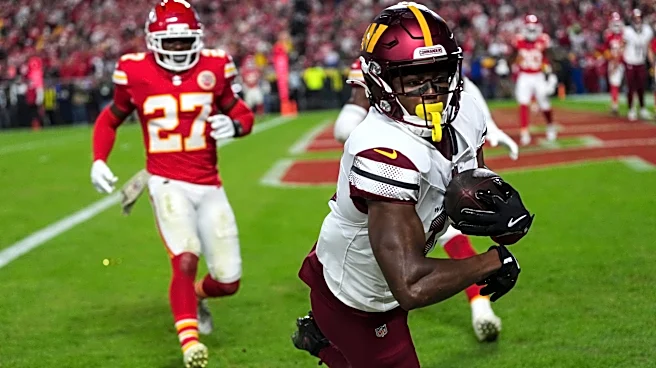
As training camp battles get underway, two things seem to be written in stone about the Commanders’ wide receiver group. Terry McLaurin has a lock on the WR1 position. And rookie third-round pick Antonio Williams will have every opportunity to compete for a position high on the depth chart.
After those two, most of the final positions on the depth chart are up for grabs.
The team’s two recent draft picks, Luke McCaffrey and Jaylin Lane, are virtual locks to make the final 53-man roster, if for no other
reason than their value in the return game. Neither has yet proved to be a reliable second or third receiving option. They will have to compete for playing time on offense, but it would be shocking if either isn’t active on opening day.
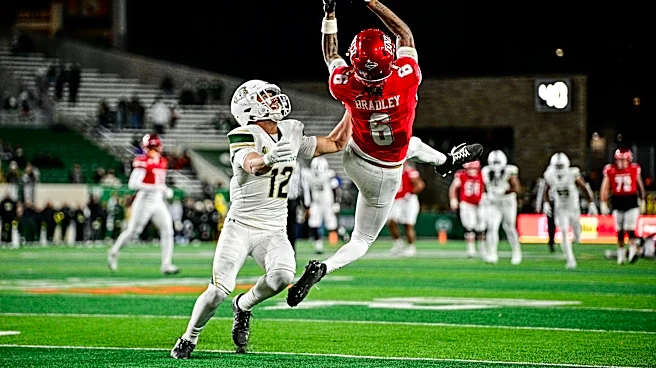
That leaves one or two roster spots up for grabs, depending on whether the Commanders keep five or six receivers. The competition for the remaining roster spot(s) at receiver features a host of characters, including cheap 2026 free-agent additions Dyami Brown and Van Jefferson, returning veteran Treylon Burks, 2025 UDFAs Jacoby Jones and Nick Nash, and this year’s UDFA signees, Jaden Bradley and Chris Hilton Jr.
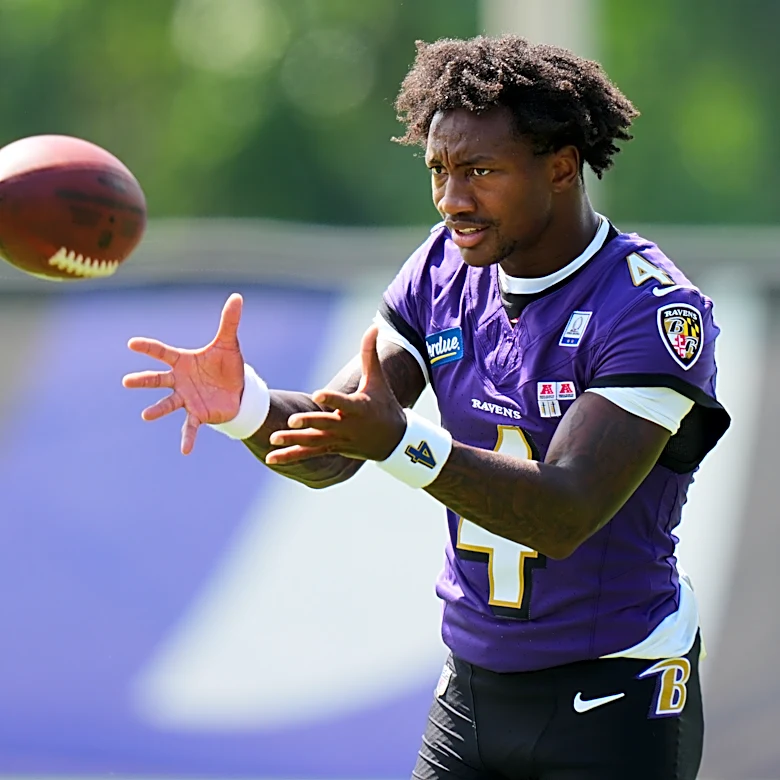
The remaining wild card in the mix is the possibility that the Commanders could sign another free agent, such as Stefon Diggs or Keenan Allen.
A quick reader poll:
Until another signing is announced, which is by no means guaranteed, there is a prime opportunity for a player currently on the margin to claim a roster spot through a standout performance in training camp and the preseason. One reason why Jaden Bradley could be that guy is his better than expected ability to catch the football.
It might seem a strange thing to say, but catching the football is an underrated skillset in wide receivers. Every NFL draft cycle, without fail, some receiver shoots up draft boards after running a fast 40-yard dash at the combine. But when was the last time that a receivers shot up boards because scouts suddenly noticed, late in the process, that he was really good at coming down with the football?
A few months after the draft, when players finally take the field, some late round pick or UDFA invariably emerges as a viable starting receiver. One thing that most of these hidden gems at receiver frequently have in common is being really good at catching the football.
The truth is, it doesn’t matter how much separation a speedy receiver can create if he doesn’t make the catch when he’s targeted. On the other hand, elite catch phase execution can make up for a lot of deficiencies in athletic testing.
The first stat that comes to mind when we think about catching ability is reception rate (Rec %). Unfortunately though, reception rate tells us very little about catching ability because that is drowned out by a major confounding variable, Average Depth of Target (ADOT). Even the most casual football fan will appreciate that it is easier to complete short passes than long passes. As a result, reception rate depends very heavily on the route tree that a receiver runs.
In order to compare two wide receivers in a meaningful way, for example Commanders’ 2026 third-round draft pick Antonio Williams (76.4% reception rate, ADOT 7.7 yds) and UDFA Jaden Bradley (61.7% reception rate, ADOT 16.3 yds), they would need to have run a similar depth of routes. In this case, they didn’t. Superficially, it might appear that Williams was better at catching the ball because his reception rate was higher. But that could just be a byproduct of his average target being less than half as deep as Bradley’s.
In fact, many previous analyses I have done have shown that ADOT explains around 40% of the variance in reception rate at both the NCAA and NFL levels. Statisticians call that level of effect a dominating influence. In order to see the effects of receiving skills, we need to have some way to factor out the confounding effect of ADOT.
My attempt to solve that problem is what first caused Jaden Bradley to cross my radar. Although I didn’t realize it at the time. To explain what I mean, let’s revisit some analysis I did for the roundup of WR draft prospects I published before the 2026 draft.
Catch Rate Over Expectation (CROE)
Two years ago, I developed a metric which I called Catch Rate Over Expectation (CROE) to adjust reception rate for ADOT. In mathematical terms, it is simply the residual of the regression of reception rate on ADOT. If you have no idea what that means, don’t worry. You don’t really need to. And I will walk through it below for those who are interested. All you really need to know is that it measures an individual receiver’s catch rate relative to the expectation for an average receiver based on ADOT alone.
There is another metric popularized in fantasy football circles called Catch Rate Over Expected, which shares the same acronym. That one is an attempt to tease out catching ability from all of the other variables which contribute to reception rate, including separation. Consequently, the fantasy football version gives the erroneous impression that receivers who excel at creating separation aren’t very good at catching the football.
My version of CROE is actually a lot simpler and makes more sense. What we want to know is how likely a receiver is to come down with the ball when targeted, no matter how he gets it done, without being fooled into thinking that receivers with shorter route trees have better ball skills. And that’s what it achieves.
To illustrate how CROE works, the following graph plots reception rate against ADOT for all the draft eligible FBS WRs in 2026 who ran 100 or more routes.

As expected, there is a strong trend for reception rate to decline as ADOT increases.
The regression line (often called the trend line), shown in blue, tracks the central tendency of the scatter of points. This essentially shows the average, or “expected”, value of reception rate at each value of ADOT.
As a predictive variable, ADOT explains 40.8% of the variance in reception rate. The remaining 59.2% is referred to as “unexplained variance”. It reflects a variety of factors, including separation, ball tracking, and catching ability, as well as QB accuracy and strength of coverage.
The blue line represents the expected reception rate, based on ADOT alone. Receivers at points above the line have better than expected reception rates. The vertical distance between a WR’s point and the regression line, measured in units of catch rate (%), is that WR’s Catch Rate Over Expectation (CROE).
The red dotted line indicates CROEs of +7.5%. Over 81% of qualifying WRs in the FBS fell below that line. The 42 receivers above the red line are the best pass catchers in the conference.
Four individual players are highlighted in the graph. Titans’ fourth overall pick, Carnell Tate, had the highest CROE in the draft class (20.75%). He is an absolute freak at catching the football, as well as a number of other receiving productivity metrics. Three future Commanders sit on either side of the red line, which puts them right on the cusp between very good and elite.
Third-round pick Antonio Williams will get plenty of attention and opportunities in training camp. The rest of this article will mainly focus on Jaden Bradley, who fill face more of an uphill climb. I think he will have a legitimate shot at earning a roster spot because of the receiving ability he demonstrated in his breakout senior season. Chris Hilton Jr, gets a mention at the end because he stood out in this metric. He will have a steeper climb than Bradley.
WR Jaden Bradley, 5th Yr Senior, UNLV – 2026 UDFA

6-3 | 203 lbs | 4.55 sec 40 | 7.91 RAS | Age 23
2025 Basic Stats: 14 games | 58 rec (61.7%) | 16.3 yd ADOT | 931 yds | 4 TD | 16.1 Y/Rec
2025 Advanced Stats: 2.53 Y/RR | 8.7% CROE | 34.6% CTC | 10.8% Drops | 3.9 YAC/Rec
Bradley flew entirely under the radar in the 2026 draft class in large part because he had minimal production before breaking out in his fifth season at UNLV.
His 8.7% CROE ranked 28th among 223 wide receivers with > 100 routes run, placing him at the 87th percentile of the FBS. He turned up as one of the non-consensus ranked hits in the analysis I did for my roundup of WR prospects. But I didn’t feature him, because I couldn’t find anything written about him on the internet.
The best, and possibly only profile available on Bradley was written by Hogs Haven’s John Portis after he turned a few heads in OTAs. John’s review of one of the few highlight clips available for Bradley described him as a big, physical receiver with deceptive speed who makes up for limitations in route running with quality ball tracking, body position and ball skills to win at the catch point. John concluded that Bradley could be effective in short to intermediate routes, if schemed open.
However, that analysis was based on a breakdown of a highlight clip, which might not have shown the complete picture. To get an alternative perspective, let’s have a look at what the advanced stats say about his standout senior season at UNLV, beyond his strong CROE.
Bradley was the 20th most productive yardage producer among 223 WRs (91st percentile) as judged by Yards/Route Run (Y/RR). His 16.3 yd ADOT and 16.1 Y/Rec receiving average indicate that he ran a fair amount of deep routes.
Bradley was not particularly effective at generating yards after the catch, and ranked in the bottom quartile of the FBS in contested catch rate (CCR%). Furthermore, his 10% drop rate was the 45th highest in the sample, placing right at the 20th percentile of the receiving class. None of those stats seemed to fit with a WR who was among the best pass catchers and most productive receivers in college football.
To make sense of those apparent contradictions, I had a look at the breakdown of receiving stats by depth of target, courtesy of Pro Football Focus, and the picture became clear.
Bradley was targeted on short routes (behind LOS to 9 yds) on 41.5% of passing attempts, on intermediate routes (10-19 yds) on 28.7% of attempts, and long routes (20+ yds) on 29.8% of attempts. He was delivered on-target passes on 79% of passes below 20 yds. The on-target rate dropped to 46.4% on passes over 20 yards. So, he was limited to some extent by quarterback play on deep passes. Not surprisingly, his reception rate dropped from 74% on short and intermediate routes, to 32.1% on long routes.
But that wasn’t all. 39% of Bradley’s deep passes were contested targets, compared to just 17% of targets on short and intermediate routes.
Putting those facts together helps to explain why Bradley had a high drop rate (4/13 on target passes) and low contested catch rate (3/11) on deep routes. He was dealing with off-target passes and getting thrown into traffic at much higher rates than on shorter routes.
On passes below 20 yards, his drop rate (5.8%) and contested catch rate (45%) were much more respectable.
In summary, in his final college season, Bradley achieved a catch rate well above expectations for his depth of target, and borderline elite receiving productivity, despite limitations of quarterback play on deep throws.
Pairing him with a passer like Jayden Daniels, who excels at deep-ball accuracy could unlock his potential as a reliable chain mover on short and intermediate routes, with the ability to stretch the field on deeper routes.
WR Chris Hilton Jr, 5th Yr Senior, LSU – 2026 UDFA

6-0 | 188 lbs | 4.41 sec 40 | 5.83 RAS | Age 23.5
2025 College Stats: 13 games | 10 rec (58.8%) | 16.9 yd ADOT | 122 yds | 0 TD | 12.1 Y/Rec
2025 Advanced Stats: 0.81 Y/RR | 7.0% CROE | 20.0% CTC | 9.1% Drops | 3.6 YAC/Rec
Chris Hilton Jr., also posted a very good CROE in 2025. But that could be a blip due to small sample size. His 0.81 Y/RR receiving productivity, in 160 offensive snaps, was very poor. It is hard to draw any meaningful conclusions from such a small statistical sample.
Like Bradley, Hilton had limited productivity in college. In Hilton’s case, it was due to a horrific series of three major injuries. As a result, he never played more than 160 offensive snaps in a season, or topped 243 receiving yards.
Hilton has good long speed and flashed ability as a deep threat in limited playing time in college. His first challenge to make it with the Commanders is staying healthy. If he can overcome the injury bug, it’s anyone’s guess what his potential might be.