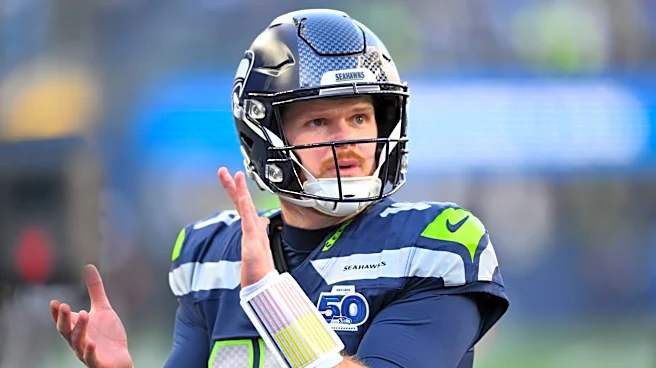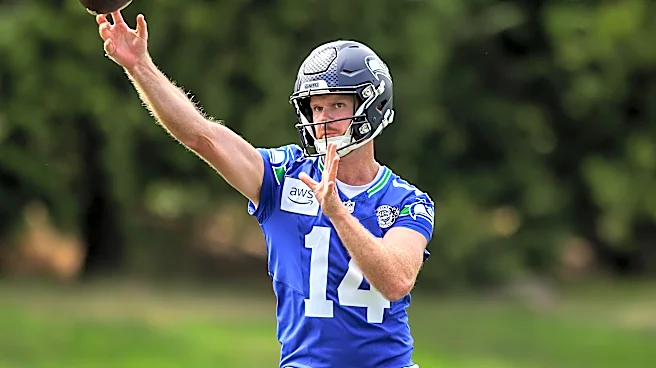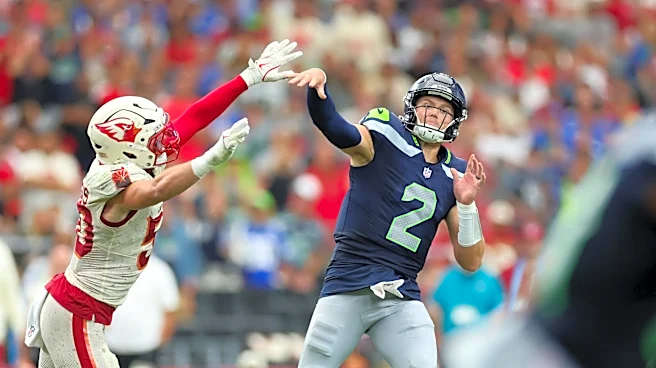


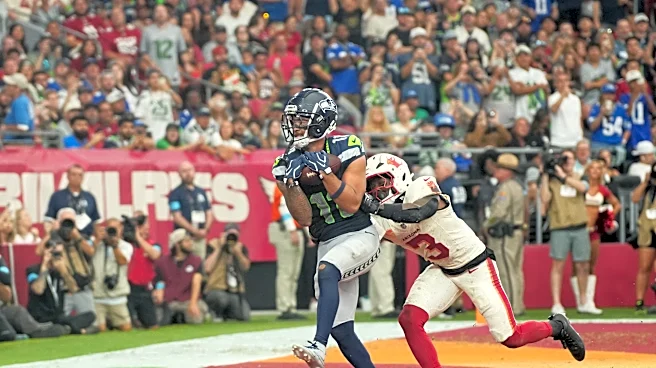
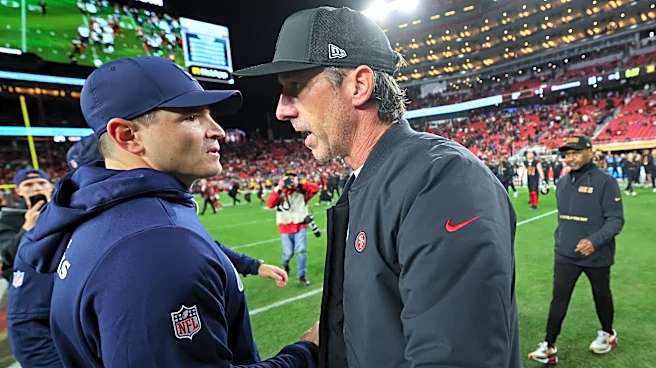
Sam Darnold remained sidelined, Drew Lock was making his first start for the Seattle Seahawks since 2023, and the Arizona Cardinals were coming off an unexpected road win over the Los Angeles Chargers. On top of that, playing in Arizona has historically been anything but straightforward for the Seahawks.
The game was still tied 7-7 heading into halftime. However, once again, Seattle made the necessary adjustments after the break and took complete control of the game.
Lock completed 19 of 26 passes
for 235 yards and three touchdowns, while Jaxon Smith-Njigba turned in one of the best games of his career with nine catches for 155 yards and three touchdowns.
But the final score doesn’t mean everything on tape was perfect.
There were still questionable decisions, missed opportunities and moments when Seattle’s execution wasn’t where it needs to be. The good news is that the Seahawks were able to overcome those mistakes — and, unlike Week 1, they eventually pulled away instead of having to survive until the final possession.
So let’s get into the good and bad from Seattle’s Week 2 win over Arizona.
The Bad
Red-zone play calling
Brian Fleury had a good game overall, and there were plenty of good play calls that I’ll highlight later in this article. But his approach near the goal line wasn’t quite as creative at times.
For a team like Seattle, which wants to build its identity around offensive efficiency and a strong defense, red-zone execution is critical.
I have no problem running the ball four straight times when you’re that close to the goal line. Even knowing you have the reigning OPOY and that he probably deserved at least one target, I understand the decision to stay committed to the run.
The problem was how predictable Seattle became across those eight runs. One drive eventually ended with a turnover on downs and the other ended in the AJ Barner quarterback sneak, but Arizona was able to anticipate what Seattle wanted to do on several of those snaps.
There were also a couple of lazy-looking screens to George Holani and Rashid Shaheed that didn’t do much to stress the defense. This is the kind of thing that becomes more important against better defenses.
Seattle doesn’t need to abandon what it does well near the goal line, but it does need to make sure defenses can’t sit on the most obvious answer. There were some good concepts in this game. The problem is that the red-zone portion of the playbook didn’t always show the same creativity.
That’s something worth keeping an eye on as the season progresses.
Offensive line communication/execution
The offensive line had a good game overall, and it’s important to make that clear before getting into the problems.
Seattle ran for 162 yards, protected Lock reasonably well and eventually took control of the line of scrimmage. The fourth-quarter drive in particular was a showcase of the physical advantage Seattle’s offensive line was able to create.
And as a Seahawks fan, seeing John Benton receive the game ball in the locker room was pretty awesome.
But there were still a few snaps where the communication and synchronization broke down, both in the passing game and the running game.
Here’s an example of a communication error.
The offensive line appears to be sliding to the right, and there is a mistake between George Holani and Jalen Sundell. My read is that Sundell should have slid to pick up No. 50, with Holani working directly into the A-gap.
Instead, both players end up blocking the same defender. That leaves the linebacker with a free path to Drew Lock. Lock still delivers a great pass under pressure, despite not having a stable base when he throws it. This is exactly the kind of snap where the quarterback can cover for an offensive-line mistake.
But the mistake is still there.
Here’s another example of an execution issue.
Seattle comes out with seven offensive linemen and two tight ends, which is about as clear a signal as you can get that this is going to be a run. Olu Oluwatimi is lined up as the fullback, while Josh Jones is serving as the sixth offensive lineman.
The idea is good, but Grey Zabel gets tangled up trying to pull, and Olu can’t adjust once the play starts developing, particularly after Abe Lucas gets pushed backward. I believe the intended path is the gap between Olu, Zabel and the tight end. Because of the execution issue, Seattle fails to convert on fourth down.
These are small details, but they matter. The offensive line was physically winning plenty of reps against Arizona. The next step is making sure everyone is seeing and executing the same picture on every snap.
Rashid Shaheed is starting the year well below expectations
Rashid Shaheed hasn’t exactly had the start to the season many expected.
After a quiet performance against New England, Shaheed finished the Arizona game with three catches for 35 yards on six targets, plus one carry for four yards. And I’m going to be honest: those numbers are better than the game he actually played.
Since the Patriots game, Shaheed has looked a little sluggish as a returner, a long way from the explosive dynamism he showed last season.
That continued against the Cardinals and culminated in a fumble early in the second half that could have changed the story of a game that was tied at that point.
Chazz Surratt bailed out the wide receiver. And, in true old-school quarterback fashion — yes, Surratt was a quarterback at North Carolina early in his college career — he took off running and got Seattle all the way to its Cardinal’s 40-yard line. That’s a nice way to redeem himself after the penalty against New England.
Other bigger concern, however, is what Shaheed has shown as a route runner. He has struggled to consistently get off the line of scrimmage and create separation in situations that don’t involve using his vertical speed.
Here’s a great play call from Fleury.
Lock escapes the pocket and delivers a beautiful ball to Shaheed, putting it in a spot where the receiver has a chance to make the catch and pick up additional yardage. Shaheed drops it.
And it’s a bad drop.
Shaheed was never going to be a possession receiver, and he doesn’t need to become one. But he needs to be better when the ball isn’t perfectly placed for him to run underneath it. The Seahawks need his explosiveness, but they also need him to make the difficult plays that come with being a major part of the passing game.
The Good
The defense continues to dominate opponents
Arizona finished the game with just 151 total yards and seven points. Seattle’s defense also held Jacoby Brissett to 95 passing yards and controlled the game much more decisively after halftime.
There were certainly some things Mike Macdonald will want to look at.
The touchdown is an obvious example.
Trey McBride one-on-one against Josh Jobe in the red zone is not an ideal matchup for Seattle. McBride is Arizona’s best offensive player, and giving him that kind of situation is something the Seahawks would probably rather avoid.
But speaking of McBride, Seattle did a very good job limiting his overall impact. He finished with eight catches for 41 yards, which was his lowest yardage total against a Mike Macdonald defense. The Seahawks weren’t just trying to take him out of the game with constant man coverage or double teams.
Instead, there always seemed to be someone in the zone keeping an eye on him. That allowed Seattle to maintain the integrity of the defense without completely changing its structure just to account for one player.
The biggest highlight for me, though, was the way Seattle defended the run. This is where you can really see the identity of Mike Macdonald’s defense.
On this play, Byron Murphy attacks the opposite gap with a slant, taking away the center’s momentum and preventing him from getting to the left side of the offensive line. Murphy gets penetration and eliminates any chance for the running back to cut back.
Leonard Williams then builds a wall inside, while Uchenna Nwosu seals the edge and leaves the running back with nowhere to go. Arizona can’t convert on third-and-short. Notice that three different defenders make great plays here. But none of it works without the other two.
That’s the biggest point.
This defense isn’t built around one player winning every snap. Everyone has a responsibility, and each player understands that if he does his job, either he or one of his teammates will have a chance to make the play.
Here’s another example.
Drake Thomas, an undrafted free agent, makes an adjustment to the defensive line and tells Jarran Reed, No. 90, to slant. The purpose is to open a lane for Thomas to attack, allowing him to do one of the things he does best: blitz against the run.
Thomas doesn’t have the ideal frame for an NFL linebacker, but you can see how much he studies tape and tries to compensate for that with anticipation and recognition. He’s already identifying how he can manipulate the blocking scheme before the snap and put himself in position to make the play.
And, as a quick side note, look at the speed from Rylie Mills to get into this play.
That kind of effort matters.
After two weeks, perhaps the most encouraging part of this defense is its consistency.
The Patriots scored 10 points in Week 1.
The Cardinals scored seven in Week 2.
The opponents and circumstances were different, but Seattle’s defense continues to give the offense room for error.
Brian Fleury had some really good moments
Brian Fleury’s first game as an NFL play caller was always going to be interesting. Then Sam Darnold got hurt five plays into the season.
That forced Fleury to adjust immediately, and Week 2 gave us a much better opportunity to see what his offense looks like when he has an entire week to build a game plan around Drew Lock.
The answer was encouraging. Seattle didn’t simply ask Lock to manage the game.
The Seahawks gave him opportunities to attack vertically, used motion and formation changes to create favorable matchups, and continued to put pressure on Arizona’s defense.
The biggest example came almost immediately. Lock found JSN for an 82-yard touchdown on Seattle’s opening drive, attacking the Cardinals’ defensive rules.
JSN’s initial fake makes Budda Baker think there are going to be two routes developing in his area, with Elijah Arroyo also involved. Baker reacts aggressively downhill, influenced by the initial action as well as Lock’s play fake. That leaves him in a bad position, and JSN is able to get behind him for the longest touchdown of his career at 82 yards.
For context, Lock has a 92-yard touchdown pass from his time with the Broncos in 2021.
We’re also starting to see Fleury’s identity take shape.
There is a lot of motion, both in the running and passing game, with Seattle mixing those concepts together rather than using motion as window dressing. Play action is another major part of the structure.
Here’s a play where Seattle uses a fake handoff and gets the ball quickly behind the linebackers, something Sam Darnold also did in the first game before his injury.
This was my favorite Fleury play call of the game. It’s a shame it wasn’t executed properly.
Once again, Brady Russell, FB, goes in motion, as he did on several runs throughout the game. Then Grey Zabel pulls. That misdirection gets the entire Cardinals defense to bite on the run.
But this is actually an end-around for Shaheed. This play had a lot of potential. Unfortunately, Charles Cross loses at the line of scrimmage, which delays Jalen Sundell and eventually run into Beau Stephens. If those two offensive linemen win their blocks, Shaheed has a much better chance of turning this into a big gain.
That’s the kind of play that shows what Fleury is trying to build. The concept works. The defense reacts exactly how Seattle wants it to react.
The problem is execution.
Fleury still has things to clean up, particularly in the red zone, but Week 2 showed that Seattle’s offense can have different answers depending on what the defense gives it.
Drew Lock was really good
There was a legitimate question entering this game about whether Drew Lock could maintain the level of play he showed after replacing Darnold in Week 1.
The answer was pretty clear: Lock was really good.
He completed 19 of 26 passes for 235 yards, three touchdowns and no interceptions, finishing with a 139.1 passer rating. But the numbers are only part of the story.
What stood out most was Lock’s willingness to trust the structure of the offense without constantly trying to create something that wasn’t there. He took what Arizona gave him when the defense played softer coverage, attacked when the matchup was available and, most importantly, didn’t put the ball in danger.
Here’s his best throw of the game.
It’s another excellent call from Fleury.
Seattle comes out in a 13 personnel package and uses the pistol with one tight end in the backfield, motioning another player while lining up Arroyo as a receiver. Everything about the formation suggests run.
And if this is a pass, all the indicators point toward JSN, who is the only wide receiver in the formation. Instead, Arroyo runs an excellent route.
And watch the timing from Lock. The ball comes out before Arroyo even makes his break, allowing the quarterback to hit him in a tight window for what I hope will be the first of many receptions for the second-year tight end.
This is the kind of throw that tells you more about Lock than the box score does. He isn’t waiting for receivers to get open. He’s trusting the route concept, anticipating the break and putting the ball where it needs to be.
There were still some throws that could have been better, and there are snaps where his decision-making wasn’t perfect. But after two weeks, Lock has done enough to show that Seattle can operate its offense with him under center until Sam Darnold is ready to return (which, admittedly, could be Week 3).
Rylie Mills is showing promising development
Mills hasn’t recorded a sack or piled up big statistics yet, but he’s been useful to this defense. He recorded a tackle for loss in the season opener and has shown plenty of signs of development during his second year.
Compare what Mills did against the double team in his preseason debut against the Colts…
And now look at his work against the Cardinals. He’s not going to be Byron Murphy. But Mills is finding ways to contribute in his own way while understanding his strengths and limitations.
Look at the leverage here. Mills gets underneath the offensive lineman, wins the leverage battle and is able to disengage quickly and aggressively. I didn’t expect Mills to be able to contribute this way from the interior of the defensive line.
This is another example of good leverage, followed by an arm-over move that allows him to disengage quickly enough to make the tackle. There may not be a lot of production showing up in the box score yet, but these are the kinds of technical improvements that can eventually turn into production.
For a second-year defensive lineman, that’s encouraging.
Final Thoughts
This was a very different game from the one Seattle played against New England.
The Seahawks didn’t need a fourth-quarter comeback. They didn’t need three interceptions in the final quarter. They didn’t need to survive a game that came down to the final possession. Instead, Seattle went into halftime tied 7-7 and then took control of the game.
The defense suffocated Arizona, the offensive line took over the line of scrimmage, Lock played within the structure of the offense and JSN delivered one of the biggest performances we’ve seen from a Seahawks receiver in recent memory.
There were still things that weren’t clean.
The red-zone offense can be better. The offensive line had some communication issues. Shaheed still hasn’t consistently delivered the explosive plays his role suggests he should.
But those problems existed inside a game Seattle won 31-7 on the road.
The Seahawks are now 2-0, and they’ve won both games despite losing their starting quarterback early in the season.
Drew Lock has done his part, Brian Fleury has shown encouraging signs, and Mike Macdonald’s defense looks every bit as difficult to deal with as it was supposed to be.
More tests are still to come! Because if Seattle wants to repeat what it accomplished last season, the goal isn’t just to beat teams like Arizona. It’s to keep improving the details that separate a good team from a team capable of winning it all again.
Go ‘Hawks!