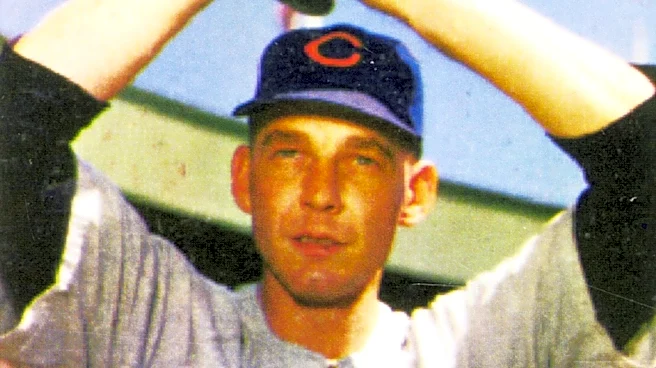


Left-hander Paul Minner was among so many pitchers in his era and later — 1940s to about the time of Tommy John surgery — who were hard throwers, suffered injuries, then tried to re-invent themselves as finesse soft-tossers.
In Minner’s case it succeeded, for a few years at least, after he was acquired along with first baseman Preston Ward from the Dodgers in October 1949 for $100,000. In case you were wondering, that was a tremendous amount of money in those days. You don’t see cash transactions
for that sort of money now. That’s roughly equivalent to $1.4 million today, even in today’s baseball market, that’s not chump change.
The Cubs of the early 1950s, as you know, weren’t very good. But Minner put together some years that were at least decent — for example, in 1951 he posted a 3.79 ERA and 1.403 WHIP in 33 games (28 starts) covering 201.2 innings. Despite striking out hardly anyone, just 68 (7.9 percent), that was good for 3.2 bWAR, a solid season. Unfortunately, Minner went 6-17 that year, leading the NL in losses, largely because he ranked 23rd of 31 qualified starters with 3.9 runs of support per start.
This was a common thing for Cubs starters in those days. Part of it had to stem from a bizarre use of starting pitchers by manager Frank Frisch, as noted in Minner’s SABR biography:
Frisch handled his staff the way his mentor, John “Little Napoleon” McGraw, did when the Fordham Flash anchored the keystone sack for four consecutive pennant winners (1921-1924) for the New York Giants, and then four more for the Cardinals. Frisch eschewed a set rotation, and as Chicago sportswriter opined, “virtually pulled his starters out of a hat.” Consequently, pitchers struggled to find a rhythm, as eight hurlers started at least 11 games
The Cubs actually started out reasonably well in 1951 and on June 5 they were 21-20 and only 5.5 games out of first place. That pitching wackiness eventually led to them going 41-72 the rest of the way and they finished 62-92, last in the NL.
Minner put together a few more solid if unspectacular seasons and his career then ended due to a bizarre injury in early 1956:
… he reportedly fell in a bathtub in his New York City hotel, suffering a concussion and hurting his back and neck. Still unable to pitch a week after the incident, Minner was re-examined and doctors discovered a cracked vertebra. His neck was placed in a cast for an expected two to three months. It was widely reported that the injury re-aggravated Minner’s initial neck problems suffered while a member of the Dodgers. With his career in jeopardy, rumors emerged in Chicago that the mild-mannered Minner’s injury was the result of a scuffle with teammates, though Minner denied the reports.
Though neither Minner nor his teammates were punished, at least not publicly, following the incident, the injury effectively ended Minner’s pitching career. He did not pitch again in 1956 and was given his unconditional release the day after the season ended.
Minner posted 14.6 bWAR in seven seasons with the Cubs. After his baseball career he returned to his native Pennsylvania and became successful in the insurance business. He died March 28, 2006, aged 82.