
Not every offseason move is designed to grab headlines.
Sometimes teams are simply trying to strengthen the bottom half of the roster — adding players who can handle multiple roles, reinforce special teams, and provide reliable depth if injuries hit during the season.
That’s where Rodney Thomas II fits into the Seattle Seahawks’ roster picture.
The former Indianapolis Colts safety arrives in Seattle with starting experience, ball production early in his career, and the athletic profile of a deep-field
defender. While he likely enters training camp competing for a depth role, his skill set gives him a realistic path to snaps in both the secondary and special teams units.
For a defense that continues to evolve under Mike Macdonald, adding versatile defensive backs with range on the back end remains an important part of roster construction.
A path from Yale to the NFL
A native of Pittsburgh, he played college football at Yale, where he originally lined up as a linebacker before eventually transitioning to safety. That position change proved to be crucial for his development. Moving into the secondary allowed Thomas to maximize his range, open-field speed, and ability to read developing plays from depth.
Seattle actually got a close look at him during the 2022 pre-draft process, when Thomas took a Top-30 visit with the Seahawks. Although the team didn’t select him that year, the interest clearly existed early in his evaluation cycle.
Instead, Thomas was selected by the Colts in the seventh round of the 2022 NFL Draft (pick No. 239).
Like most late-round defensive backs, he entered the league as a depth option expected to contribute primarily on special teams. But circumstances quickly pushed him into a much larger defensive role.
Early playing time in Indianapolis
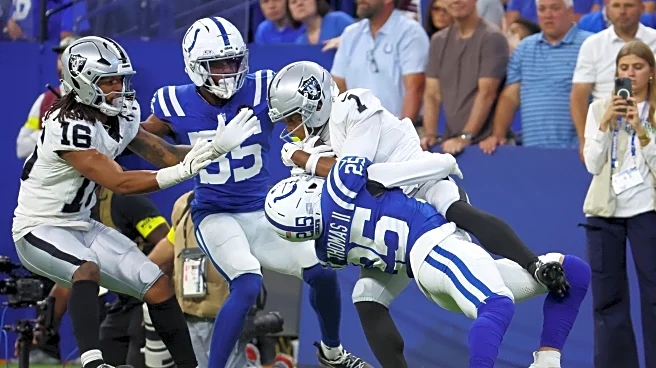
Thomas saw significant action during his first two seasons with Indianapolis.
Across that stretch he accumulated more than 1,600 defensive snaps, starting several games and flashing ball production from the deep safety position.
During his first two years he recorded:
- 6 interceptions
- 10 passes defended
- 1,682 defensive snaps
There were clear flashes of playmaking ability, particularly when he was allowed to patrol the deep portion of the field.
However, his performance profile also showed some volatility. From his rookie season to his second year, several efficiency metrics declined:
- completion percentage allowed increased from 52.6% to 60%
- yards allowed per reception jumped from 9.8 to 21.2
- missed tackle rate from 10.4% to 23.3%
Those inconsistencies eventually reduced his role in the Colts’ defense. Over the following two seasons, Thomas logged only 248 defensive snaps, functioning mostly in dime packages and special teams.
All-22 review: What Rodney Thomas shows on film
Alignment tendencies
Thomas has spent the vast majority of his NFL career aligned as a deep safety.
Alignment distribution:
- Deep safety — 84.2%
- Box — 8.2%
- Slot — 7.4%
- Corner — 0.2%
That usage reflects his natural role in a defense. His athletic traits translate best when he’s playing over the top in coverage structures such as Cover 2, Cover 3, or quarters, where he can read the quarterback and react to the ball.
Tackling angles and hesitation
One area where inconsistency shows up on tape is run support.
Thomas occasionally takes wrong pursuit angles, and there are snaps where he hesitates briefly before committing downhill. That delay can allow ball carriers to gain additional yards and contributed to the spike in missed tackles during his second season.
Still, when he arrives cleanly to the tackle point, he generally shows enough physicality to finish the play.
Coverage communication
There are also moments on film where coverage communication appears to break down.
Against certain receiver formations, Thomas processes route combinations a step late, which can be problematic for a deep safety responsible for preventing explosive plays. That likely played a role in the high 21 yards per reception allowed figure during the 2023 season.
When deep coverage responsibilities are miscommunicated, the results often show up quickly on the scoreboard.
Range and ball tracking
Thomas looks most comfortable when he’s patrolling the deep part of the field.
He flashes solid sideline-to-sideline range, accelerates well once he diagnoses the play, and tracks the football naturally in the air. On several snaps he arrives at the catch point with strong timing.
One of the best plays on his tape came in a Cover 2 look where he quickly processed a trips formation, covered significant ground, and arrived just in time to break up what looked like a certain touchdown.
Those moments highlight his potential value as a situational ball-hawking deep safety.
Effort and competitiveness
Another positive trait that stands out on film is Thomas’ effort level.
Even when a play initially appears lost, he consistently keeps pursuing the ball. On one snap against the Browns, he stayed stride-for-stride with David Njoku after a play-action concept and prevented what seemed like an inevitable touchdown.
That same competitiveness shows up during scramble situations, where he remains attached to receivers and uses his length to contest throws downfield.
Occasional blitz usage
Although he isn’t commonly used as a blitzer, Thomas has appeared in a few defensive back pressure packages.
In one snap from last season, the Colts dialed up an aggressive dime blitz that confused the right side of Seattle’s offensive line, allowing Thomas to come free at quarterback Sam Darnold.
He didn’t finish the sack, but he did record the first quarterback hit of his career on the play.
Footnote…
Thomas has influenced the Seahawks’ path in the past. Beyond the 30th visit, this bizarre mistake was the difference between picking 4th and 5th in 2023. If this interception happens, would Devon Witherspoon be our pick?
Final Thoughts
Thomas likely enters the Seahawks roster as a depth safety and core special teams contributor, but his experience playing significant defensive snaps gives Seattle additional insurance at the position.
In a defense that relies heavily on disguising coverage and rotating safeties post-snap, having athletic defensive backs capable of handling multiple assignments becomes valuable over the course of a long season.
Thomas may not be the most talked-about addition of Seattle’s offseason. But players with range, ball skills, and special teams experience often find ways to carve out meaningful roles — especially in defensive systems that demand versatility from the secondary.