

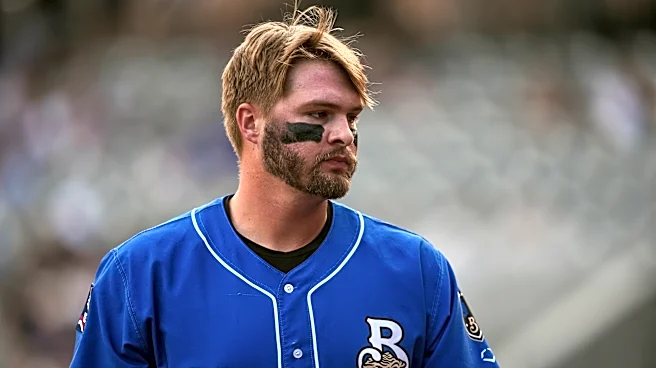

Minor League Baseball is full of quirks and oddities. With over 200 teams and 5,000 players across MiLB, you can find every type of profile imaginable. Out of all of these unique players, we are focused on Twins’ 19-year-old infield prospect Quentin Young.
Before The Pros
In the 2nd round of the 2025 MLB Draft, the Twins selected Quentin Young out of Oaks Christian High School in Westlake, California. It took a $1.76 million signing bonus to pry the LSU commit away from Baton Rouge. With impressive athleticism for a guy
with a powerful 6’6” frame, Young was on MLB scouts’ radars early in high school.
The raw talent and potential hoisted him to the top of class rankings for a few years. After a rough summer against top competition with Team USA’s U18 baseball team in 2024, some concerns grew with Quentin’s game and draft value. This put a ton of pressure on him to perform in his senior year, and that he did. He kicked off the season with a homer in his first at-bat and continued his dominance with 13 more over the next couple months. On top of being 2nd in the state of California in home runs, Young batted .381 with 34 RBIs. This monster senior season was enough for MLB to come calling in the middle of the 2nd round, as Sean Johnson and company decided to make Quentin Young a Minnesota Twin.
Year 1
At 19 years old, he is spending his first full season as a pro with the Fort Myers Mighty Mussels in the Florida State League(Single-A). This season has been a mixed bag for Young, possibly one of the most aggressively-mixed bags we’ve ever seen. His 44.8% strikeout rate is the highest among qualified Single-A hitters and his 62.1% zone contact ranks in the 3rd percentile. Saying that there are hit tool concerns would be an understatement. We need to see significant contact improvements for him to have any chance at even reaching the upper levels of the minor leagues.
Meanwhile, the power numbers are completely off the charts. Young’s swing is geared for power with sheer violence and and a ton of lift. His 19.9% barrel rate is the 2nd highest in the Florida State League and the highest by a teenager since at least 2021. His 115.8 MPH max exit velocity is a mark that only 15 major league hitters have eclipsed this season. The 108.4 MPH 90th percentile exit velocity has only been bested by 18 MLB players this season. While strikeouts and whiffs have ailed him all season, the power is incredibly advanced for a 19-year-old.
The two extremes have led to middling results this season. The slugger is batting .213 with a 77 wRC+. His .298 xwOBA is right around Single-A average and he is making even better contact as of late. There are promising signs with the rest of his game as well. Young is making quality swing decisions, running a healthy chase rate around 26% while being fairly aggressive in the zone. There is promising spin recognition and he has done a pretty good job getting to fastballs at the top of the zone. High velocity has given him some troubles. Defensively, Quentin is raw and hasn’t been a particularly reliable fielder this season, but he has a cannon of an arm with enough range to find a home at third base. He is playing mostly shortstop this season, but likely won’t quite move well enough to play the position at a high level in the big leagues.
Is History On His Side?
After looking through Single-A data in recent years trying to figure out how teenagers with similar profiles developed, my main conclusion is that there truly is no closely comparable player to Quentin Young. The biggest name that stands out is 2022 5th overall pick Elijah Green of the Nationals, who similarly has elite raw power with extreme whiff rates. Still, Green doesn’t have the same elite barrel feel that we’ve seen from Quentin this year.
There are not many other recent cases of players with such extreme power/whiff profiles. Since 2021, there are nine Single-A seasons for a player under 21 years old with 200+ PA, OPS over .650, ISO over .150, and strikeout rate over 38%. Five of them are this year. Of the other four, three of them are now free agents and the other is posting mild production in High-A two years later. While the odds of a player with such monstrous strikeout numbers is extremely unlikely to make the majors, Quentin Young possesses some of the most immense raw power that Single-A has seen in recent years.
What Next?
There are not many good words to describe Quentin Young’s first professional season of baseball. A player who is so frustrating and seemingly unfixable, yet so exciting and explosive. His hit tool development next season will be a huge checkpoint for the future of his career. If we see a significant drop in strikeout rate, then the hope for Young becoming a major league slugger lives on. If he continues to strike out at a 45% clip, then it will be hard for me to believe he has a future in Major League Baseball.
With all of the moving parts and effort in his swing, I think that some mechanical adjustments could be made to add more control and contact to his swing. Even if it saps a little power, it would likely still be beneficial for his future. There is no telling where his career will go, and with all minor league prospects, the odds are not in his favor, but if Quentin Young can cut down on the whiff, he has the raw tools to be a major league star.