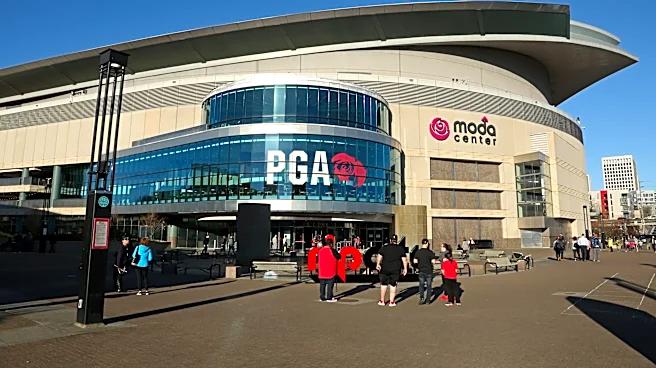






The Portland Trail Blazers are in a well-publicized argument with the City of Portland over public funding for the Moda Center, the Blazers’ home arena. At stake are $120 million out of $600+ million needed for the project, plus the wheels continuing to roll forward on the renovation. Less-spoken, but omnipresent, is the threat that—if local governments don’t contribute to the cause and fund the project—Blazers owner Tom Dundon will pack up the team and head for greener pastures and a more-amenable
constituency.
Most of the discussion surrounding the debate has centered around keeping the Blazers in town, the favorable outcome for Portland fans. But today Blazer’s Edge Reader (and occasional contributor) BlazerTag takes a look at the other end of the spectrum. Forget emotion and bias towards the red and black. Think like the City of Portland for a minute. Would the Moda Center become a boondoggle for the municipality if the Blazers really did pack up and leave? Is the threat of a skeleton building, unused and rotting, credible?
Here is BlazerTag’s take. Thanks to him for the work and for all Blazer’s Edge Readers for creating such an amazing, thoughtful community.
————————-
The red button has been pressed; the nuclear option engaged. It’s DEFCON 1 in Rip City.
After months of stonewalling with no end in sight, Tom Dundon has finally had enough. He found himself a better deal, just like he said he would. Portlanders are left to suffer in shame. Our giant, municipally-owned stadium no longer has a major sports team as an anchor tenant. Alas.
Its heart ripped out, Moda Center is sure to bleed red ink all over the City’s ledger. The Rose Quarter’s future is in ruin.
Let’s mentally prepare ourselves by checking in on the tragic condition of other stadiums around the country that have recently lost their anchor sports team. Brace yourself, it’s about to get ugly.
Arenas Without Anchor Tenants
Desert Diamond Arena
The former NHL home of the Arizona Coyotes has been without its anchor tenant since 2022; they’ve moved onto the greener pastures of Salt Lake City. To see how bad the finances got in the immediate aftermath, let’s hear from Glendale City Manager Kevin Phelps.
“The venue (Desert Diamond Arena) smashed its all-time record for revenue after the (Coyotes’) departure,” Phelps said. “The next year, they beat that number by almost $10 million.”
Wait… what? The stadium’s finances actually improved after the anchor tenant left? But that flies in the face of prevailing wisdom. I’m sure it’s due to a unique set of circumstances that aren’t even remotely comparable to anything going on here in Portland. Maybe Glendale Mayor Jerry Weiers can enlighten us.
“For years, there was a sense that the team was always looking elsewhere rather than investing in Glendale,” Weiers said, “It’s hard to build something lasting when one side is never fully committed to staying.”
Well, that sounds kind of familiar.
The ink from Tom Dundon’s signature was still wet on the purchase agreement when threats of Blazers relocation first appeared in the media. The veracity and intensity of the intimidation has only escalated since.
Here’s more from the Glendale Mayor.
“The city was taking on significant operational costs while the team controlled the most lucrative revenue streams.”
Boy howdy, does that ever sound like a certain initial term sheet where 100% of the $573 million burden for renovation is carried by the State of Oregon, Multnomah County, and City of Portland, on top of another $315 million for post-renovation operations, while the Blazers control every revenue stream from all events at Moda.
In exchange, the only financial commitment from the Blazers is a property tax offset payment that amounts to $100 million over a twenty year lease. There is absolutely no way for any government body to recoup the investment they make into Moda Center.
Yet somehow, that still isn’t good enough.
I’ve heard “the City is the landlord, they’re responsible for Moda’s maintenance and renovations” enough times that I want to carry that analogy further. How many landlords charge a rent that guarantees they lose money?
None that I’ve met.
Oakland Arena
The Coyotes never resonated with their community in Arizona the way the Blazers have with ours here in Portland, so maybe that’s why their loss didn’t hit as hard financially. Plus they’re a hockey team. [ed. Ouch!] Let’s examine a franchise that’s at least in the same league as the Blazers whose fanbase is just as loyal.
The Golden State Warriors were the last NBA dynasty, winning the Larry O’Brien trophy four times between 2015-2022. They have one of the best players of all time, who doubles as one of the NBA’s most marketable personalities. Even before that, during years-long stretches of losing seasons, the Bay still showed up to cheer their team on.
At the peak of their popularity, the Warriors left Oracle Arena in Oakland for a new facility in San Francisco: the Chase Center. So what happened to Oracle (now called Oakland Arena) when the Warriors left? It had its best fiscal year ever and reduced its operating deficit by 97% between 2019 to 2023.
The turnaround has been so successful that just last month, Oakland Arena sold in a deal that granted the City of Oakland a lump sum payment of $50 million, plus 6% of all gross ticket sales, and they no longer have to pay for renovation or maintenance. Oakland gets $50 million, plus a projected $3 million a year from ticket sales that goes straight into their general fund.
In contrast, the initial term sheet for the Moda agreement has the City of Portland paying $120 million for renovations, while their 6% cut of ticket sales gets dumped right back into maintenance. Portland loses $120 million, plus another $13 million a year that goes straight towards post-renovation operations.
In strict financial terms, the Warriors skipping town is the best thing that could’ve happened to the City of Oakland’s ownership of the stadium formerly known as Oracle Arena. The Blazers residency at Moda will be an albatross for the City of Portland, by comparison, if the initial term sheet is accepted as is.
KeyArena
The spectre of the Supersonics has haunted nightmares of relocation ever since they left Seattle in 2008. KeyArena famously ran at an operating loss while it was hosting the doomed NBA franchise. When government funding for stadium renovations fell through, the team moved to Oklahoma City.
What happened next adds another piece of fabric to the pattern we’re sewing here, KeyArena turned a bigger profit than it ever did with the Sonics. It happened the same way it did in Glendale and Oakland when their anchor tenants left: by freeing up the stadium revenue the sports teams were hoarding for themselves.
The City of Seattle ran the arena on its own for ten years before partnering up with Oak View Group, who paid for all the renovations to the arena in exchange for a master lease that gave them complete control over the daily revenue. This year, the City of Seattle sold it to them.
I just want to reiterate that of the estimated $1.15 billion dollars used to renovate the arena, exactly zero of them came from public funds.
There are stadium management companies who are willing to share the financial burden of maintenance and renovation with the city that owns them. In the case of the stadiums formerly known as Oracle Arena and KeyArena, the Oak View Group took on all of that responsibility and bought the buildings outright.
ASM Global paid $15 million of the $40 million renovation at Desert Diamond Arena. They have a similar arrangement with the T-Mobile Center in Kansas City where they’re responsible for 35% of the capital improvements and maintenance. Neither of those arenas has a major league sports team as a tenant.
These corporations don’t contribute financially to large stadium construction projects out of some sense of altruism. They do it because they make a ton of money off of them. The lesson of the Sonics relocation isn’t how dangerous it is for taxpayers to refuse to fund stadium upgrades; it’s how stupid it is for NBA owners to not pay for the renovations themselves.
Howard Schultz sold the Sonics for $350 million dollars. He could’ve invested $220 million in KeyArena and kept a franchise that would be worth closer to $6 billion today.
Allstate Arena
So, now that we’ve seen how the finances improve for a city government when they partner with, or sell to, a venue management conglomerate after an anchor sports tenant relocates, I want to show you how much more lucrative it can be for a government body to run a stadium on their own.
Allstate Arena has been owned and operated by the Chicago suburb of Rosemont, Illinois since it opened in 1980 and it is a model of responsible financial stewardship. Without a middleman to siphon a cut of the stadium’s revenue, Allstate Arena runs at an operational surplus year after year after year.
The consistency with which the Arena runs in the black allows the Village of Rosemont to finance all of the necessary capital improvements on their own and still contribute to the general fund, to the tune of $8.1 million in 2025, $15.7 million in 2024, $12.7 million in 2023, and $7 million in 2022.
They do this with a performance roster consisting of minor league hockey, WWE, Andrea Bocelli, Bob Seger, the Harlem Globetrotters, J-Hope, and TXT. That is a sample of the highlights they brag about in the Annual Financial Reports. All wonderful events, but I think they prove that a schedule full of A-listers isn’t required for a stadium to make money.
The Lost Sports Revenue Fallacy
A stadium without an anchor sports tenant can still be a financial benefit to the government body that owns it, but what happens when we step back and look at the economics beyond the arena? Will losing the Blazers hurt the broader Portland economy?
According to this peer-reviewed study of peer-reviewed studies of the economic impact of sports teams, no.
“No evidence of supporting broad metropolitan-level effects exists, indicating that sub-local (neighborhood) effects are not equally distributed in host jurisdictions. Localized impacts likely reflect intrajurisdictional displacement or crowding out and these transfers in economic activity creates both winners and losers.”
The economic activity of a local sports team doesn’t just vanish when they’re gone, it gets displaced. It goes to different events, different venues, and creates different jobs. Losing the Blazers is a zero sum, so the fiscally responsible thing to do is get a Moda deal that rewards the City best.
In a recent op-ed, Councilor Tiffany Koyama Lane implied as much with this rhetorical question:
“Before we hand over a 20-year monopoly on a building the public owns, shouldn’t we test the market first?”
The rhetorical answer is “yes”, but the reason we haven’t is because a Blazers relocation will create winners and losers, just like the peer-reviewed study said it would. The economic activity will be displaced, but displaced from whom?
The people whose job it is to keep us informed, but whose self-interests are best served by keeping us ignorant, are local journalists covering the Blazers who stand to lose their job if the team relocates. Alongside them stand politicians who often trade favors with billionaires to fund their reelection campaigns.
Tom Dundon is so notoriously cheap that he wouldn’t pony up the dough for late hotel checkouts when Blazer staff was on the road during the play-in, but he certainly didn’t mind paying $100K to lobbyists during his nascent drive for the Moda Center renovation funds.
Maybe the reason the market hasn’t been tested is because the market will produce a better deal, but only for citizens. And we’re never meant to be the winners.
Fandom is Passionate, not Dumb
During this whole Moda lease ordeal, the only thing that Blazers ownership and I have agreed on is that the initial term sheet is a non-starter. Any deal that doesn’t give public funding for Moda renovations a decent ROI is an insult, because I know that any tax payer investment into our stadium without them as a tenant will.
I also know that finances and economics aren’t the only thing at play here. The journey of my Blazer fandom has helped form me in a deep and spiritual way, which is why their recent adversarial approach to Portland hurts me so bad.
When I think about the Blazers, I want to remember the first time I went to a Blazer game, how awestruck I was by the Memorial Coliseum, the thousands of fans, and the magnificence of Mark Bryant’s high-top fade.
I want to remember nervously watching the 1990 Western Conference Finals as I sat in an exact certain way, in an exact certain chair, in an exact certain pair of Blazer sweat pants, lest I jinx the team who was counting on me.
I want to remember a sense of loss so deep that I still can’t bring myself to write too much about a blown fourth quarter lead in game seven.
I want to remember the childlike giddiness I felt as Jerome Kersey smiled and shook my hand, my old man’s hand, and the hands of the hundreds of other fans who had camped overnight in the Rose Quarter to buy tickets for the 2009 playoffs.
I want to remember the tears in my eyes as I watched a hobbled Brandon Roy will his team to an impossible comeback playoff victory against the Mavs, knowing it was a star burning its brightest and hottest right before it extinguished.
I want to remember screaming so loud after 0.9 that it still echoes throughout SE Division.
I want to remember how proud I was of an interim first-year coach and an intrepid first-year all-star who refused to quit on a season full of adversity, their faith rewarded with a trip to the playoffs after a clutch performance in a road play-in game.
I want to remember all of it, because there’s no way to separate myself from who I am as a person, from who I am as a fan. They are the same. If the Blazers relocate, I know at first I’ll casually follow them in the box scores; check them out on league pass here and there, like a recent amputee scratching a limb that’s no longer there. Eventually, I’ll come to the slow realization that they’re absent from my heart, where they belong.
I’m aware of the sorrow that awaits if no Moda deal is struck. I understand the emotional stakes, but I won’t let them blind me to the cold, hard financial truth.
“Moda Center will crumble without the Blazers” is Stockholm syndrome reasoning from a fanbase being held hostage by ownership. It’s misinformation that I will not suffer.