
The offseason is well underway at this point, and there have been two trades so far that have caused me to scratch my head a bit. Both have involved Front Offices that, in terms of pedigree and past experience,
seem to know what they’re doing — so I’m shrugging a bit in addition to the impromptu scalp massage — but I still feel weird about the moves.
The first was the Angel Zerpa trade for Isaac Collins and Nick Mears trade. The more you read about it, the more convincing it feels. But, in order to get that “yeah okay” feeling, I think you need to approach it specifically from a, “Here’s what the Brewers didn’t want/need anymore” and a “Here’s what they can do with what they’re getting” angle. It doesn’t discuss market dynamics much, and is very tunnel vision-y with regards to “Isaac Collins and Nick Mears are likely going to be much worse going forward, and Angel Zerpa is likely to be much better.” I’m not really going to discuss that trade any further here, but again, it’s a move that slightly wigs me out.
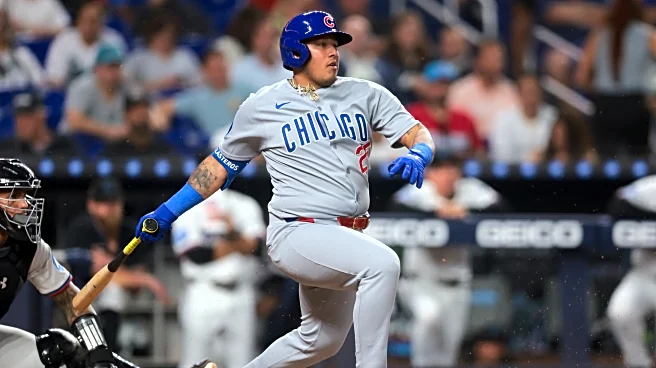
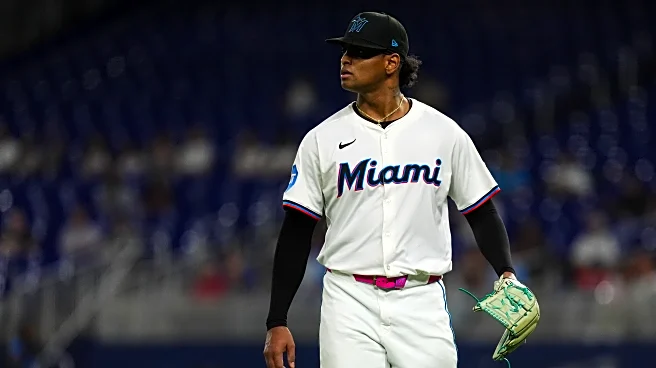
The other one was consummated yesterday: the Marlins sent starter Edward Cabrera to the Cubs for a package of three position player prospects. The headliner was Owen Caissie, a 23-year-old outfielder who made his debut last year after crushing minor league pitching at pretty much every level since being drafted in the second round of the trimmed 2020 MLB Rule 4 Draft. The other two prospects, as summarized by a block quote from Eric Longenhagen here, are basically fringy throw-in types. As Michael Baumann notes in that article, you can definitely get a tunnel vision-y sort of post hoc justification for this deal, on the basis of the Marlins needing offense, and Caissie, in theory, providing a lot of offense. But to me, it feels like the Marlins could’ve gotten something more solid or substantial in return. Dan Szymborski noted that ZiPS felt fine about Caissie being a regular last July. I’ll quote Longenhagen at length with regard to Caissie pre-2025; his 2025 was very good but it also came in a repeat of Triple-A, which to me is not a particularly exciting or positive note:
A Canadian outfielder originally drafted by the Padres and traded to the Cubs for Yu Darvish, Caissie’s power output exploded in 2023 and held firm in 2024 even though his underlying power data backed up quite a bit. He still generated plus raw pop, but Caissie’s peak exit velocities were below the elite numbers he posted in 2023. It’s important for Caissie to get to big power because he has other limitations as a hitter. For instance, he is very vulnerable to fastballs located at the top of the zone. His contact rates are near the bottom of what is usually acceptable from a good big league corner outfielder. With elite power, that’s okay. With plus power, Caissie looks more like a platoon option that an everyday cleanup hitter. He’s still just 22 and Caissie has long been the sort of prospect who could break late; he’s a cold weather guy and didn’t play baseball under lights at night until he turned pro. This grade pulls him back to the lefty platoon role, but leaves room for him to reclaim the power-hitting clout from last year.
Fundamentally, I think my discomfort with the return hinges on the fact that Caissie may not be a regular. If he’s a regular, then yeah, okay. And Rays honcho Peter Bendix presumably knows what he’s doing here. But, still, that’s a lot of risk, in my view, for an asset that probably could’ve had a better central outcome.
Cabrera has not exactly been a standout producer himself, with just 3.7 fWAR in 431 2/3 career innings — a career 95 ERA-, 107 FIP-, and 97 xFIP-. His value has been yoinked downward due to serious homer problems; the rest of his profile looks nice and he had a shiny 88 xFIP- last year. So, it’s not like the Cubs didn’t take on a measure of risk, too — a homer-prone pitcher playing at Wrigley, with a notable injury history. On the one hand, that’s why they really only had to give up Caissie. On the other hand, Cabrera’s already made it work in the majors, and that counts for something.
Anyway, when you get a deal like this, you wonder if your team could’ve beaten it. With Cabrera, it’s not clear whether the Braves would’ve even wanted to beat it: they probably need to diversify risk away from “could get killed by HR/FB” or “could miss a bunch of time with injury.” Those things already ruined their most recent season, doubling down on them is probably not on their specific offseason menu. At the same time, the Marlins probably wouldn’t have had much interest in trading with the Braves, who don’t have an MLB-ready Caissie-type guy to plug in — Nacho Alvarez Jr. would not solve Miami’s offensive problems. So, in some ways, it’s moot. But anyway, the question is what it is: if you were the Braves, what would you have traded for Cabrera’s services (which you’d receive for three full seasons… or whatever results from the impending 2027 lockout)?