
Welcome back to our series on the innovations the Yankees pitching department is making with the sinker! They’ve dusted off the pitch from a period of league-wide dormancy and have a renewed focus on disseminating it across as much of their pitching room as are willing to use it. In May, I kicked off the series by looking at the way Cam Schlittler has incorporated the sinker into his arsenal and how that decision helped launch him to the stratospheric heights he is now pitching at. Then in June,
I wondered whether the sinker was the solution to Ryan Weathers’ home run woes. Most recently, I investigated how Paul Blackburn’s transition from throwing the cutter to throwing the sinker as his primary fastball helped key his transformation into a bullpen ace.
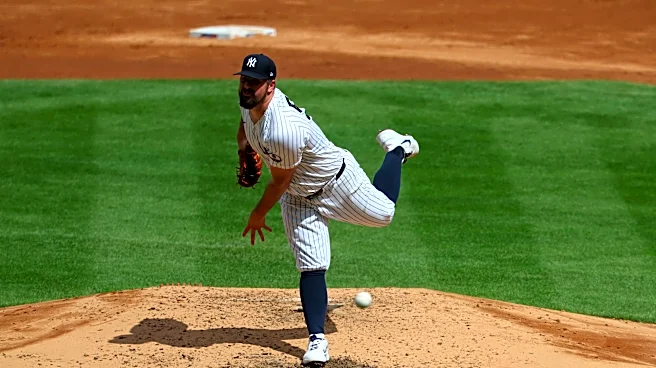
We return to the starting rotation for our fourth entry in this series. Carlos Rodón’s season has largely been interrupted by injury, but there’s plenty to be encouraged about the times he does take the mound. Recovery from offseason elbow surgery to remove a bone spur cost him the first month-and-a-half of the campaign. Inflammation in that same elbow cost him another month-and-a-half between July and the first half of August. In total, it’s limited him to 11 starts, the 33-year-old lefty pitching to a 3.15 ERA and 3.61 FIP with 58 strikeouts in 54.1 innings. He’s been limited to just four innings in each of his two starts off the most recent IL stint as he builds his pitch count up, but he’s done well to allow just two earned runs across those eight innings.
After such a disappointing debut season in pinstripes, we’ve written extensively over the intervening three years about his transformation as a pitcher. Not content to simply sit around and collect a paycheck, Rodón reinvented himself in 2024 and 2025, going from a power pitcher who only threw four-seamers and sliders to a true pitcher’s pitcher with a legitimate five-pitch arsenal. Over the last two seasons, we focused a lot on the integration of the curveball and changeup into his repertoire, and particularly the effect that mastering the latter pitch has had on him rediscovering his form in the rotation. Starting in the second half of last season and coming into greater focus this year, it appears reintegration of the sinker is the latest step in his evolution as a starting pitcher.
Rodón threw the sinker pretty regularly his first two seasons in the bigs before it took a backseat to his four-seamer in the following two seasons and disappeared completely from 2019 through 2024. The Yankees encouraged him to dust off the pitch following this six year hibernation, and in 2025 he deployed the sinker with a 9.7-percent usage rate. That’s now up to a 14.5-percent usage rate in 2026.
Not only has he increased his usage of the pitch, but it is also a better offering by several raw metrics then when he threw it his first four seasons with the White Sox. From 2015 to 2018, Rodón’s sinker averaged about 21 inches of drop and about 15 inches of arm-side run, making it a league-average sinker by both vertical and horizontal movement vs. average. Between this year and last, his sinker is now exhibiting about 24.5 inches of downward tilt while maintaining the same amount of lateral break, turning it into a well above average pitch by vertical movement vs. average.
He has done this by tapping into the seam-shifted wake effect created when the orientation of the ball’s seams disrupts the laminar air flow across the ball’s surface during flight — the spin rate, spin axis, and active spin on the pitch have remained pretty stable his entire career meaning this increase in downward movement is conferred by a tweak to the positioning of the seams at release. The result is a sinker that exhibits some of the greatest downward deviation in observed movement vs. the movement profile you would expect from the arm angle he throws it out of. The pitch’s observed movement is deviated 30 degrees downward relative the movement you would expect based on its axis of spin, which for a hitter means a pitch that breaks downward more than you would usually anticipate the sinker would when thrown from his arm slot. Contrast this with when he was with the White Sox, and his sinker had zero deviation in observed movement vs. expected spin-based movement.
The main function of his sinker is as a lefty-neutralizing fastball given that the four-seamer doesn’t perform quite as well against same-handed batters. The sinking movement down and in is super effective at keeping the ball off a lefty’s barrel, particularly when thrown to the arm-side edge of the strike zone.
The way this pitch darts in toward the label of Devers’ bat and downward at the last moment is key to generating the inning ending double play ball. Of all the pitches Rodón has thrown at least ten-percent of the time this year, the sinker is the best in terms of expected wOBA (.194), average exit velocity (83.5 mph), hard-hit rate (22.2-percent), and ground ball rate (59.3-percent) and has yet to allow a barrel in 27 batted ball events.
Not only that, the pitch can act as a swing and miss pitch against lefties, especially those who are expecting a four-seamer.
Devers whiffs over the top of this sinker for the strikeout. With the extra downward movement Rodón is able to impart on the pitch, at times it can almost act as hard reverse slider. Traditionally not a chase or swing and miss pitch, Rodón’s sinker has induced impressive marks of a 29.9-percent chase rate and 18.2-percent whiff rate in 2026.
Which brings me to the final facet of the pitch I’d like to talk about — it’s the interaction between Rodón’s four-seamer and sinker that has me most intrigued. Rodón has proven quite adept at tunneling his sinker off his four-seamer. Just check out this overlay against Devers from last year:
Both four-seamer and the sinker that followed it exit Rodón’s hand aimed at a similar spot. Whereas the four-seamer flies pretty straight and stays level on its vertical plane, just look at the way the sinker falls off the path charted by the four-seamer, resulting in two pitches that look almost identical out of the hand landing in two different spots in the zone.
A lot of research that has been done over the last few years in the pitching arena concerns the benefit, especially for starting pitchers, of throwing at least two different types of fastballs. The above overlay illustrates this effect well. Because it is almost impossible for the hitter to distinguish different fastball types based on spin the way you might be able to discern a slider or curveball from a heater, throwing two or more fastballs with divergent movement profiles makes each individual pitch better. Indeed, Rodón’s four-seamer and sinker are performing at their highest level in years, both pitches holding hitters well below the Mendoza line while the four-seamer has its best whiff-rate (25.3-percent) in his Yankees career, and I believe this is down to Rodón throwing his sinker more.
With the injuries mounting in the rotation to Rodón’s fellow southpaws Max Fried and Ryan Weathers (though both with encouraging prognoses), Rodón’s continued build up from his latest injury setback becomes all the more critical. The Yankees need him healthy and firing on all cylinders if they are going to mount a challenge for the division much less make a deep postseason run. With the sinker representing his latest evolution as a starting pitcher, I feel he is well equipped to reach the heights he hit last season.