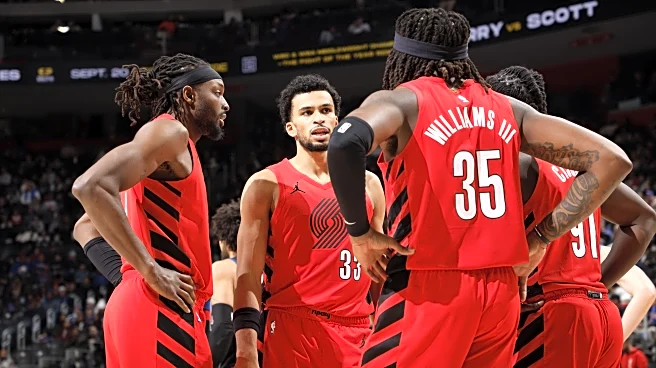

Portland Trail Blazers fans knew going into the year that their team was destined for an up-and-down season. Injuries and a couple of rough stretches have conspired to put the Blazers on the “down” side
of that equation lately. After a 5-3 start to the season, their record now stands at 9-15, meaning they’ve registered only 4 wins in their last 16 games.
While many supporters remain upbeat, several submissions to the Blazer’s Edge Mailbag can be summarized as, “What’s wrong with the Blazers? Are they OK?”
Let’s address that today.
We mentioned injuries in the opening paragraph. That’s not just a subtext to the season so far, it’s the main story. Given the number of games so far, 19 appearances would constitute an 80% participation rate, prorating out to 65 games in a season. Only 7 regular rotation players have reached that threshold so far. Sidy Cissoko, Shaedon Sharpe, and Donovan Clingan have squeaked in with 19, 20, and 21 games respectively. Kris Murray has played 22, Jerami Grant 23, and the backbone duo of Toumani Camara and Deni Avdija have played in all 24.
Realistically, Cissoko and Murray shouldn’t be considered huge contributors to the roster at this point. They have been. There’s no other choice. Putting them in the “emergency substitute” category leaves just five of Portland’s key rotation members at the start of the season playing a reasonable number of games. That’s not good.
It gets even worse when you consider the other end of the scale. Robert Williams III has missed 9 games. That’s not surprising. The real story is that he’s the best of the absentee list when it comes to participation. You can add Jrue Holiday with 12 games missed, Matisse Thybulle with 20, Scoot Henderson with 24, and salt it off with Damian Lillard who won’t be playing at all this season. Add in rookie Yang Hansen playing only 7.7 minutes per game in 13 appearances–because of learning curve, not injury–and you have a huge swath of Portland’s lineup just…gone.
In this sense, no, the Trail Blazers aren’t alright. Not even close. Every discussion of their performance in the early season should start with this reminder.
But injuries are simply a preliminary factor in their play. The things happening on the floor matter too. Even a cursory examination reveals pretty quickly why the Blazers are having trouble.
If you missed our analysis of Portland’s style of play at the beginning of the year, here’s what it amounted to:
The Blazers try to overcome lack of shooting and offensive firepower by playing an aggressive, hounding defense, forcing turnovers, running the ball down the floor quickly, and either scoring in transition or getting the first open look, for the most part regardless of shooter or position. They hope to make up for relatively poor percentages by getting up more attempts than the opponent, playing fast and hard even if they can’t play well in the classic sense.
The only addition to that formula over the last month has been an emphasis on offensive rebounding, an old tactic that doesn’t really belong in this new, fast-paced approach. It’s a gambit to try and keep field goal attempts high, generating extra possessions off of misses.
So now, let’s take a look at how this is going.
The first thing that jumps off the page is that the Blazers are currently 29th in the NBA in overall field goal percentage and 30th in three-point percentage. They’re in a titanic struggle with the Indiana Pacers for the honor of being the worst-shooting team in the league. This isn’t just an offensive struggle, it’s borderline ineptitude.
But ok, that’s fine. We knew this going in. The first eight words of the analysis above are, “The Blazers try to overcome lack of shooting…” The problem may be worse than we anticipated, but they’ll compensate for it, right?
They’re trying, Jennifer. At this point, it’s just not enough.
The Blazers generate the fourth-most field goal attempts and three-point attempts in the league. That part of the plan is working. But “fourth-most attempts” doesn’t make up for “absolute worst shooting”. Portland needs to be running away from the competition in shot-attempt differential per game. They’re not.
The Blazers are currently attempting 91.5 shots per game, giving up 89.2. That’s just a little over a two-shot edge. The story is better in three-point attempts. The margin there is 41.7 to 34.9, a 6.8 shot advantage. But at the percentages the Blazers are shooting versus their opponents, that only amounts to 4 more points per game from the arc.
Earlier in the season, those gaps were HUGE. The Blazers were attempting ten more shots per game, on average, than opponents. Even their mostly-bad three-point shooting wasn’t killing them, as they were generating a dozen more attempts per game than the opposition, not just seven.
The Blazers are trying to do the same things they were earlier. They’re just not doing it enough. The weaknesses in their approach are immutable. (They can’t suddenly become a great shooting or scoring team, especially with all the injuries.) The strengths are still there, but they’ve waned enough that former wins have turned into losses.
The issue can be summarized by looking at the margin of victory for the team. Back on November 9th, a month ago, the Blazers were averaging 121.6 points and giving up 119.8, a +1.8 point margin per game. Today those numbers stand at 117.4 for, 120.6 against. That’s a -3.2 average margin of victory, a full 5-point swing to the negative from a month ago.
Results repeat in the substrata elements of Portland’s approach.
- A month ago the Blazers led the league in turnovers forced, earning a +2.5 edge over opponents on average per game. Today they’re still decent, ranking 8th, but they also commit more turnovers than anybody else, leaving them in a -1.0 deficit.
- A month ago the Blazers were averaging 19.6 fastbreak points per game, a +2.0 advantage over opponents. Now that’s down to 14.3, a huge plunge. They’re running a deficit of -2.3 despite allowing opponents fewer points on the break than they did back in November.
- The Blazers are still keeping up offensive rebounding, earning a +2.7 advantage per game in that category. But a month ago it was +3.6. Portland averages the same number of offensive rebounds per game but they’re allowing the opponents more.
Side Note: For those thinking that the refs are mixed up in this somehow (often, and understandably claimed in our Game Day Threads), the Blazers are in a virtual tie with opponents now in free throw attempts per game. A month ago they were running two free throws behind. This is actually one of the few areas in which they’ve improved, both in shots taken and shots allowed.
If you throw all this under a microscope, it’d be easy to say that nothing is going right for the Blazers. That’s true as far as trends. At a more macro view, though, the story is a little different. Things are going right for the Blazers! In most of these categories they’re still decent, ranking in the NBA’s Top 10! But they’re not going right enough to make up for lack of scoring, lack of shooting, and lack of live bodies.
Anyone who’s watched the Blazers this year understands how thin the margins are in most of their games. It’s thrilling, but it also leaves little room for downward trending. A five-point swing on average is more than enough to move the needle from 60% wins to 75% losses. That’s the reality of the 2025-26 campaign.
What are the solutions to this? Getting healthy wouldn’t hurt. More players equals more redundancy. That should equal more energy and ability to absorb/counter cold streaks. Beyond that, the Blazers need better offensive players so they won’t have to rely on playing faster, generating more shots, and forcing turnovers quite so much. They’re not going to get away from those techniques…this is the style of today’s NBA. But without shooters and scorers, it’s kind of like having good form on your baseball swing using a Wiffleball bat. You can make contact and have pristine follow-through. It’s probably going to be an infield out anyway. It sure has been for Portland lately.
Thanks to everyone who wrote in with some version of this, “Is Portland OK?” question. You can send your own questions to blazersub@gmail.com and we’ll try to answer as many as possible!