
The Brewers are already pretty deep in the outfield. When healthy, Jackson Chourio, Sal Frelick, and Garrett Mitchell form a consistently productive core, while Blake Perkins and Brandon Lockridge serve as capable depth options.
Well, what if I told you they may have just added another starting-caliber outfielder?
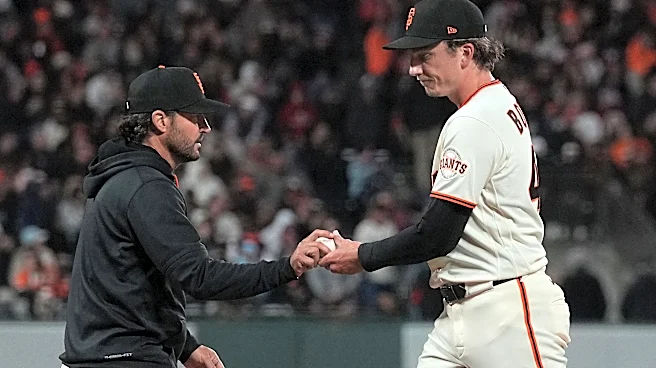
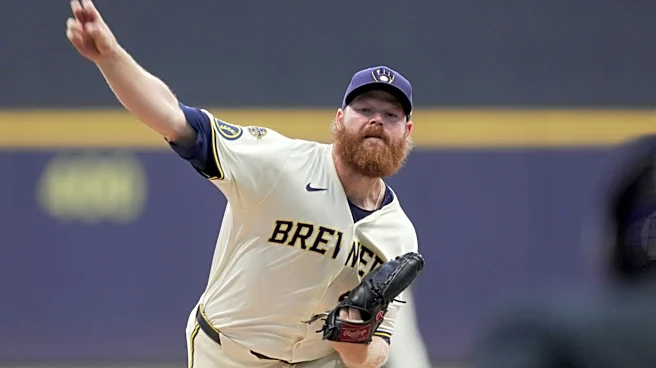
This offseason, the Brewers traded for left-handed starter Kyle Harrison, who has looked like a solid find through two starts with Milwaukee. At the time of the trade, a lot of the analysis
around Harrison centered around his “untapped potential” as a guy who didn’t put up eye-popping numbers in the majors but was at one point a top prospect in baseball.
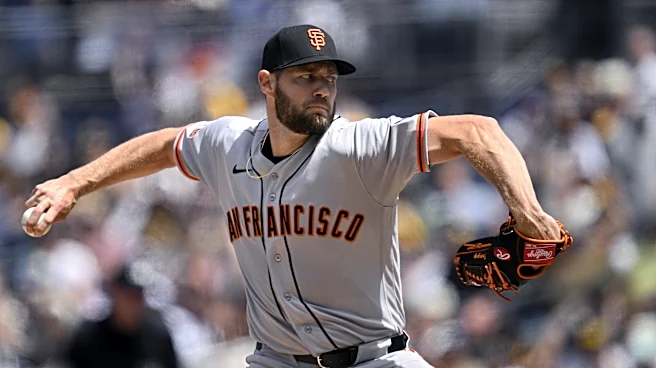
When Harrison made his major league debut in 2023, he was ranked as the San Francisco Giants’ No. 2 prospect according to FanGraphs. Can you guess who the No. 1 prospect was?
No, it wasn’t Patrick Bailey. Or Marco Luciano. Not Carson Whisenhunt, either.
It was Luis Matos.
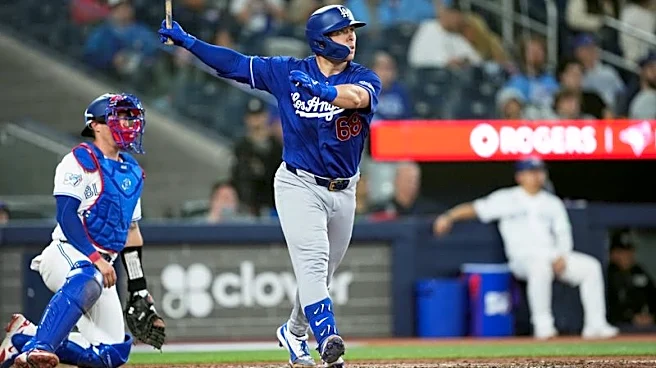
Now 24 and only a few years removed from that status, Matos was acquired by Milwaukee for cash considerations. That raises an obvious question: why would a team give up on a young, talented former top prospect for nothing?
Last year, I wrote an article arguing that Andrew Vaughn could be the Brewers’ first baseman of the future, or at least the next couple years. “The Case for Andrew Vaughn” justified the acquisition of Vaughn on the grounds that the Brewers could get the best out of a player who fell victim to a stalled developmental process in his time with the White Sox organization. That article aged pretty well, as Vaughn went on to hit .308 with an .868 OPS in over 200 at-bats with the Brewers. He’s on the IL with a broken hand right now but entered the season as the Brewers’ starting first baseman.
Matos fits a similar mold. Here’s why:
What Went Wrong in San Francisco
Just a few years ago, Luis Matos was one of baseball’s top prospects. Players like that aren’t typically moved for cash considerations.
In 2023, president of baseball operations Farhan Zaidi — with the Giants hovering around .500 — looked to inject life into the roster by calling up Matos, his top outfield prospect. Matos had been lighting up Triple-A, slashing .398/.435/.685 in 108 at-bats. At 21 years old, he was the second youngest player in the majors but held his own with a .250 batting average and a .319 OBP. His trajectory pointed toward a long-term role in San Francisco.
Unfortunately, Matos regressed in 2024 (.213/.237/.347 in 150 at-bats) and remained below league average in 2025 (.221/.266/.424 in 172 at-bats).
Following the 2024 season, Zaidi was replaced by Buster Posey, who highlighted defense and situational offense as areas of improvement. Those priorities didn’t necessarily align with Matos’ profile. While he offers speed and arm strength, his defensive performance has been inconsistent, and his offensive value hasn’t come from power or specialized situational skills. Despite his higher long-term ceiling, Matos’ lack of a defined role made him expendable.
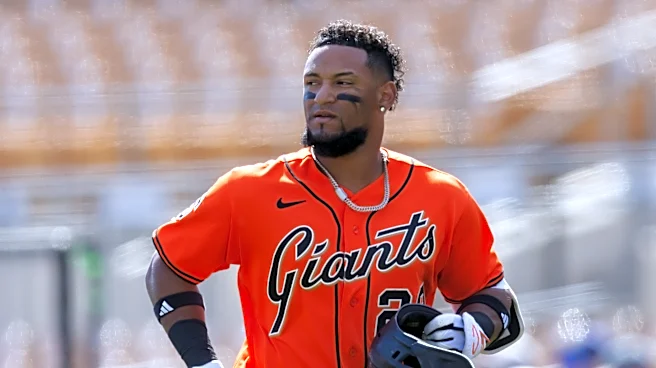
When Matos was designated for assignment last month in favor of Jared Oliva (remember him?) and Jerar Encarnacion, Posey explained that the decision was made to prioritize specialized skillsets off the bench because Matos wasn’t going to start over Heliot Ramos, Jung Hoo Lee, or Harrison Bader. Oliva “is a speedster… on the basepaths and… a weapon defensively.” The “hope” with Encarnacion is to “have some power,” and Matos has yet to show consistent power at the major league level.
The other piece of the puzzle is opportunity. Matos has never had more than 228 at-bats in a season, and he hasn’t been close to 200 in either of the last two years. Just for context, Brice Turang had 404 at-bats in 2023. He didn’t have room to develop in San Francisco — a team that is trying to win now despite finishing .500 last year — and wasn’t going to this year.
Matos’ best skill at the plate is his contact ability; in three big league seasons, he’s never struck out more than 15.4% of the time. At the same time, he’s struggled to make good swing decisions despite putting the ball in play at a near-elite rate. Matos’ 37.7% chase rate was 28th worst among players with at least 150 plate appearances last year. His out-of-zone swing-and-miss percentage was 58th best. In effect, Matos was swinging at too many pitches — regardless of location — and putting them in play without generating consistent quality contact.
If you’ve been following how the Brewers’ front office evaluates players, the case for Luis Matos becomes clear.
The Case for Luis Matos
“If you chase, you don’t play. The guys with the best ability to control the strike zone are going to play.”
“When (Joey Ortiz) swings at a breaking ball in the dirt, I want to tase him. I don’t know if that’s legal.”
These quotes echo a sentiment that Brewers manager Pat Murphy has repeated often — making good swing decisions is a core tenet of the Milwaukee Brewers’ offensive philosophy. It’s also an area the Brewers targeted when Vaughn joined the organization.
Matos, like Vaughn, has the underlying tools to succeed at the major league level. He’s athletic, great at making contact, and has shown the ability to drive the ball when he squares it up. The issue has been his approach. Matos expands the zone by swinging at pitches he can make contact with but can’t punish. The result is a diluted Statcast chart — more balls in play, but fewer of them hit hard.
When Matos gets a pitch to hit, he can do some damage. But those opportunities have become increasingly rare because opposing pitchers have learned they don’t necessarily need to challenge him in the zone.
In short, Matos’ biggest weakness is the Brewers’ greatest offensive focus. If he can implement the advice of the coaching staff and earn enough playing time to continue developing, he’ll look like a new player with Milwaukee. Andrew Vaughn was able to do it. There’s a case that Matos can, too.