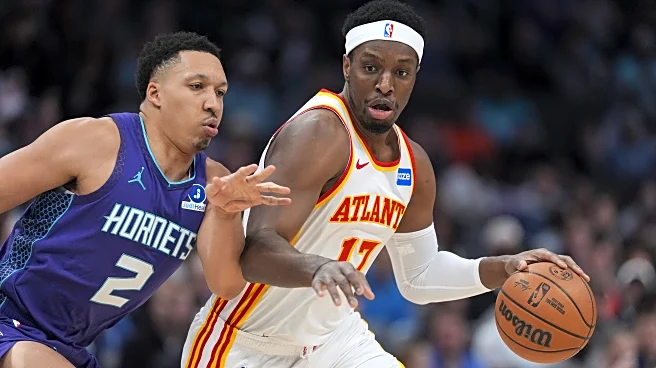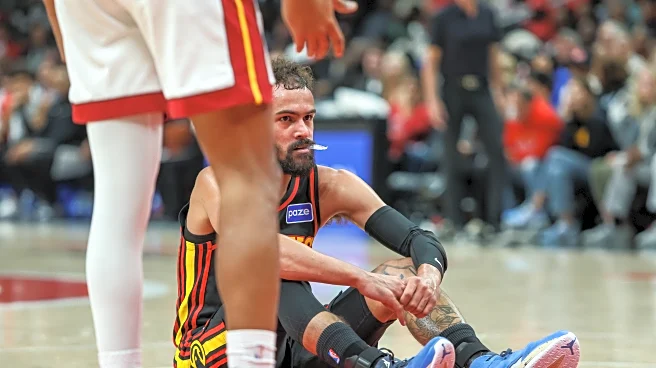

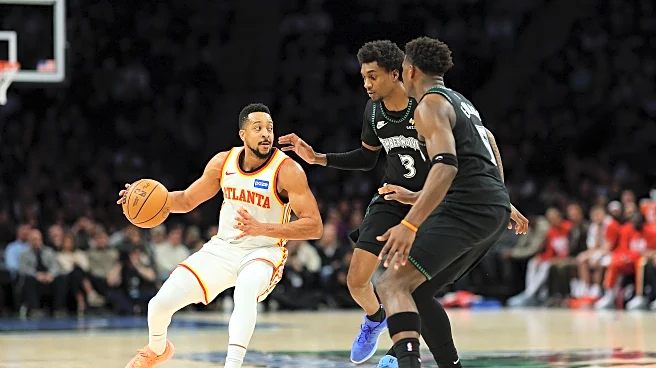

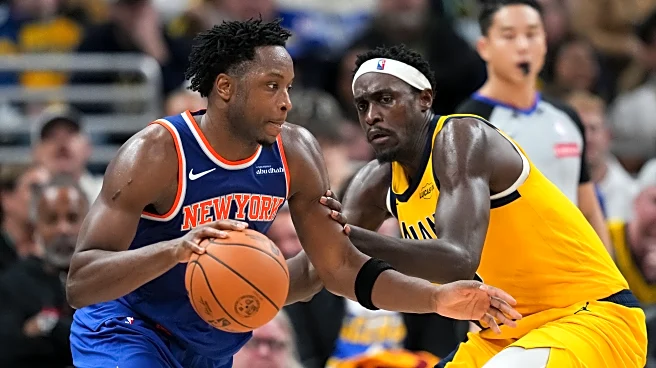
The Atlanta Hawks suffered their fifth consecutive defeat, dropping another game at State Farm Arena in a 126-111 contest against the Miami Heat on Friday night. Norman Powell led the Heat — without Bam Adebayo and Tyler Herro — with 25 points, while Pelle Larsson added 21 points. For the Hawks, Trae Young scored a game-high 30 points and Jalen Johnson added 24 points, nine rebounds, and 10 assists.
Heading into the fourth game of this five game homestand, the Heat and Hawks entered in very similar
circumstances. Both teams enjoyed a solid start to the season but have been reeling of late; both teams now hover around .500 and both teams were 2-8 over their last 10 games and desperate for a victory as both teams slide in the Eastern Conference standings.
Affairs were, initially, even to start but a cold offensive stretch behind isolation basketball allowed the Heat to run out to a 24-15 lead. The Hawks responded well after a timeout, but what continued to plague the hosts (not just in the first quarter, but all game long) were the turnovers.
The Hawks committed 21 turnovers on the night, leading to 22 points off of turnovers and contributing to 22 fastbreak points for the Heat. These also contributed to a shot disparity, with the Heat attempting 104 field goals to the Hawks’ 85 field goal attempts. This matters quite significantly, with both teams shooting exactly 47.1% from the field, but the Heat made nine more total field goals than the Hawks, winning the game by 15 points.
Turnovers typically come in many different forms but let’s take a look at some.
Turnovers such as this one — an entry pass attempted from Onyeka Okongwu which slips out of Johnson’s hands — can happen at any time and aren’t indicative of any larger problem in the game:
Similarly, outlet passes can be prone to being picked off, as this attempt from Young towards Johnson is:
However, other turnovers were more problematic.
Here, Dyson Daniels attempts to take Powell off the dribble, but he’s quickly pounced upon and loses his footing, leading to a turnover:
This was a good defensive scenario for the Heat, who are well spaced defensively to help and have an additional body either side who can swarm Daniels on the drive and are more than willing to leave Zaccharie Risacher and Mo Gueye open for three.
On a drive from Nickeil Alexander-Walker, the Heat again throw a body on the drive which unsettles — and makes contact — with Alexander-Walker, and his pass back out to Johnson drifts into the backcourt for a turnover:
Inbounding the ball, the Heat’s pressure helps cough the ball into a turnover, and Dru Smith scores:
A turnover underneath the basket and not in the fourth quarter with full-court pressure is never ideal.
Off the dribble, Vit Krejci does well to open the space to step into a mid-range jumper but as he he rises he elects to pass to Johnson, and commits the turnover:
With the Hawks chasing the game in the fourth quarter, turnovers such as this double-dribble violation from Johnson only add insult to injury:
There were two quarters where Atlanta’s sluggish opening really cost them: the second quarter and the fourth quarter. Both opening stretches to these quarters were rough, and there were a number of turnovers to be found to open the second quarter.
To begin, the lineup Hawks head coach Quin Snyder rolled out to begin the second quarter included Keaton Wallace, Risacher, Krejci, Asa Newell, and Onyeka Okongwu. On paper, that is immediately problematic: where is the offensive creation going to come from? It would have to start with Wallace, and if he isn’t playing well then it creates issues for this unit…which is exactly what happened.
Here, Krejci comes off the curl and is looking to pass to Wallace, who has relocated away from the free space, and a frustrated Krejci is credited for the turnover:
Wallace’s pass to Krejci is picked off by Larsson, who does well to come up with the steal and finish in transition:
Wallace misses a three before committing a bad turnover, as his entry pass for Newell has absolutely no hope of reaching the rookie and the Heat come up with the loose ball:
A missed shot by Krejci continues the offensive struggle to begin the second quarter, followed by this sequence of what is a good block by Newell but immediately undone by throwing the ball away underneath his own basket, and Wallace then wraps up Smith underneath for the foul:
Wallace is pulled from the game at this point, with Daniels checking back in. Not to pile on Wallace, but he was really poor in this stretch, and his role has to be highlighted more because, as the point guard on the floor at this stage, it falls on him initiate the offense. He would not play again for the remainder of the game, and in less than three minutes he missed his only shot, committed two turnovers and committed two fouls. Excluding Wallace, it was a really poor lineup choice from the Hawks, and they were lucky not to be punished further as the Heat missed multiple shots during this same stretch.
Luke Kennard, meanwhile, received a DNP-CD, and while Kennard hasn’t been able to find a ton of open threes in Atlanta compared to previous stops he can still facilitate the ball and make plays — both of which would have been beneficial to the Hawks in this stretch. Snyder’s justification for Kennard’s DNP-CD was in finding combinations that work since Young’s return to the rotation.
“With Trae coming back, we’re searching a bit right now to figure out what combinations work,” said Snyder of Kennard’s DNP-CD. “It felt like Keaton could give us his ability to defend the ball with a team that drives. When you’re not playing well and losing, you’re looking for ways to impact that. It’s no reflection on the way Luke has played, I think Luke’s done some really good things. It’s typical to play 11 guys is what it comes down to. You get to a point where you play guys really short minutes and that’s not fair to a player as well. Nothing written in stone about that.”
I have to presume Snyder might have meant to say it’s ‘typical to play 10 guys’, since that’s what the rotation was last night, with no room for the ‘typical’ 11th man in Kennard. I’m a bit perplexed overall by several elements in that answer in general. Alas…
The Heat would take a double-digit lead before the Hawks cut the Miami lead to 11 points heading into the half. A 14 point quarter for Young — including a three-pointer to reduce the Miami lead to one point with 3:07 remaining in the third — helped the Hawks close the gap, but a Heat surge saw them push the lead back up to six points heading into the fourth quarter.
Snyder essentially ran the same four-man unit (Risacher, Krejci, Newell, and Okongwu) as he did to begin the second quarter — with Daniels handling the ball this time instead of the benched Wallace — and, again, the lineup ran into problems. The struggles of this lineup at the start of the fourth were far more costly than the slow start of the second quarter.
It begins with a well set up play between Okongwu on the bounce-pass and Daniels with the cut, the Aussie missing the left-handed layup attempt at the rim:
The choice to put Asa Newell in the game at this stage of the game I thought was curious, as he was likely to be targeted on defense due to his inexperience, and with the Hawks already close to trailing by double digits it’s a precarious point in the game. Andrew Wiggins attacks Newell off the dribble, spins, and finishes at the rim:
On the block, Okongwu is matched up by Nikola Jovic, and tries to back him down before getting into his hook shot but is missed:
Again at the point of attack, Newell is targeted defensively, this time it’s Jovic who attacks off the dribble, with Newell committing the foul and sending Jovic to the free throw line, where he dispatches both free throws to give the Heat a 10 point lead:
A three from Krejci pulls it back to seven, but another foul from Newell on the drive from Jaime Jaquez Jr. contributes to another two free throws made for the Heat:
Okongwu attempts to reply as he takes Jaquez into the paint on the drive, leaves the layup short and misses the tip, letting a good opportunity for a basket at the rim slip through his fingers:
A tough jumper from Wiggins near the baseline over the contest of Risacher puts the Heat back up by 11 points and leads to an Atlanta timeout — this play is just a good, tough shot made by Wiggins:
The Hawks are already on the back foot, and Snyder inserts Johnson in for Okongwu. The following sequence is messy: Risacher turns the ball over on the attempted pass to the corner, leading to a Heat fastbreak which is broken up by Risacher, who is credited for the block. This fuels an Atlanta fastbreak, led by Johnson, but the ball slips through Newell’s hands, leading to another Heat transition opportunity which Wiggins finishes at the rim:
Messy from both sides (and a great block by Risacher) but ultimately it’s the Heat who add to their lead, and they’d push the lead to 15 points after a Johnson inbounds pass (which he was lucky to get a foul call for leading up to, to begin with) is picked off by Smith, who leads the break for Miami and scores, leading to another timeout for the Hawks:
The game was, essentially, dead for the Hawks at this point. Young returned to the game after this timeout, and while Young helped trim the lead, very briefly, under 10 points, it did not last long. That lineup, which did not work at the start of the second quarter, did not work at the beginning of the fourth quarter either, even without Wallace in the lineup. Johnson’s reintroduction over Okongwu was probably not the change that was needed.
Newell was the player the Heat, correctly, targeted to begin the run, but Snyder persisted in keeping him out there despite how affairs were unfolding. Even after the first timeout, Snyder kept Newell out there when he probably should have come out. Outside of Newell, Snyder could have handled these lineups a lot better during a crucial stretch in the game where going down double-digits would lead to an uphill battle for the remainder of the contest, one the Hawks could not recover from.
Postgame, Snyder described Atlanta’s 21 turnovers as key to this game getting away from the Hawks.
“We put ourselves in a tough situation when we turn the ball over 21 times,” said Snyder. “There were things from a technical standpoint— trying to stay in front of drivers, there were times when we did those things, but also times where we did that and got back-doored for a layup. For the turnovers, we’ve got to get more connected, more determined to execute so we don’t turn the ball over and put ourselves in a position where we’re playing at a real disadvantage. When we do get in the halfcourt, any of those breakdowns are exponentially impacted.”
“It’s not any one thing,” added Snyder when asked about contributing factors to the lack of execution. “A focus on detail and the precision it takes to execute in those situations. Inbounding the ball out of bounds; two games in a row we’ve turned the ball on a baseline out of bounds, and they lay in the ball. That’s what I’m referring to with the connectedness: if someone is not open, someone else has to flash, we have to find that person, we have to back cut, we have to attack. There’s too many plays like that for us to overcome unless we’re doing everything perfectly … there’s stretches where we aren’t doing that.”
The Hawks have now lost five games in a row and with wins for both the Heat and the Bulls last night, Atlanta has now fallen to 10th in the Eastern Conference with a 15-17 record. The slide is bad, but cannot be attributed to the return of Trae Young:
Young himself enjoyed an efficient game, scoring 30 points on 8-of-16 from the field, 5-of-8 from three, and 9-of-9 from the free throw line. The assists may not have been what you’d expect from Young, six last night, but Young hit timely shots for much of the night, a big third quarter to help the Hawks close a double-digit gap, and he was put back into the game when it was too late in the fourth quarter.
Jalen Johnson was efficient overall — 24 points on 10-of-17 from the field — but struggled from three, shooting 1-of-6 from three (and a couple of forced ones, too) and was poor on defense. The numbers were really solid from Johnson but as he’s grown on the offensive end, his defensive effort and impact has really nosedived.
Still, he cannot be attributed a ton of blame for defeat last night, in fact not many individuals could. Okongwu had the most difficult night shooting the ball, shooting 5-of-16 from the field, and 0-of-5 from three. The three wasn’t falling, and the hooks that Okongwu has hit often this season just didn’t fall last night — a shame, as Okongwu had some mismatches as we saw in the fourth quarter.
The turnovers — a team wide problem — and the rebounding (another 16 second chance points for the Heat off of 13 offensive rebounds) helped contribute to the Heat taking 19 more shots than the Hawks. This really does add up and makes a huge difference, and it’s ultimately in these aspects the Hawks lost this contest.
Now, the Hawks face a tough upcoming schedule. The Knicks (21-9) are in Atlanta tonight, before the Hawks (15-17) head West for games against the Thunder, Timberwolves, then back to New York for another tilt against the Knicks, followed by two road games in Toronto against a Raptors side that have already defeated the Hawks twice in Atlanta.
Wins don’t come easy in the NBA, and in their current form the Hawks need to execute to a much higher standard if they’re to get their season back on track during this stint.
Until next time!