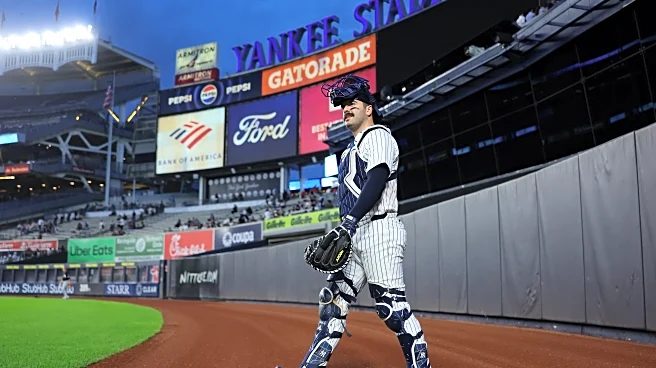


Austin Wells was one of the biggest success stories on the 2024 Yankees, breaking out as a plus-glove and, when on his game, plus-bat catcher who figured to help anchor the lineup in the Bronx for years to come. His second full season in the Show was not a full-blown sophomore slump exactly, but Wells had his share of hiccups and cold stretches which poured a bit of cold water on the unfettered optimism I expressed in these pages last season.
Nevertheless, Wells remained an outstanding defensive backstop,
which is more than half the battle for that position, and ultimately finished with comparable offensive production despite a concerning nosedive in walks. Even if the mustachioed former first rounder never fully comes into his own as a fearsome hitter in MLB, his now multi-year track record of elite defense means his spot on this roster is secure.
Grade: C+
2025 Statistics: 126 G, 448 PA, .219/.275/.436, 21 HR, .302 wOBA, 92 wRC+, +12 FRV, 3.0 fWAR
2025 Contract Status: Pre-arbitration until 2027
Before we get into the nitty-gritty, let’s just consider the fact that Wells was, at least according to FanGraphs, a 3-win player in 2025. It didn’t always feel that way. Even with the understanding that defense is king and offense is a luxury at catcher, there were points in Wells’ season where his offensive futility made him feel like so much more of a sap to the team’s value than he was. Since the Yankees traded veteran Jose Trevino in the offseason to reinforce their bullpen with Fernando Cruz, they didn’t have the kind of guy who could spot Wells for a week or so to help him ‘get right’, without paying a big toll on defense. Even Ben Rice, who enjoyed a breakout campaign, wasn’t a realistic choice to play catcher most days. It was on Wells to rally, and he did an admirable job cobbling together a nearly-average body of work.
What spurred so much of the optimism around Wells as a hitter was his plate discipline: an 11.4 percent walk rate in 2024 paired with a low chase rate and manageable strikeout rate which felt like the signs of a mature hitter waiting to break out. There were also indications that he was teetering between patience and passivity, but overall it felt that discipline would be a constant part of his game.
Not so in 2025. Wells’ walk rate plummeted to a below-average 6.7 percent this season, and his strikeout rate also took a five-percentage point hike. His chase rate climbed significantly, and those extra swings were a massive drain on his overall profile. We don’t need to get into the gory details as to why this happened—to a certain extent it’s likely that the league just adjusted to him and found ways to pitch him more aggressively. We’ll see if he can rediscover that discipline in 2026.
At the very least, Wells did produce more power, though it remains to be seen if it redounded to his benefit overall. His slugging percentage increased by about 40 points, and his 21 home runs were an eight-bomb improvement over last season. That surge helped to partially offset the crumbling walk rate, but had the overall effect of making him a more all-0r-nothing hitter.
I would not consider these developments to be proof of some massive personal or organizational failing. We’re a bit spoiled by the generational greatness of Aaron Judge, but most hitters never reach the happy medium of contact, discipline, and power. As we’ve seen with the extended Anthony Volpe melodrama, trying to chase one of those qualities can often lead to you getting worse at all of them. Sometimes you are what you are, and trying to chase an ideal standard rather than one that fits your skillset can wind up backfiring.
Entering his age-26 season, I do not believe the concrete has set on Wells as a hitter just yet. I doubt he’ll work batting averages much higher than .230, and expecting him to hit 30 home runs might be a bit of a stretch. But within those limitations, there is still potential for a consistently great hitter. I still think he can reach that point.
But if not, at least Wells continues to rank among the league’s elite on defense. Now, it is true that most if not all of his value comes from framing, which doesn’t figure to become less valuable even with the advent of the ABS challenge system, which arrives in MLB next season. If in due time the league feels it has outgrown such a system and deigns to switch to a fully-electronic zone, that will be its death knell, but I suspect we still have at least half a decade until then, which gives Wells plenty of intervening time to be an extremely impactful defender. His +12 Catcher Framing Runs was a bronze medal figure for MLB backstops, behind only Patrick Bailey and Alejandro Kirk. He profiles as completely average in the blocking and throwing departments, which are of course far more situational skills than how often you can steal—or preserve—strikes for your pitchers.
Managing a modern pitching staff is a difficult enough job on its own, especially with the caliber of pitchers the Yankees have in their employ. Wells does that job quite capably—if he does take the next step with the stick, so much the better. But even this version of Austin Wells remains plenty valuable. Perhaps it’s not the sexiest thing in the world, but many other teams around the league have searched far and wide without success to find some stability behind the plate. For the Yankees, that isn’t a problem they’ll have to worry about.