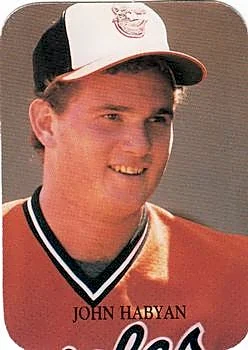

Happy 62nd birthday to John Habyan, a local boy done good who was a key cog in the Yankees’ bullpen for parts of four seasons. Habyan was born on Long Island and pitched well enough at St. John the Baptist
High School in West Islip to garner the attention of the Orioles, who picked him up in the third round of the 1982 MLB Draft. He steadily rose through the minor league ranks, culminating in a 1985 campaign in which he earned Baltimore Orioles Organizational Player of the Year Award while going 13-5 with a 3.46 ERA in 28 starts with Triple-A Rochester. He briefly debuted with the Orioles that year as well during a two-appearance stint. He would spend the next four years shuttled back and forth between Baltimore and Rochester. Habyan’s only extended opportunity in the bigs during this period came in 1987, when he pitched to a 4.80 ERA in 116.1 innings while posting a lackluster 64:40 strikeout-to-walk ratio.
John Habyan
Born: January 29, 1964 (Bay Shore, NY)
Yankees Tenure: 1990-1993
In Janury of 1989, Habyan’s career trajectory was thrown violently off course. While sledding near his home in Maryland, he hit an ice patch and flew 10 feet into the air. He came down on his pitching shoulder, suffering a third-degree shoulder separation. It’s the kind of contact injury common in football and hockey, but never expected for a baseball player. “I was scared because no other pitchers ever had this,” he would later say. “I didn’t know if I would be able to pitch again. I put the fear behind me because I wanted to pitch.” While recovering from surgery, Habyan discovered he had lost some heat off his fastball. Instead of seeing this as a setback, however, he saw it as an opportunity. “I learned to pitch a little bit,” he said. “Everything I had ignored from pitching coaches started to make sense.”
In July of 1989, in the midst of this transitional period, the Orioles shipped the right-hander off to the Yankees for outfielder Stan Jefferson. He was assigned to Triple-A Columbus and would not make his debut in pinstripes until the following season, when injuries to Chuck Cary and Lance McCullers pressed him into action. But, after two scoreless outings, it was back to Columbus for Habyan after McCullers’ return. He wouldn’t return until the final weeks of the season. At 27 years old entering the 1991 season, the hurler was likely running out of chances to show what he could contribute at the MLB level.
It was at this inflection point, with his back up against the wall, that Habyan delivered the best season of his career. After cracking the Yankees’ roster out of spring training, the veteran earned his first win since 1988 in a May 10th victory over the Athletics. Joining the likes of Steve Farr, Steve Howe, Lee Guetterman, Greg Cadaret, and Eric Plunk, Habyan helped form a surprisingly potent — if unheralded — bullpen mix that kept a moribund Yankees team above water for much of the season. The reliever remained circumspect in the face of the first sustained success of his career. ‘I don’t think any of us wants to pat ourselves on the back,” he said of the bullpen’s performance in July. “You start to do that and you lose your focus. It’s important to keep respect for the other team. Besides, it’s hard to pitch with one foot in your mouth and the other foot on the mound.”
In July and August, the unassuming pitcher who teammates dubbed “flower pot” due to his low-key nature ripped off a 21.2 inning scoreless streak. In the midst of this run, his pitching coach offered effusive praise. “He went from being the last guy to make the club to being the second guy in the bullpen,” Mark Connor said. “If he is not the best or one of the best setup men in the league this year, I don’t know who is. I don’t think I’ve seen a guy who can consistently throw good pitches like this kid can.”
By season’s end, the sinkerballer had thrown 90 innings out of the bullpen, posting a 2.30 ERA while striking out 70 against just 20 walks. That performance was good enough to earn him a major raise in arbitration, from $148,000 in 1991 up to $500,000 for 1992. He began that season continuing his run of dominance, including a stretch in which he was pressed into closing duty and proceeded to record saves in his first five appearances in the role. When that streak ended on July 9th, Habyan had a 1.54 ERA and appeared locked into a key back-end role for years to come. He’d allow 24 runs in 26 innings the rest of the way, though. Things got bad enough that the Yankees attempted to pass their erstwhile closer through waivers in August to give him a reset in the minors, though he was claimed and the request had to be withdrawn.
Habyan’s struggles continued into 1993, at which point he was relegated from his high-leverage role. He took the move in stride. “Sometimes you have to take a step backward to go forward,” he said. “I’m going to sit tight. I know that I won’t be out there in the late innings in games. I’ve been through this before. My whole career has been up and down.” The resilient Habyan wouldn’t get that chance to go forward in New York. At the ‘93 trade deadline, he was shipped to the Royals in a three-team deal that netted the Yankees left-handed reliever Paul Assenmacher.
Habyan would bounce between the Royals, Cardinals, Angels, and Rockies over the next three-and-a-half seasons, mostly performing capably in middle and long relief. He signed with the Mets as a non-roster invitee for spring training in 1997 but failed to make the cut, ending his career at the age of 33.
After his playing days, Habyan spent 17 years back at his alma mater, St. John the Baptist High School, as head varsity baseball coach before joining Hofstra University as its pitching coach in 2015, a position he still holds. While his best work came during the Yankees’ dark years, his steady demeanor and durability were bright spots as the overlooked reliever helped anchor the team’s bullpen.
See more of the “Yankees Birthday of the Day” series here.