



When you don’t have a first-round pick in a draft, the notion that you can just take the best player left on the board, and fit him into your system as you go, takes a bit of a knock. You are then tasked with ensuring that the guys you take from the second round on down don’t need a lot of transitive time to fit into what it is that you want to do.
Which brings us to the Atlanta Falcons, and the fact that as it stands, they’re not making a selection until the 48th overall pick. Dealing their 2026
first-round pick to the Los Angeles Rams last year in order to select James Pearce Jr. 26th overall turned into a bit of a value clang in that the Rams wound up with the 13th overall pick in return, which the Falcons could certainly use right about now.
In any event, when we look at the players who would best fit what Kevin Stefanski and his staff would like to accomplish in 2026, and with all the big names eliminated, it’s a bit more of a niche thing in that you’re looking for those fits as opposed to “generational” athletic potential. That doesn’t preclude the Falcons from getting the five picks they currently do have right, but it will be more about targeting who can help without a major growth curve.
Here are five prospects I think will be available in the mid-second round and below who could help out a lot. Two of these guys, by the way, were in my recent seven-round Falcons mock draft.
Zachariah Branch, WR, Georgia

I’ve watched tape with two of the five players in this article, and Branch was the first. And the first thing I wanted to ask him was the philosophy behind how he was utilized in 2025. The 5′ 8 ⅝”, 177-pound Branch led the entire NCAA with 62 screen routes run, and he caught 44 or 46 screens thrown to him for 313 yards, 451 yards after the catch, and three touchdowns.
“I’m a dynamic player,” Branch told me. “Once the ball gets in my hands, I can make something happen at any moment in the game. And those are momentum changes as well. I’ll be able to take a screen, you know, eight yards. And now it’s second-and-2 rather than you do a different play or whatever the case may be, and it doesn’t work or whatever it is. And now it’s second-and-10 again.
“So, those things are definitely like an extension of the run game. I feel like just to help you set yourself up for better situations down- and distance-wise. Those were working for us as well. We have great blockers on the outside. That was something that was very helpful for us. Our tight ends took pride in blocking, and our receiver corps took pride in blocking as well. I never had to worry. Like I’m just focused on the ball. As soon as the ball comes, I’m focused on the ball. I already know my guys around me are going to do their job. You know, I never had to worry in my mind. So I think that was very successful for us as a team.”
The tape agrees, and the tape doesn’t lie.
Yes, he can be a YAC monster, and the 4.35 speed at the combine shows up on tape with those shorter routes, but he’s capable of more. Even as a smaller slot receiver, he’s not afraid of contact, and he can line up outside once in a while.
Where Branch would be a great for the Falcons as they’re currently constructed is that whether the quarterback is Michael Penix Jr. or Tua Tagovailoa, that guy will need an escape-hatch receiver who can consistently turn a quick one-step drop throw into an eight-yard gain. And Branch has enough vertical catches to make you see the vision for a speed slot receiver. He would accentuate the passing game in ways the Falcons need.
Dae’Quan Wright, TE, Ole Miss

It’s going to be interesting to see how Kevin Stefanski and new offensive coordinator Tommy Rees deploy Atlanta’s tight ends. Of course, they already have two pretty good ones in Kyle Pitts and Austin Hooper. When he was running the Browns’ offense, Stefanski was running 12 and 13 personnel (two and three tight ends on the field) before Sean McVay made it cool, and it’s a big part of the overall offensive mentality.
Stefanski has always been good at deploying multiple tight ends in ways that maximize their specific skill sets, and in the case of the 6’4”, 246-pound Dae’Quan Wright from Ole Miss, the alpha skill is the ability to get open in a hurry. No matter where he lines up in the formation, Wright generally presents a favorable target to the quarterback, and that’s especially true in the short to intermediate levels — again, another guy to give the Falcons’ quarterback du jour as many quick-game opportunities as possible.
Last season, Wright caught 39 passes on 55 targets (only two drops) for 635 yards and five touchdowns, and in a TE-centric offense, I think he’s capable of more.
Romello Height, EDGE, Texas Tech

Of course, the Falcons thought they had the speed-rusher problem solved when they took James Pearce Jr. with the 26th overall pick in the 2025 draft. From a football perspective, that played out pretty well. Pearce had 11 sacks and 45 pressures in his rookie season, and looked like he was going to continue on a positive arc.
But now, with Pearce facing multiple felony charges, the football thing goes in the rearview, except for the fact that Pearce’s NFL future is uncertain for all kinds of reasons.
So, with that in mind, let’s see if we can give defensive coordinator Jeff Ulbrich another speedy disruptor off the edge. The need may be there right away, and even if/when Pearce returns to play, you can never have too many pass-rushers. Here, let’s go with Texas Tech’s Romello Height, the guy on the other side of David Bailey, who’s probably going to hear his name called in the first half of the first round.
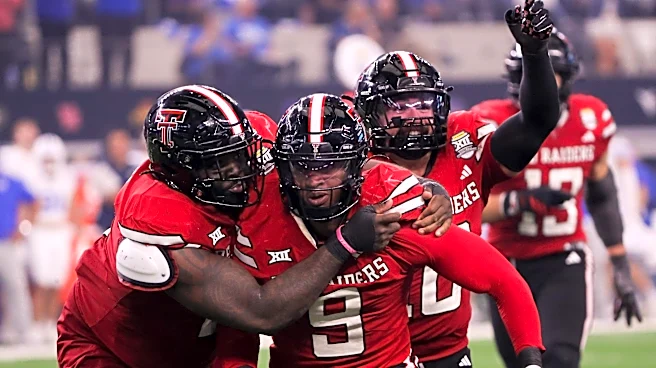
The 6’3”, 239-pound Height got a bit overlooked when people studied the Red Raiders’ awesome defensive line, but he is very much an NFL traits player. Last season, he had nine sacks and 62 total pressures in 350 pass-rushing reps, and very much like David Bailey, this guy comes off the snap like a bat out of hell. There was no better speed-rushing EDGE duo in the NCAA last season, and Height made his mark just as much as Bailey did at times. Age will knock Height down a bit — he turned 25 on April 13 — but if you want a pure speed demon in the middle rounds, he’s going to make it hard to argue against him.
Jacob Rodriguez, LB, Texas Tech

The Falcons also need linebacker help after losing Kaden Elliss to the Saints (ouch), and while the signing of Christian Harris is a decent stopgap, this defense (like any defense) needs a real tone-setter in the middle, and that was Elliss. That’s why Texas Tech’s Jacob Rodriguez would be such a great addition. There’s no guarantee that he’ll be there when the Falcons pick at 48, but if he is, general manager Ian Cunningham should run screaming to make that pick.
Rodriguez is the other player on this list that I got to watch tape with, and he just confirmed everything I love about his ability to key and diagnose. But before I get into my spiel, I’ll cede the floor to Luke Kuechly, who knows one hell of a lot more about linebacker play than I do.
Maybe let’s not make it happen, Dan. Maybe let’s get Rodriguez to Flowery Branch instead.
Last season, the 6′ 1⅜”, 231-pound Rodriguez had 94 solo tackles, 70 stops, nine tackles for loss, seven forced fumbles, and in coverage, he allowed 55 catches on 67 targets for 550 yards, 368 yards after the catch, two touchdowns, four interceptions, three pass breakups, and an opponent passer rating of 85.9. Rodriguez isn’t quite the athlete that Sonny Styles is, but Sonny Styles is going top 10.
Rodriguez looked like a better athlete during the combine drills than people may have expected, and he’s got a knack for knowing where to be, which means that he’s able to play fast most of the time without making mistakes. And his nose for the ball would be attractive for a team with a turnover ratio of plus-5 last season.
I especially liked what Rodriguez told me about playing a multi-faceted linebacker position in any new-school Vic Fangio/Mike Macdonald-style defense, where he might be the only ‘backer on the field.
“I think it’s important,” he said. “It’s just how you play good defense. You know, you try to give yourself the best advantage you can. And if you can play good defense with a light box and help yourself in the passing game, you’re good to feed the ball to those big guys up front. I think being able to play multiple spots and being able to play multiple different techniques is something you need to play as a linebacker in this age.
You need to be able to cover. You need to be able to overlap gaps in the run game. You need to be able to do all these things. And it just takes practice. It takes time. It takes work. And it takes trusting the guys around you.
Jacob Rodriguez would be a set-it-and-forget-it option for the Falcons.
Devon Marshall, CB, North Carolina State

The Falcons had some very interesting coverage splits last season. They had one cornerback in press coverage on 44% of their snaps, which was the NFL’s highest rate. But they had two cornerbacks in press on 13% of their snaps, one of the NFL’s lowest rates, and they had three cornerbacks in press on 2% of their snaps — again, one of the NFL’s lowest rates.
This, of course, is all about how well (and how often) A.J. Terrell plays in press coverage. Those guys don’t grow on trees, especially in their transitions from college football, where there’s much less press coverage in general. Let’s assume that Ulbrich would like a guy who can perform well in any coverage (because duh), and has enough press snaps to make the jump pretty seamless.
North Carolina State’s Devon Marshall, one of my favorite under-the-radar corners in this class, would qualify. Last season, the 5’11”, 200-pound Marshall allowed 27 catches on 62 targets for 308 yards, 89 yards after the catch, two touchdowns, two interceptions, 12 pass breakups, and an opponent passer rating of 56.4. When he’s in off coverage, which he was on 48 of his targets, he has a great ability to read the quarterback and jump the route. In press last season, he allowed just five catches on 14 targets for 72 yards, one touchdown, two pass breakups, and a lot of frustrated receivers who couldn’t shake him from the snap to the catch point.
I haven’t seen a lot of buzz about Marshall, but I loved the tape, the versatility, the controlled aggression, and the ability to read the quarterback’s intentions. The ball skills are good, and can get better. Everything else is there.