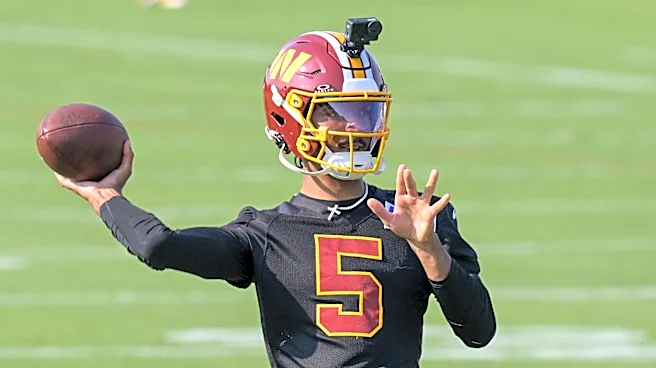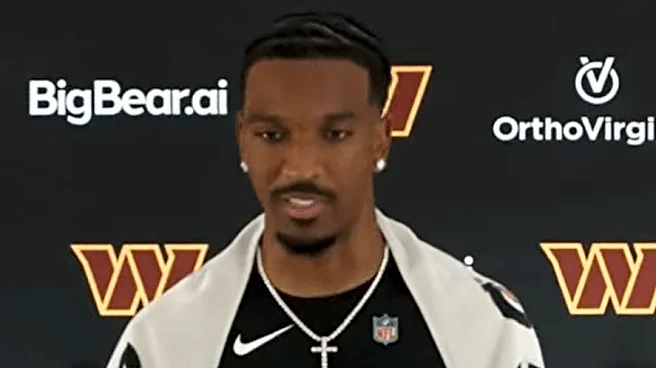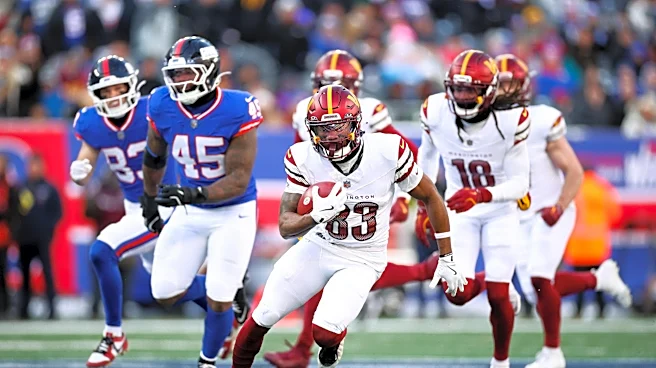



When Jaylin Lane was selected in the fourth round of the 2025 NFL Draft, Adam Peters made it clear the selection was endorsed by everyone in the building. Part of the reason was the Virginia Tech alum was their No. 1 punt returner in the draft. Lane met expectations with two punt return touchdowns, which tied for the league lead last season. His 314 punt return yards were good for eighth-most, and his average of 13.7 yards per punt return finished fifth-best.
Peters also drafted the wide receiver for his speed and versatility in the passing game. Despite his success on special teams, Lane has become something of an afterthought in the receiver room headed into his second season. Analysts are predicting either Treylon Burks, Luke McCaffrey, or Dyami Brown will have a bigger role than the Commanders fourth-round selection. In this article, we will look at why one of the team’s fastest skill players is currently being slotted towards the bottom of the receiver depth chart, and what the reasonable expectations should be for his sophomore season.
The first thing to discuss regarding Lane’s rookie season is his drop rate. Fan perception is that it was unusually high but, in fact, Pro Football Reference only credited Lane with one drop for a rate of 3.1%, which is well below the league average of 4.0% in 2025.
While clearly at least one more drop could be credited to Jaylin, his total on the season still wasn’t excessive. Lane wasn’t known for having an issue with the drops coming out of Virginia Tech, with only 12 dropped passes on 294 targets at Middle Tennessee State and Virginia Tech. The problem is those drops came in key moments that altered the perception of his performance. There is a strong possibility the moment may have been too much for him in his rookie season, and he will be able to resolve this issue with a full offseason and less pressure to carry the offense.
The other issue with his receiving ability revolves around a similar, yet different metric, catch rate. Catch rate is simply the number of passes a receiver catches divided by the number of targets in his direction. Targets can be hard to assess — there are some passes that get arbitrarily assigned to a receiver even though they’re not remotely catchable or get batted away before the receiver has a shot at catching the ball. Still, a receiver’s catch rate is a worthwhile measure of efficiency. Lane’s 2025 catch rate was 50%, well below the 62.4% league average, which leads us to the next part of the discussion— route running.
While drops certainly play into catch rate, part of the reason his production was down on 32 targets was due to his route running. While going from starter Jayden Daniels to backup Marcus Mariota accounts for some of it, Lane’s lack of timing and refinement on his routes resulted in several missed connections. Coming into the league, Lane was not known as a great route runner, needing to work on being more consistent and fluid while adding separation at the top of his routes. While it was by no means perfect, Jaylin did demonstrate significant improvement over the course of his rookie season.
Lane’s All-22 film from the Bengals preseason game showed some early promise, as he gains separation by driving the corners off balance with his speed, but it also highlights how he lacks variation and nuance in the timing of his routes. Most of Lane’s routes are run at 100% speed.
Over the course of the season, Jaylin started to add to the mix. Below you can see it against Tyrique Stevenson in the Bears game, and then later in the year versus Pat Surtain.
While the double move is impressive, I would like to focus more on Lane’s route versus the Broncos. Initially, you can again see how Lane uses his speed to eat up the big cushion Surtain gives him, and then takes a subtle jab step at the 45-yard line to gain some space before breaking his route inside. There isn’t a huge amount of separation as Surtain recovers quickly but, given the cornerback’s talent level, it is impressive. This may have been a completion if Mariota didn’t have quick, direct pressure in his face.
While his route skills have improved, Lane still won’t consistently win on press coverage and needs to be schemed open to utilize his speed and yards-after-catch ability. Prior to his rookie season, I detailed ways then offensive coordinator Kliff Kingsbury could use his play-calling to maximize Lane’s skill set, including switch releases, stick routes, and screens in the short area of the receiving game. Possibly due to Terry McLaurin’s absence, Kingsbury went almost the complete opposite direction with the wide receiver’s utilization, making Lane into more of a vertical threat. His average depth of target was 13.3 yards last season. Instead, Deebo Samuel was the one moved around the formation and heavily targeted in the underneath passing game (ADOT 5.2) with varying levels of success. Below is a route diagram Bobby Peters of Alert The Post drew of one of Kingsbury’s plays last season.
You will note how the diagram demonstrates Kingsbury’s use of the vertical passing game to help clear out the underneath with crossers happening well down the field. Kliff typically had Lane playing on the outside or in a stasis role, instead of using him in motion or underneath. Conversely, new coordinator David Blough’s offense is expected to utilize multiple players with Lane’s type of versatility that can split wide, line up in the slot, and take sweeps off designed runs. The offense is expected to target the short-to-intermediate portions of the field, and there should be opportunities to get multiple players in space where they can use their speed and quickness to create yards after the catch. For a visual reference, here is another diagram from Bobby Peters on how Ben Johnson utilizes stick combinations.
Washington’s prospective offense and Lane’s development both appear to set the receiver up for an improved sophomore campaign. But in order to realize his potential within the offense, Jaylin needs to earn his place within it. Competition for snaps will be greater this season than last, with the addition of TE Chig Okonkwo and WRs Antonio Williams, Brown, and Van Jefferson. UDFAs Jaden Bradley and Chris Hilton Jr. will also push for a spot on the team. So far, Lane has been keeping pace, returning from a December ankle injury for full participation in offseason activities and minicamp.
He continues to work on his route running and footwork, and Dan Quinn singled him out during those sessions, saying “You see it, I think [WR Jaylin] Lane is taking that step that you’d hope to see a player take from Year 1 to Year 2 of what it can be.”
As training camp gets rolling, Lane will need to make his mark early to win a spot in the rotation. He has the talent and speed to push players like Luke McCaffrey and Dyami Brown for snaps this season. Importantly, the Commanders’ new offense should give him a chance to show it.