





Every other Friday throughout the course of the 2026-27 season I am going to take a look at some numbers from the Pittsburgh Penguins that stand out to me, what importance they might have and what they might mean.
Let’s get it started today.
1. Ben Kindel’s offense
It is not a stretch to suggest that Ben Kindel has been the Penguins’ best player through the first four games. He not only looks bigger, stronger and faster than the 18-year-old version we saw as a rookie, but he has also been one of their
most productive players and is making an impact every single time he is on the ice.
Entering play on Friday his 5.41 points per 60 minutes of 5-on-5 play not only rank him tops among all Penguins forwards with a minimum of 25 minutes, they place him 10th in the entire NHL among all NHL forwards.
Of course it’s a small sample size, but he has already established himself as a good, two-way NHL player at an incredibly young age. If the offense follows he really starts to become somebody you can build around.
I will say it again, and I have been guilty of it as well, but we are underselling his upside. His ceiling is not the second line. Not only based on the production or numbers, either. He just seems to have “it.”
The work ethic. The mindset. The desire. The drive. All of it.
2. Give Nicholas Robertson a longer leash on the top line
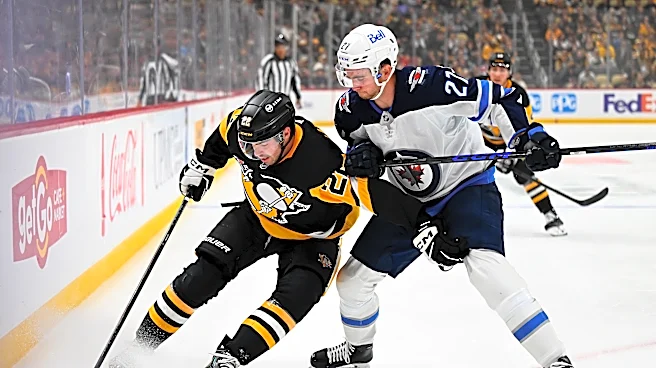
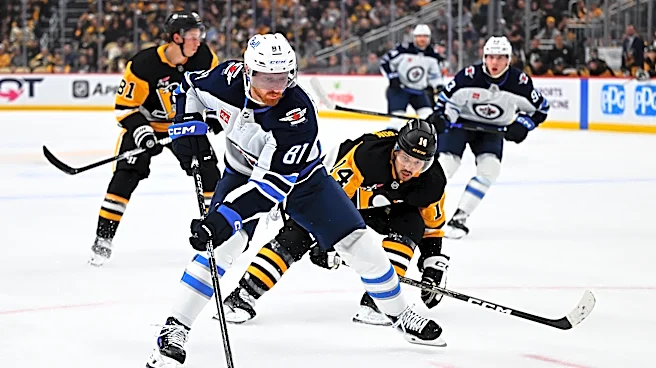
I understand why he is doing it (to a point), but one of my early season criticisms of Dan Muse is that he’s not giving much of an extended leash to some of his line combinations. It’s early, he’s still trying to figure out who works well together and who doesn’t, and he is also dealing with an overflow of forwards that all need to play. There will be some juggling. Especially if the team is not getting wins and playing sloppy at times. But I really didn’t like Nicholas Robertson getting bumped down the lineup and off the top line after one bad game, and really, only one bad turnover against the Winnipeg Jets.
Not only is Robertson doing what he has always done offensively (score a lot of goals in his limited minutes), but the Sidney Crosby-Rickard Rakell line was playing at its best when he was next to them.
The numbers for Crosby and Rakell with Robertson vs. without him.
Small sample sizes, yes. But everything at this point is a small sample size. Those are also two dramatically different small sample sizes in terms of results.
As soon as Robertson did not clear that puck that led to a goal against Winnipeg he was immediately demoted. It’s not like the other alternatives have worked better.
Coming into this season Robertson was one of the NHL’s best goal-scorers on a per-60 minute basis. He already has three goals in four games this season (including two during 5-on-5 play). I know Rust on that line is the security blanket for everybody, from the head coach to the captain, but I would like to see the line that was cooking early on get a little bit more of a run.
3. Ville Koivunen: Still a fancy stats All-Star
Koivunen had some of the best underlying numbers on the Penguins roster a year ago, and through his first three games this season he is doing it again.
The Penguins have a 71 percent expected goal share when he’s on the ice, and unlike last year, it’s actually producing better results on the scoreboard. Both for him and the team.
Not only does Koivunen already have two points in his first three games, but the Penguins are outscoring teams 5-0 when he is on the ice. Is he directly responsible for all of that on his own? Of course not. But he’s clearly making a contribution, and the eye test backs that up. I loved the play he made to start Declan Carlile’s goal against Winnipeg. Fascinating player to watch develop this season for a lot of reasons.
4. Blake Lizotte is putting in work
Lizotte only has a single assist this season, but the numbers around his play are painting a pretty strong picture.
Among those numbers:
- The Penguins have a 74 percent expected goal share when he is on the ice.
- Individually, he has generated 1.95 expected goals per 60 minutes. No Penguins player that has played at least 25 minutes this season has a higher number (Crosby, by the way, is second at 1.75, while Robertson is third at 1.02).
- He is doing all of that while getting the heaviest defensive zone starts on the team, getting only nine offensive zone starts and 24 defensive zone starts.
- The Penguins have also allowed just one 5-on-5 goal in his 41 minutes.
Hard to ask for more from a fourth-liner.