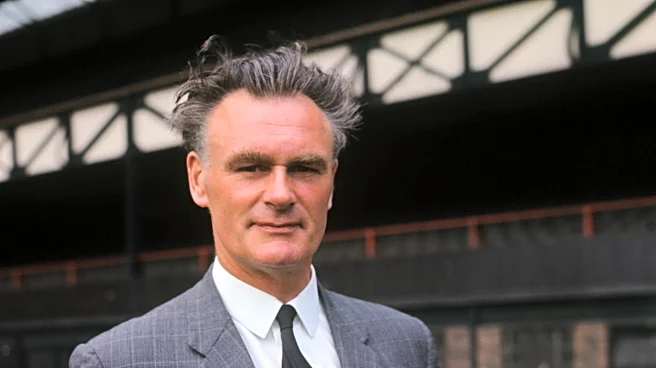

Alan Brown is a strange figure in Sunderland’s history on paper. If you purely look at the fact that he was in charge during Sunderland’s first two relegations in the club’s history, you might be forgiven
for looking at his legacy in a certain way.
Brown’s arrival in 1957, however, came at a time when the football club was in the middle of a series of scandals involving illegal payments to players while at the same time fighting against being relegated for the first time. In those circumstances, it was maybe no surprise that at the end of the first season, Sunderland slipped into Division Two.
It took two years of struggling in the second tier – finishing 15th & 16th in the first two years – before Brown rebuilt the club by trusting in youth, to become promotion contenders. Even two years of Brian Clough’s goals saw Sunderland narrowly miss out until promotion was finally achieved after six years outside of the top flight.
Alan Brown had achieved his goal at this point and returned the club to the position where he found it, and fans could look forward to a season in Division One under Brown. But that didn’t happen. Just two weeks ahead of the 1964-65 season, Brown resigned – a long story that had something to do with the purchase of a house in Roker, amongst other things – and ended up as manager at Sheffield Wednesday.
The directors selected the team until November, until George Hardwick steered the ship to a 15th-place finish, which meant survival. Hardwick was a temporary manager, however, and in the summer of 1965 Sunderland looked north and appointed the Scottish national manager Ian McColl as the new man in charge.

McColl’s first game in charge on the opening day of the season was also Jim Baxter’s debut, which raised optimism around Roker as the transfer fee of £72,500 was the highest ever paid to a Scottish club at the time – but the game ended in a narrow defeat at Leeds United via the only goal of the game.
By the time Alan Brown’s Wednesday arrived at Roker on this day in 1966, for a game that was rescheduled on January 15th due to a waterlogged pitch, the Lads had won only once in the previous eight games – a 2-0 win against the visitors, which left McColl’s side perilously close to the relegation places.
The problems were piling up for the Sunderland manager ahead of the game as he was missing Charlie Hurley and Jimmy McNab, as well as Baxter, who was beginning a fourteen-day suspension.
In a hard-fought affair, Sunderland struggled to make the chances count as Jimmy Montgomery kept Wednesday out at the other end. This was especially true in a frantic end to the goalless first half, where both sides were unfortunate not to take the lead.
Just over ten minutes after the break, however, Wednesday took the initiative. John Hickton was the architect who played in John Fantham, who was suspiciously in an offside-looking position, and Fantham controlled well, rounded Montgomery, and shot into an empty net.
Sunderland threatened to get back on level terms, but five minutes from tim,e the game was put out of sight when Jim McCalliog beat Martin Harvey and then smashed a 25-yard drive past Montgomery and into the net. The jeers arrived from the Roker crowd at this point, who made it clear they weren’t happy with the defeat, especially to a side led by Roker manager Brown.
Division One
Roker Park
Sunderland 0-2 Sheffield Wednesday
[Fantham 57’ , McCalliog 85’]
Sunderland: Montgomery, Irwin, Ashurst, Parke, Harvey, Elliott, Hellawell, Herd, O’Hare, Martin, Mulhall Subs: Gauden
Sheffield Wednesday: ASpringett, Smith, Megson, Eustace, Mobley, Young, Usher, Fantham, McCalliog, Hickton, Dobson Subs: Quinn
Attendance: 25,033