


Doubles are cool.
This was the major realization I came to half asleep on my couch after the Marlins offense recorded their third lead-off double in as many innings off of Giants starter Adrian Houser.
In my groggy state, I continued to muse. Is it better to hit a lead-off double than a lead-off home run?
A dumb question in one sense with a simple answer: in a game of preventing runs, one swing equals a run, one swing does not. I’m sure many arms would take the second chance of preventing a run. But
with some flips, stretches, and somersaults of mental gymnastics, it can be like the solo shot never happened. There is no evidence of it left on the base paths. The pitcher can just go back into his wind-up and start again, start over. The presence of the double lingers. The double changes behavior. The pitcher has to throw from the stretch to keep an eye on the runner lurking behind him. The middle infield defense gets pulled out of shape to manage the runner’s lead creating less-than-ideal gaps in their alignment, perhaps making a less loud but just as effective hit more likely. A slow roller slapped through the 5.5 hole, good for an RBI single, another hitter becoming a runner, meaning more stress for the pitcher, dividing their attention.
Would Adrian Houser have preferred Jakob Marsee’s 107 MPH double in the 1st to have cleared the wall in right? Trading the one run and a chance to restart rather than the eventual three runs to come around as well as the stress of managing the running game, of pitching for consecutive strikeouts. Houser was so close, one out away from stranding Marsee at third. He fanned Kyle Stowers on three pitches. Otto Lopez got beat by a hanging slider for another strikeout.
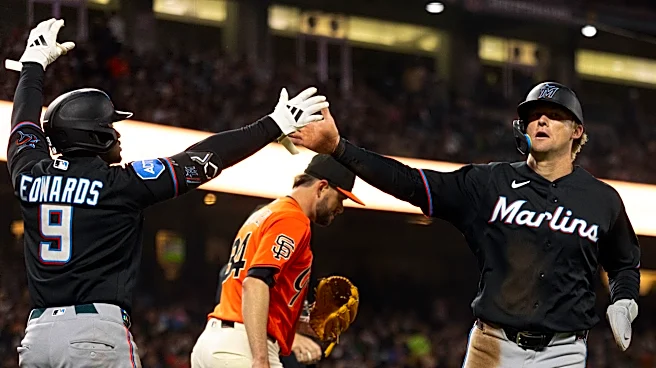
But as the inning pitch count grew, Houser’s location around the zone got wonky, putting him in a 3-1 hole to a dangerous hitter in Xavier Edwards. Then he overcorrected and grooved a four-seam fastball right down the middle that Edwards turned on easily for an RBI double. A double that rescued the inning for the Miami offense, broke the seal on the scoring, and really won Miami the game. Five pitches later, hot-hitting Liam Hicks punched a 2-run shot over the bricks in right.
A double might be my favorite hit in baseball — at least that’s what I decided as I watched from the couch as Edwards’s low liner short-hopped the right field wall. I like seeing a batter leave the box and know they have to become a runner. I like that brief moment when watching on television you see the ball leave the bat and shoot out of frame. You see through the hitter’s eyes. They get wide, calculating, and you know that wherever it lands, tucked along the foul line and burying itself in the corner or splitting the outfield defense in the gap, that it’s going to be trouble.
It must feel so good to hit a double.
The Giants doubled their hit total from their previous game against Tyler Glasnow within the first three hitters on Friday night. That was nice, but they just couldn’t figure out a way to make it mean something. Rubbing two sticks together supposedly makes fire. Two hits rubbed together supposedly make a run too. Just not when the Giants do it. The two singles off the bat of Luis Arraez and Matt Chapman made smoke, but no flame.
The secret: doubles help. Double plays don’t. Don’t be fooled: double plays are not doubles.
Have the Giants ever hit a double?
I legitimately wondered this after the first inning. I understand that individual players who wear Giants uniforms have hit a double in their career, but like…when?
Going into the game the Marlins and Giants were actually tied with 40 doubles total in their first 25 games. Fangraphs team leaderboard said that — but I didn’t believe that. 40? That seemed really high. And tied with the Marlins? After Friday night’s first inning, not anymore.
Then the number continued to get more outdated. The Marlins doubled four times in the first three frames. Three of those doubles led-off innings, and all of those doubles eventually scored. In the 4th, when the lead-off man didn’t double, he still reached second with nobody out, and he still scored.
Doubles aren’t everything though. Patrick Bailey didn’t hit a double last Wednesday. He hit a home run. That’s a double double. Unfortunately the Marlins did that too. Hicks in the 1st, and then number-9 hitter Connor Norby launched a 3-run double double in the 4th. That’s two times. Double double doubles.
How come the Giants can’t do that? How come they can’t hit doubles and double-doubles that ring out across the stadium like a lonely toll of a church bell, like a hammer hitting a nail into a coffin? Rafael Devers hit a double on Wednesday, but that was Wednesday. And it didn’t even score a run. It didn’t ring out or announce anything or intimidate. It didn’t mean something.
Casey Schmitt and Heliot Ramos both had a double last Sunday in Washington, but the Giants got shutout in that game, so they didn’t mean anything either. Schmitt and Ramos did double in the 2nd and 3rd innings in their 7-6 win last Saturday. Going back through the records, it appears that these doubles, did in fact, contribute to a couple of runs. So to answer my previous question, that was the last time the Giants hit a double, a real one.
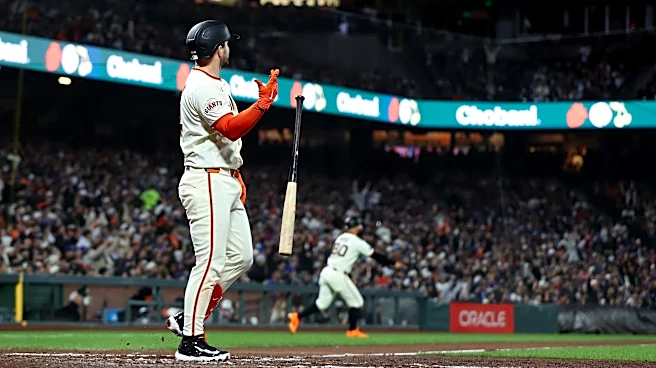
All this double talk, and they manifested. Heliot Ramos yanked a one-out double in the 5th off Miami starter Sandy Alcantara. And Eric Haase with another double, scored Drew Gilbert from first after his RBI single. Arraez then cashed in Haase with a 0-2, 2-out slap to the opposite field. That was rubbing sticks together! That was the arithmetic that was missing: A pair of doubles plus a pair of half-doubles equals three runs.
But were those real doubles? Like an Xavier Edwards double? A double that means trouble?
Their timing was way off. Already down 8-runs — the long-awaited doubles didn’t do much to change the tone of the game. Better to have them than not, sure. There was potential and opportunity in those three runs, each one of them essential in constructing a comeback, in building momentum — but momentum can’t stop, it needs to keep building. Those “comeback runs” lose their value as “comeback runs” the moment the opponent takes back those runs. The Marlins did that. They did that with a two-out double, another half-double, off of JT Brubaker the very next frame. There was hope in an 8-3 deficit. Only confirmation of defeat in a 9-3 deficit.
Overall, the Marlins lined six doubles in the game and eight total extra base hits. They collected 11 hits in total, producing eight earned runs in the first four innings, inflating Adrian Houser’s ERA nearly two points, from 5.40 to 7.36. In five starts, the right hander has pitched through the 6th inning once, and surrendered at least 4 earned runs in four outings.
Lee recorded his second homer of the year. The solo shot in the 8th ended up in the Cove but didn’t clear the railing on the walkway below to count as an official splash hit. Both Arraez and Lee had three hits apiece. They’ve been doing their job in the box, but their job just doesn’t add up to much without contributions from Adames and Devers and Chapman, who went 1-for-13 on Friday night. Devers has yet to get hot. Adames has been in a nose-dive for awhile now. Both seem to be perpetually in an 0-2 count and have little feel for the zone. Of the three, Chapman has the highest OPS at .703.
Singles need doubles.