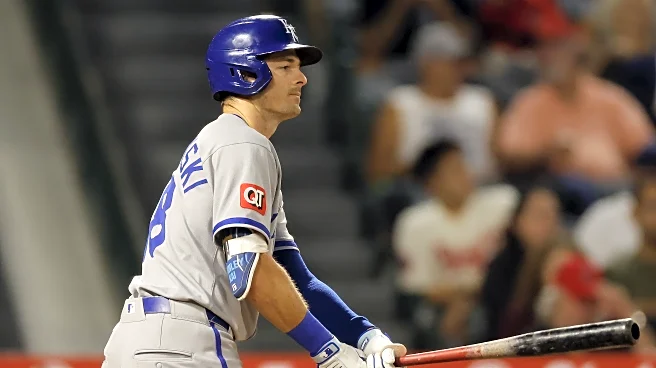

Love it, like it, dislike it, or hate it, the Mike Yastrzemski signing is done. The Braves are now committed to a fourth outfielder for multiple years, and will potentially end up exercising his club option
for 2028 given the size of the buyout ($4 million) relative to the salary ($7 million).
While there’s infinite space to argue about the merits of the move, either in a vacuum or in the context of what the Braves already have on the roster, I find myself worrying less about what Yastrzemski will do — both because he’s been so consistent to date, and also because he’s not making enough for it to go horribly wrong relative to expectations — and more about what his signing means in terms of broader team strategy. Here are some specific things I’m thinking about:
Moving away from a rigid starting nine
It remains to be seen whether the Braves will actually do this, and it’s unlikely it will matter once the inevitable spate of injuries takes hold, but at the moment, it looks like the Braves have committed to a pseudo-platoon. Specifically, with the guys on the roster right now, my guess is the tentative plan is:
- Against RHP: One of Jurickson Profar or Ronald Acuña Jr. gets the DH spot, Yastrzemski starts in their place in the corner outfield, and Drake Baldwin catches. You could add some more stuff here about how Yastrzemski should bump Profar to DH with a lefty starting for the Braves (Chris Sale or a fill-in like Joey Wentz or Jose Suarez), and bump Acuña to DH with a righty starting for the Braves, but given that the Braves are mostly right-handed in the rotation and the fact that only Spencer Strider has a particularly notable fly ball rate, I’m not sure anyone is going to get that specific with it.
- Against LHP: Yastrzemski sits (since he has not hit lefties at all in his career), Sean Murphy catches, and Drake Baldwin slides into the DH spot.
This arrangement is perhaps not optimal with regards to the specific personnel: ideally, Murphy would catch more, while Baldwin stays in the lineup, given his defensive value — but as of right now, I don’t see the Braves doing something like benching Profar against some RHPs to get Murphy some extra starts.
In any case, this is a deviation from what the Braves have tried to do the last few years, i.e., start everyone every day. While the Braves under this regime have not been strangers to platoons altogether (Adam Duvall and Eddie Rosario, for example), they’ve become at least somewhat estranged from the idea, and this looks like a bit of a re-acquaintance.
Is depth the new thing? (Or is this more a matter of opportunity?)
The Braves have, at times, wheeled hard around to prior-year issues. The terrible bullpen at the start of 2019 led to heavy investment in bullpen spending thereafter. The rotation being a shambles for the 2020 “season” led to investment in Charlie Morton and Drew Smyly. Though not quite the same, the Braves gave Eddie Rosario a pretty ill-advised deal after their outfield was exposed in 2021. While this is more speculative, you could argue that adding Profar and changing the team approach was a response to persistent xwOBA underperformance and other issues in 2024. (We’ll get to more on this later.)
Many things killed the Braves in 2025, but having to start some absolutely awful performers for long stretches was one of them. By adding Mauricio Dubon and Yastrzemski, while having two strong catchers, and an out-of-options Eli White has basically wheeled the roster around to the exact opposite… provided that Dubon actually functions as a super-utility guy or handcuff to another season of Ozzie Albies struggles with the addition of an actual starting shortstop.
Given that the Braves don’t have said actual starting shortstop at the moment, this situation can break either way. If they don’t add one, then the moves we’ve seen to date are less a deliberate attempt to fix the depth issues from 2025 (and earlier) and more just some opportunistic moves, given that Dubon is a one-year commitment for a modest salary, and Yastrzemski can provide part-time starter-level production without a starter-level salary outlay. If they do, well, then the Yastrzemski move was an intermediate step in a plan-coming-together effort that would elate Mr. T.
The elephant named “Braves offensive approach” hanging out in the clubhouse and dugout
When the Braves let Kevin Seitzer go, my main concern was not the future absence of Seitzer, but what that meant for a team that had built itself around a very specific offensive approach for a half-decade and then struggled with severe offensive underperformance that almost derailed their 2024 season. That concern only grew when Tim Hyers came aboard and immediately started giving quotes to the press that involved very little of said specific offensive approach, and instead focused on things that offensive approach purposefully eschewed. The Braves signing Profar was further suggestive, given that even with his breakout, Profar was more of an “all of the above” guy than a guy very deliberately trading in-zone contact (and a bunch of other things) for contact quality and power production.
Well, you know the rest of the story. The concerns became manifest, as the coaches kept talking about things other than mashing the ball through Spring Training and the start of the season, the chase rate contest was a thing, and the team walked a lot (and talked about walking a lot) while a bunch of guys struggled to adjust to the new directive, in whole or in part.
Well, now we’re heading into 2026, and Tim Hyers is still employed amid a substantial coaching turnover. Dubon isn’t much of a hitter in general, but he’s a low-whiff, contact-over-everything-even-if-I-have-to-chase-to-get-it slap hitter with a slow (but long, for some reason) swing and abysmal, near-worst-in-class contact quality. (On a side note, can someone finally change Dubon’s swing so that it stops being both slow and long? One or the other, and given that his bat speed dropped precipitously in 2025, I’m guessing shortening it up is the way to go. It’s not like it could hurt much given his overall hitting acumen.) And now, we have Yastrzemski in the mix.
Yastrzemski is also not a very Braves 2019-2024-ish hitter. He’s a guy with moderate slugging, whose power has declined as he’s aged through his 30s (which has been much of his career given how late he made his MLB debut). While his production has been more consistent than his component pieces, he tends to have good contact quality while garnering both a lot of walks (because he doesn’t chase much) and a lot of strikeouts (deep counts plus the fact that he’s not super contact-oriented). Last year was a bit weird for him, especially once he got traded to the Royals, as he ran a really high contact rate without dramatic changes to his swing decisions or his contact quality. In any case, it’s hard to guess what Yastrzemski is going to do for the Braves given his continued descent towards an age-based end to his career and his 2025 being a bit of a c-c-combo breaker for his offensive trends earlier, but whatever it is, it probably won’t look very much like a prototypical 2019-2024 Braves hitter.
So, given only what we know now, reading the tea leaves on team offensive approach is… not gladdening? The Braves haven’t added anyone that looks like a Braves PowerPoint_old.pptx hitter, and they’ve added a slappy guy and a walk-y guy this offseason. There aren’t very many shortstop options out there for the taking, but if they manage to reunite with Ha-Seong Kim, well, the lineup will be multidimensional at best and overly 2025-y at worst.
None of this is directly an issue for Dubon, or for Yastrzemski, or even for someone like Matt Olson, who managed to walk enough to offset diminutions elsewhere until he just said “screw it,” changed his place in the box and a bunch of other things midseason, and went on a homer binge down the stretch. (Drake Baldwin is another guy who seemed to have a best-of-both worlds approach in a lot of ways.) But to the extent that team success in 2026 still relies on positive contributions from guys like Albies and Michael Harris II, I’m not sure this is a positive sign. We’ll have to wait and see.
Anyway, those are the things I’m thinking about in the context of the Yastrzemski addition. What about you?