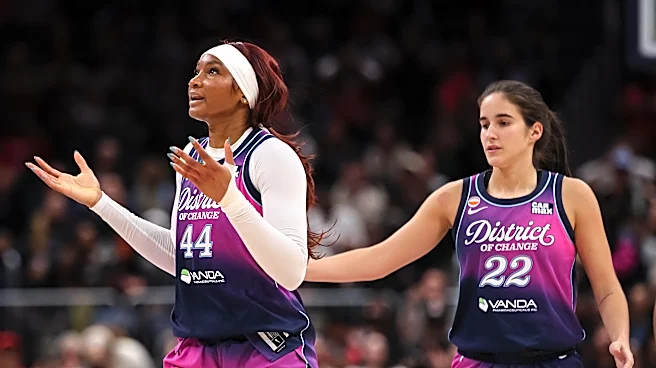





The 2026 Washington Mystics made the playoffs as the youngest team in WNBA history, in addition to setting a franchise record with 28 total wins.
The overwhelming reaction to the Mystics is that they’re here to stay, and will be somewhat of a perennial contender under the current core.
And while I don’t think that’s a unreasonable claim, there’s some context that has begun to be swept under the rug of Washington’s wins.
Jamila Wideman’s legacy lingers over the present and future of the Mystics

A name that has been quickly forsaken in the wake of Washington’s success is Jamila
Wideman. Wideman flew into the nation’s capital as the team’s alongside head coach Sydney Johnson, positioned to direct Washington’s future from the front office as general manager.
She excelled in that expectation.
Wideman drafted Sonia Citron, Kiki Iriafen and Georgia Amoore in the 2025 WNBA Draft. She stockpiled three more first-round picks for the 2026 draft. She cut loose Brittney Sykes, a pivotal player in recent Mystics history who, nevertheless, was the antithesis of Washington’s precise roadmap. Wideman carefully molded the pillars of Washington’s temple, and on the first day of free agency in April, she was released.
Wideman’s departure has been oft-cited as a difference in vision between her, Johnson and Michael Winger, Monumental’s president of basketball. The exact rift is unclear.
What’s known is that much of Washington’s success was set through chess moves of Wideman herself. She condemned the 2025 Mystics to an early offseason when she traded away Sykes, but that gave Citron, Iriafen and Shakira Austin the freedom to develop into ball-dominant players. She took the public blow of missing the playoffs in the interest of her team’s future, but isn’t here to bear the fruits of her labor.
Why does this matter, though?
Washington made the playoffs without Wideman. Johnson and Winger delivered on a promise of hope and potential. They’re positioned to have one of the brighter futures in basketball. What does it matter that Wideman isn’t around to bask in the sunlight?
The Mystics succeeded in spite of obvious issues that should have been addressed

Winning wants to cure all ailments, but it doesn’t.
Wideman’s legacy matters because she mixed the colors for the 2026 Mystics to paint with. There still isn’t enough evidence to suggest that the new front office—or lack thereof, as the Mystics have no general manager—is capable of maintaining the team’s upwards ascension.
The Mystics current operations team is responsible for three main roster moves: the 2026 draft selections, signing Michaela Onyenwere and signing Betnijah Laney-Hamilton. Onyenwere was a solid starter, and Laney-Hamilton was a reasonable low-cost signing late in the season. Neither were “pivotal” to the Mystics success, but they helped.
But let’s have an uncomfortable conversation in the shadow of Washington’s playoff run.
How much did three first round picks contribute to the team’s seasonal success? Widemen delivered one of the greatest draft classes in league history in 2025. Has the new front office proved anything with their 2026 selections?
Lauren Betts felt like a “must-pick” player for value, but she fits awkwardly into the Mystics present and future. Behind Iriafen and Austin will she ever get to shine? Angela Dugalić barely saw the court and never felt like a necessary archetype for what Washington was building. Cotie McMahon may have been their most impactful pick, but even she was a strange type of player to take knowing that Washington’s biggest weakness was shooting. Maybe Wideman had different opinions on draft strategy, and that’s why she was released. Maybe that’s not it at all! We have no way of knowing where Wideman differed in opinion, but her draft choices were franchise-changing, while the 2026 class was not.
Johnson knew that Washington’s biggest weakness was 3-point shooting. That was a message he conveyed with power during last season’s exit interviews. With three first round picks and an abundance of free-agent flexibility, did they address that whatsoever? For the second-straight year, Washington finished last in 3-point attempts. They finished second to last in makes, and third to last in percentage. Their team three-point percentage dropped from 32.9 percent in 2025 to 32.3 percent in 2026.
Washington didn’t struggle from distance due to ignorance. Johnson was well-aware that his team needed shooting. So who should be responsible for the gross failure to address that weakness? Is it a failure of front office and roster construction? A failure of development staff?
It would be irresponsible to wash away such a strange story just because Washington had the privilege of getting swept in the playoffs. Washington’s biggest issue against the Dream was turnovers, but it didn’t help that they shot 31 percent from 3 in both contests.
Greatness requires some uncomfortable conversations.
It’s important to fully understand why the Mystics overachieved in 2026

It feels admittedly strange to not rave about the most fun Mystics team since 2019.
They have some generational players who sell tickets and take wins from the league’s best. Johnson is a strong leader and a proven coach who led this team well beyond expectations.
But context will always be necessary.
How much of the 2026 Mystics success came from the banished Wideman, and how much came from the current shell of a front office?
As Mystics fans or just WNBA fans in general, do you have trust in the team’s current approach to organization? Why or why not?
There are no objective truths in this. Johnson and Winger led Washington to the playoffs, and there are many realities in which they could ride this core all the way to a trophy. But nothing is guaranteed, and the Wideman situation still leaves a strange aftertaste. The Washington Mystics are in a better place than they were two years ago, but none of that matters if they lack the resources or direction to continue growth.