
In Economics, there is a fairly basic concept known as the law of marginal utility. We usually explain this to students through the use of pizza. Each slice of pizza is a little less satisfying than the one
before it. This lesson is usually taught at a similar time as the law of diminishing returns. They are similar concepts and both have a ton of relevance for big league baseball teams.
One of the more infamous lines from “Blazing Saddles” was when Mel Brooks character (the governor) said, “we gotta do something to save our phony baloney jobs!” I imagine the job of general manager is the same in many instances. Executives want to look like they are actually doing something. It comes down to being able to explain yourself when things don’t work. If you can point to moves that were popular at the time then you can plausibly deny responsibility for the failure.
Of course, this is organizational groupthink we are describing. This has little to do necessarily with what Dana Brown or Jim Crane might be thinking. It is an industry wide issue. We can illustrate this psychological dilemma with the Astros backup catcher situation. The Astros need a backup catcher now that Victor Caratini is in Minnesota. The temptation is to panic and go out and sign the biggest name available so you can show the fans you are doing something.
Some of this is about the name itself. Fans in general feel better about players they have heard of. We can dog Jeff Bagwell for hours, but he is generally right about casuals. Most people know the numbers on the back of the baseball card. Some of it is an overall perception. If Jim Crane says he is willing to spend up to the CBT then fans feel better if the team spends all of those available funds. That is true whether all of those funds are actually dedicated to making the team better or not.
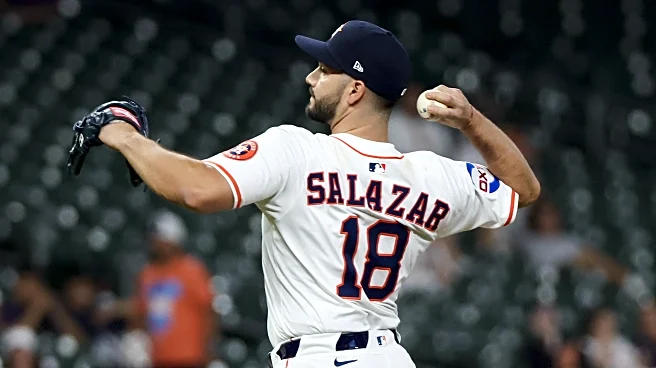
The Astros currently have two internal options at backup. Cesar Salazar has come up for brief cups of coffee in each of the past two seasons. Framber Valdez notwithstanding, most pitchers enjoy pitching to him and he comes in with high marks as a receiver. The minor league offensive numbers are not sparkling, but he is slated to be a backup catcher and those players may make 40 starts in a typical season.
The club also signed Carlos Perez to what we commonly refer to as an NRI. That stands for non-roster invitee. It is officially a minor league contract with an invitation to spring training. He has spent parts of five seasons with the Angels and Athletics, but has never done anything more than perform as a backup at the big league level. However, he has seen a power uptick since 2021 where he has hit 27 or more home runs four different times.
Those players have little in their track records to compare with Jonah Heim and Christian Vazquez historically. Thus, we get to the Bagwell theory. Those numbers have relevance only insofar as they are likely to be repeated. Thus, we get to the crux of the law of marginal utility. A player’s extra income must justify additional production. If you are paying more money for the same thing then you are overpaying. In a universe where resources are limited, you cannot afford to pay extra for the same thing. Below are the ZIPS DC projections for the four catchers mentioned. ZIPS DC stands for ZIPS Depth Chart. They include the same percentage stats, but estimate playing time based who is likely to be on the team’s depth chart.
Most of you are familiar with the basic stats here, but you may be unfamiliar with weighted on base average (wOBA). Essentially, it takes everything a hitter does and converts into a number that approximates OBP. Therefore, it can be interpreted the same way. The league average tends to hover between .320 and .33o depending on the season. So, none of these guys are good offensive players. For instance, Yainer Diaz is projected to have a .317 wOBA according to ZIPS. So, none of these catchers are going to seriously challenge Yainer for playing time.
However, all of these catchers have roughly the same value because of differences in defensive skills. In a vacuum, signing either Heim or Vazquez is defensible based on their projected overall value. According to Fangraphs, the current going rate for wins is somewhere between eight and nine million dollars. Obviously, this is theoretical in nature since many players are pre-arbitration players making pennies on the dollar, but in free agency, these rates normally average out fairly well.
So, paying a Heim or a Vazquez in the neighborhood five million or less seems reasonable on its face. If the Astros signed such a contract with one of those two then it would be defensible on that level. Yet, when you already have two catchers projected to produce the same value it makes less sense. So, each additional catcher is like that additional slice of pizza. It is just less useful than the one before it.
Depending on the source, the Astros have approximately nine million left to spend under the CBT. That might not be enough for anything really useful, but if you shed some salary here or there you could afford an extra position player or starting pitcher. That money gets eaten away when you add in a catcher that might not be any better than the guys you already have.
Organizations limit themselves all the time by chasing veterans on the margins. There is some positive utility there. Veterans can help stabilize a clubhouse under the right circumstances, and there might be the slightest of bumps at the gate. Yet, when resources are finite, the teams that do the best are the ones that resist that temptation. They either get veterans for far underneath their going rate or they rely on younger players. The Astros probably will go that direction at catcher.