


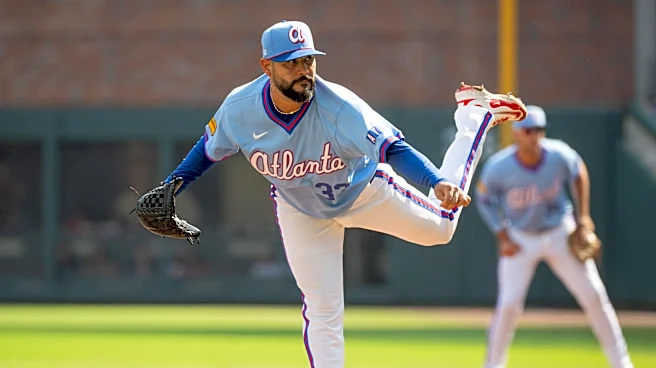

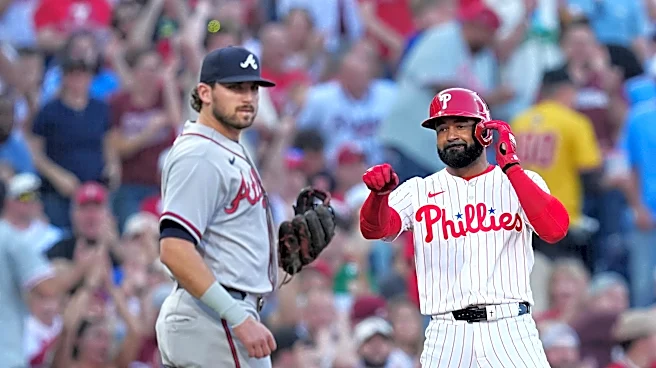
Yeah, I could’ve phrased this as a question and had the same post body anyway, but why bother when I can just make a post? After the Braves split their big series on the road against the Phillies, I have three big picture thoughts, two of which were prompted by their dramatic comeback win in Game Three.
Why is everyone, including Ronald Acuña Jr., obsessed with going the other way?
In this series, the Braves’ most common ball in play was a grounder up the middle, followed by a ball in the air hit the other
way. For the Phillies, it was fly balls to center, followed with a tie between pulled and opposite-field fly balls. The Braves managed a .180 wOBA and .167 on their 19 opposite-field fly balls in the series; they managed an .809 wOBA and .665 xwOBA on their 15 pulled fly balls.
This isn’t really surprising because yes, pulling fly balls in the air is great. But, maybe target it a bit better? Here’s the pitch plot of fly balls the other way by lefty batters:

This looks okay-ish at first glance, there’s maybe one pitch that was weirdly inside-outed, and it was Matt Olson against Cristopher Sanchez. There were some elevated balls you’d hope guys would pull, but it is what it is. And then you get the right-handed batter plot:

That’s a fair bit of basically middle-ish pitches hit the other way.
On the season, the Braves are 15th in pulled fly ball rate, but seventh in the rate of hitting fly balls the other way. But this obscures a lot of inconsistency:
- Through April: 10th and 14th, respectively
- May: 26th and 4th
- June: 26th and 15th
- July: 4th and 24th
- August-onward: 17th and 1st
You get the idea. What’s the obsession with going the other way? By the way, while being first in that last bullet, the Braves have a .302 wOBA and .297 xwOBA on those balls. That’s actually ranked pretty high — their opposite-field fly balls are better than other teams’, but… those are terrible on-contact marks in general.
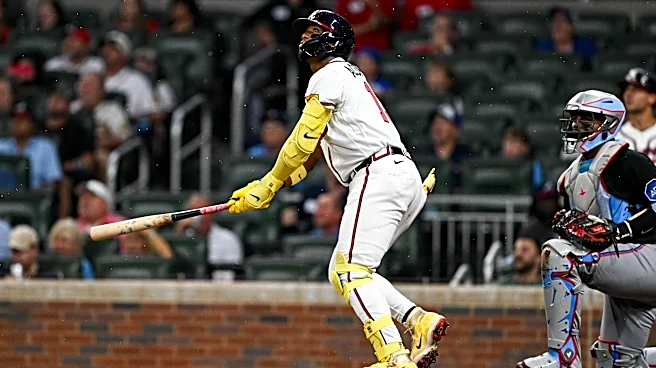
Acuña is an interesting case here. The first pitch of the series was a sinker a little bit away but squarely in the zone, and he hit a hard double into the right-center gap. Okay, he executed a clear plan there. The next time he got a pitch anywhere on the outer half was two PAs later, and that one turned into a hard groundout to second. He pulled a similar pitch but from a different pitcher (Alex McFarlane, his later victim) and turned it into an infield single.
In Game Two, he started stuff by pulling an outer-edge fastball from Zack Wheeler for a hard single. Then he homered off a Wheeler knee-high splitter also towards the outer half of the plate. The next outer-portion pitch he saw was a non-strike in both dimensions from Aaron Nola, a knuckle curve he dropped into right field for a double. But then, he got a hanging changeup down the middle on 2-2 from Nola and could only hit it weakly to right for a sac fly. Then, it was his homer against McFarlane. In the finale, Jesus Luzardo didn’t really throw him stuff outside he could poke; even his one fly to right came from basically an inside-out effort on a pitch inside. So, Acuña isn’t really the guy to pick on here, he’s at least wrapping his bat around pitches away from him sometimes.
Still, even he has a .320 wOBA / .227 xwOBA on balls in the air the other way since the start of August, compared to an absurd 1.053 wOBA / .877 xwOBA on pulled balls in the air in that span. I’ll keep hoping for some realignment in this regard.
Acuña did something amazing anyway
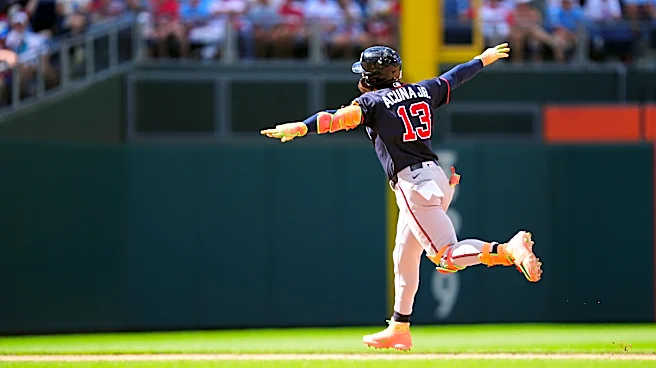
The pitch Acuña homered on was a four-seamer nearly bisected by the outer edge of the zone at 100.5 mph. Acuña got around it and pulled it into left field for a massive homer, both in terms of distance and effect on the game (and the series). This season, the highest-velocity pitch on an outer edge homered on by a right-handed batter was 98.6 mph (Pete Alonso). Acuña basically skipped two ticks relative to anyone else.
In fact, in the entire Statcast era, only one right-handed batter has homered on a pitch on the outer edge that was harder than what Acuña did on Sunday: Avisail Garcia, who took a 100.7 mph pitch from Ryne Stanek in 2017 and hit it the other way for a longball. So, there you go: Acuña turned around the hardest righty outer-edge pitch to a righty batter for a pulled homer that we know of.
This series had the Braves doing what they do best
The Braves weren’t favored to win any of these games. Two games — and in fact, the two games they lost — had some of the lowest pre-game odds the Braves have faced all season.
The Braves posted a matching .260 wOBA and xwOBA in this series. The Phillies were cut down by some poor fortune and good defense en route to a .284 wOBA and .327 xwOBA. Does that seem like it should be a series split? Okay, fine, that’s a little unfair, because wins aren’t awarded after the entire series finishes.
- Game 1 (win): Braves .303 wOBA / .269 xwOBA | Phillies .266 wOBA / .281 xwOBA. Some combination of defense and luck bails out the Braves.
- Game 2 (loss): Braves .248 / .266 | Phillies .352 / .355. Yeah, a blatant loss.
- Game 3 (win): Braves .350 / .326 | Phillies .278 / .334. A reprise of Game 1, except the Braves actually hit okay.
- Game 4 (loss): Braves .107 / .160 | Phillies .224 / .334. It’s miraculous this was a 1-0 game.
It amuses me that the Phillies compiled 0.7 more fWAR than the Braves in these four games, yet both teams won two games. But that’s par for the course. The Braves are now 85-59, and have just 73 WAR-wins based on fWAR. While there is probably some assumption that over time, a team’s record would trend closer to its WAR-wins record just due to adding extra sample that aligns… the Braves are once again defying the odds in this regard, pulling further away. There isn’t really enough time in the season for any of this to be “fixed” unless they hit basically a gigantic September collapse, and I don’t expect it to be “fixed” because the team itself is fine. It’s just… weird. And they used that weirdness to split with the Phillies.
I continue to be amazed that the Braves have avoided the bottom dropping out despite whammying themselves into stupid (stupid-bad, not stupid-good) offense after July, but it is what it is.
If this were a question post, I guess I’d ask what takeaways you had from this series split. Feel free to drop those in the comments, I guess.