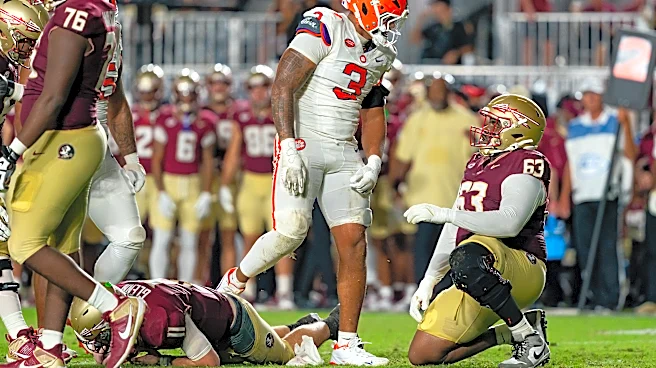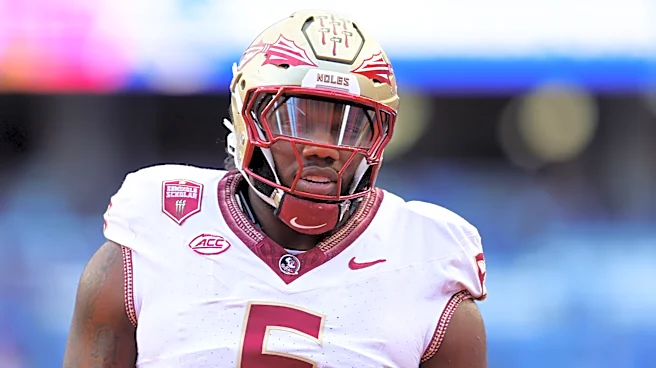



The Las Vegas Raiders are heading into the 2026 NFL draft with a big need (literally and figuratively) at nose tackle. It’s one of the biggest holes on the roster, which should put Florida State’s Darrell Jackson Jr. on the Raiders’ radar as a mid-round option. According to NFL Mock Draft Database’s consensus big board, he ranks as the 87th prospect overall and could be an option in either the third- or fourth-round for Las Vegas.
Granted, Jackson doesn’t have a ton of experience lining up at nose
tackle, recording just 288 snaps in the A-gap over the last five seasons, according to Pro Football Focus. He was used as more of a versatile interior defensive linemen, playing anywhere from a 4i-technique (inside side of the offensive tackle) to head up on the center. So, he can bring some position flexibility to the Raiders’ defensive line, in addition to owning the physical profile and run defense chops to fill the void at nose tackle.
In 2025, the 6-foot-5.5, 315-pounder ranked third among ACC defensive tackles with an 81.3 PFF run defense grade and was tied for first with 23 ‘defensive stops’ against the run. A big reason for those numbers is that he possesses the requisite strength and length (nearly 35-inch arms) to be a force in the trenches, which the clips below highlight.
Jackson needs to be more consistent with his pad level to consistently maintain gap control against double teams, especially if he does become a full-time nose tackle in the NFL, but the rep above is a great example of what he can do when he plays with good leverage.
The former Seminole is lined up as a 0-technique and is responsible for the weakside A-gap in the defense’s run fit. Meanwhile, Virginia runs split zone, where the running back’s aiming point is the strongside A-gap and the center and left guard are responsible for combo blocking the nose tackle to work up to the middle linebacker.
However, Jackson does a decent job of keeping his pads down and using his strength and length to get a leverage advantage against the center, standing up the offensive lineman at the point of attack. Also, he keeps his feet moving after contact and plays with a wide base to stay in his gap, even as the guard comes to help the center. That allows him to occupy two offensive linemen at the line of scrimmage, freeing up the linebacker (No. 28) to fill the playside A-gap.
As a result, the running back has to cut to the backside B-gap and right into No. 5’s arms for a tackle near the line of scrimmage. This is a good example of Jackson “making the play without making the play”.
Building on the section above, we’ll take a look at another example of Jackson making an impact without making the tackle.
He lines up as a 2i-technique and slants to the strong side of the offense’s formation to get square on the guard and execute a two-gap or gap-and-a-half assignment, where he’s responsible for the strong A- and B-gaps. The defensive tackle gets left one-on-one this time and manages to physically dominate the guard to win at the point of attack.
Notice how he unwinds his hips after contact, showcasing the strength in his lower body to reset the line of scrimmage. That also helps stand up the offensive lineman to get a leverage advantage on the block and effectively close the A-gap with the lineman, while still being in a position to make the tackle if the running back tries to run through the B-gap.
With the interior rushing lanes plugged up, the back has nowhere to go, allowing the two unblocked edge defenders to make the tackle in the backfield.
This time, the Florida State product gets the glory.
He’s at the 2i-spot again and is on the backside of the split zone call from NC State. Post-snap, he does a good job of moving his feet and working laterally to flow with the offensive line and stay in the A-gap. Then, it’s more of the dominance at the point of attack that we’ve already seen, gaining control of the block and locking out the guard to help plug up the interior rushing lanes.
So, the running back cuts to the backside B-gap. However, Jackson manages to escape his block and puts one of those 35-inch arms to good use, sticking it out there to get involved in the tackle. This is another rep that highlights how he should be able to make a smooth transition to being a two-gapping nose tackle, as he takes away the rushing lanes on both sides of the guard.
Another impressive aspect of Jackson’s game is that he can make tackles with offensive linemen hanging onto him.
The clip above is a short-yardage situation against a halfback dive from Miami. Once again, he’s physically dominant at the point of attack and manages to reset the line of scrimmage, playing as a true nose tackle versus a base block from the center this time. However, the Seminole’s other playside defensive tackle gets washed inside to open up a rushing lane for the first down.
Luckily, Jackson manages to escape his block just enough to wrap up the running back to come up with the tackle for no gain, all while the center still has a hand on his chest and is on his hip. It takes quite a bit of size and strength to pull that off and make a play in the trenches like this.
Finally, as a change of pace to his traditional block destruction, the Florida State product has a nice hump move in his bag that he uses to catch offensive linemen leaning with.
Here, he’s lined up as a 4i-technique on the backside of the inside zone call from Virginia. With the defense blitzing its two off-ball linebackers, the running back immediately looks to cut backside. Meanwhile, the left tackle tries to fire off the ball and gets a little overaggressive, with his nose getting over his toes as he goes to block Jackson.
The defensive lineman feels the tackle leaning on him and recognizes that the tackle is overextended. So, he puts that upper body strength back to work by getting a hand under the blocker’s armpit to execute the hump move, effectively closing the B-gap with the man while being in a position to make the tackle in the C-gap.
That’s going to make the offensive lineman think twice about firing off the ball next time, and we know Jackson has no problem defeating blocks when blockers are more measured.
With Klint Kubiak telling reporters during the NFL owners’ meetings that Rob Leonard will use a variety of defensive fronts this season, there’s even more reason for the Raiders to target Jackson in the draft. He can line up at nose tackle in the 3-4 base packages and has plenty of versatility to also play as a shade nose, 2i-technique, 3-tech or even as a 4i on early downs.
The biggest question or hurdle is whether the coaching staff is looking to get more pass-rush production from the interior linemen, because Jackson doesn’t offer much in that phase of the game.