




When Jamison Battle scored his first two points nearly one minute into the fourth quarter, the Toronto Raptors caught a glimpse of something intriguing.
Over the course of the final frame, the Raptors continued to slow-drip Battle into more actions, before eventually unlocking a new page of the offensive playbook. By the final buzzer, Battle proved that he was worth investing possession equity in.
If the Raptors can build on what Battle provides – and afford to keep him on the court – then it’s not
an exaggeration to believe that the Cleveland Cavaliers have a problem.
Here’s a closer look at what Battle does to warp the defence and what he can do to stay in games.
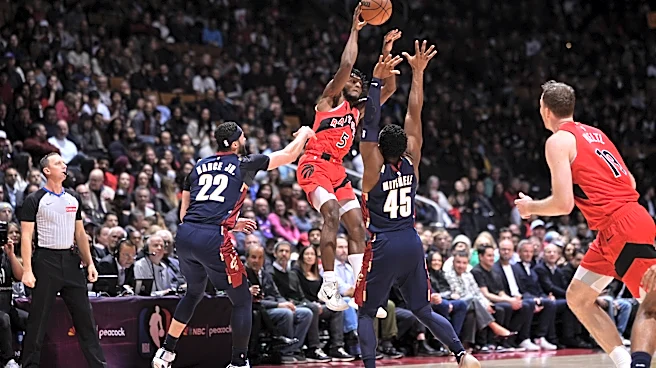
Let’s begin with what the endgame looks like. The frame below shows what the Raptors might view as their most ideal ‘10’ on the court. The ten on the floor didn’t materialize by accident. It’s a byproduct of a series of actions that the Cavaliers struggled with.

Ultimately, Cleveland can’t hide Donovan Mitchell. Even if the Cavaliers go with Dean Wade instead of Max Strus, Toronto can attempt to drag Mitchell into a screening action with any of Brandon Ingram, RJ Barrett or Battle.
We’ll come back to this, but let’s break down how we got here.
Here’s the aforementioned possession that led to Battle’s first bucket. Toronto tries to get Mitchell involved twice, with an on-ball and an off-ball screen. The Raptors eventually decide to force the issue and set up a right-wing pick-and-roll (PnR) with Scottie Barnes and Battle.
Mitchell traps the ball, Battle slips to the basket for a push shot.
The Raptors go back to it again, this time seemingly by chance because of Barnes’ offensive rebound. Setting up in the left corner, they force Mitchell to deal with a Battle screen again. This time, Mitchell switches onto Barnes and fouls him on the drive.
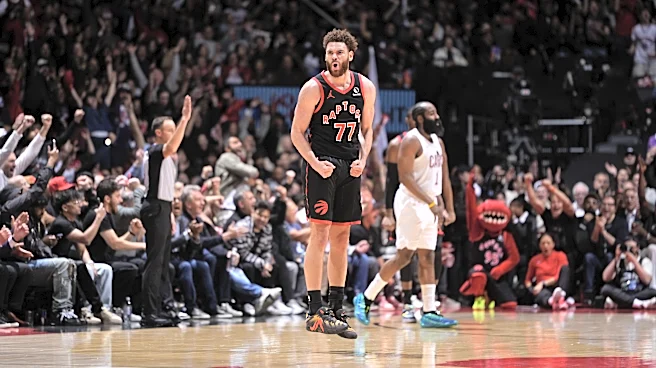
The next sequence that involves Battle and Barnes is also the play that convinced the Cavaliers to try other defenders. This is a baseline-out-of-bounds action that also incorporates the brick wall that is Collin Murray-Boyles. By the end of the movement, Battle knocks down his first three-pointer.
Cleveland subsequently goes with Harden as the primary defender for a handful of possessions.
With Battle heating up, the Cavaliers immediately attempt to put out the fire by attacking him on the other end (more on that later). But with Harden spending an exorbitant amount of energy isolating on offence, he isn’t able to get back in semi-transition, resulting in Battle’s second triple.
This forces Cleveland’s hand again, and this time, the coaching staff call on Keon Ellis.
Even with Ellis on Battle, Toronto is intent on keeping the sharpshooter involved. In this sequence, he’s responsible for freeing up Barnes, possibly with the intent of attacking Mitchell again. Instead, Jamal Shead goes to Murray-Boyles, who then bullies Evan Mobley. This is significant because it’s the Raptors’ response to the Cavaliers going small. Barrett ducks past Harden and gets two points.
Moments later, the Cavaliers make a few personnel changes and opt to go with Strus on Battle. As long as Barrett is on the floor, it’s an easy decision to put him in a PnR with Barnes to bring Harden into the play. The Raptors score here.

On the very next possession, Cleveland hedges its bet on Shead being less destructive. The Cavaliers move Harden off Barrett and onto Shead. Due to an auto-switch, Barnes gets an easy post-up, which results in two more points.

And that brings everything back to the original frame. With the Cavaliers having trouble with Barnes and Murray-Boyles’ physicality, they deploy both Jarrett Allen and Mobley late. That means Mitchell has to defend Battle or Barrett. For some reason, Mitchell traps Barnes up top after the screen, which results in an open three for Battle.
It’s beneficial to also highlight how the Raptors can keep Battle on the court. Despite his tendency to go nuclear anytime he sees a Cavaliers jersey, there has to be a reason why Battle struggled to find minutes during the regular-season. The film – and assumption – leads the analysis towards his defence.
After Battle hit his first three-pointer, Cleveland attacked him six times on the opposite end and scored nine points on 80 per cent shooting. The lone miss came on a wide-open Jaylon Tyson three-point attempt from the right corner. All six possessions involved Battle guarding Ellis.
With Harden generating quality offence, the Raptors leaned on an assortment of point-of-attack defenders in Barrett, Shead, Barnes and Murray-Boyles. Cleveland also leveraged this advantage off-ball when the Raptors tried to top-lock Mitchell. How Battle fares on the defensive side – particularly in on-ball sequences – over the course of four quarters will have a major impact on game four.
It’s also fascinating that when all three of Harden, Mitchell and Strus were on the court, they didn’t attack Battle. At least for the end of game three, it seemed like the Cavaliers valued Strus as a corner shooter, weren’t thrilled with the idea of having Mitchell or Harden turn into a spot-up shooter from the wing, or chose to keep things hidden with the game nearly out-of-reach.
The Raptors’ hot-shooting could regress to the mean. That’s a likely outcome. But assuming that doesn’t swing too violently the other way, how the Cavaliers scheme their way out of this new Battle plot twist will be one of the key storylines headed into game four.