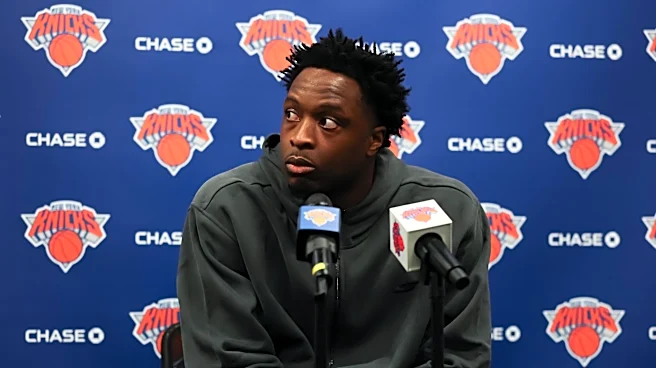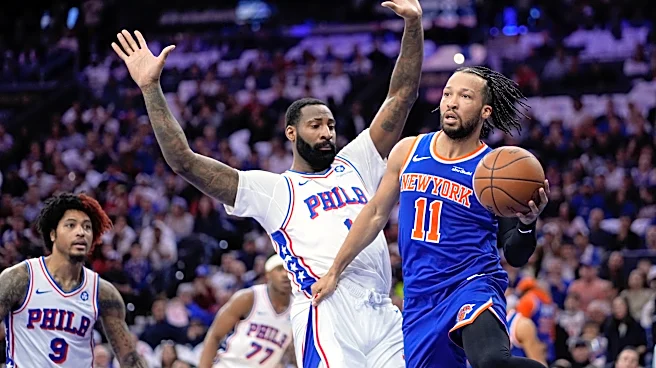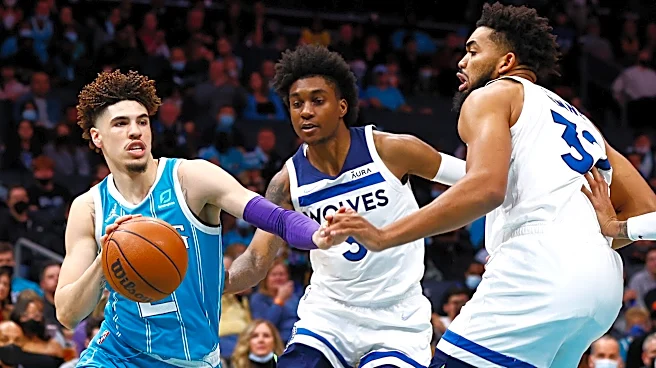

To many modern fans, the Karl-Anthony Towns trade was a pivot point of their fandom.
I can speak to this myself as well. It’s hard for me to move on from a player who defined the era of Minnesota Timberwolves basketball to which I felt the most connected. I watched KAT battle with the reputation that Jimmy Butler had assigned to him, trying so hard to prove that he was, in fact, a winning, capable player who deserved the money he had just signed for.
I celebrated when he was reunited with draftmate
and friend D’Angelo Russell in a pairing that would ultimately produce very little but was still incredibly fun. I spent evening after evening watching him blossom again, renewed in his vigor and joy, alongside Anthony Edwards, and you know what? It was fun!

I still remember where I was when that trade happened. I used to live in Washington Heights, at the very tip of Manhattan, and I remember walking down the streets of New York and seeing Towns stitched onto the back of a Dominican Republic national team jersey.
It was so weird to know that he would be so loved here, but still deeply miss him. I think it was even cooler, however, to watch him win his title this past year.
Now, time has come and gone, and while sentimentality never fails to cloud objectivity with nostalgia, it seems clear now that the Wolves lost that Karl-Anthony Towns trade pretty overwhelmingly. I know, who could have seen it coming when you trade an All-NBA center for a role player, a star that had outstayed his welcome, and a fake first-rounder (that turned out to be real)?
Still, it’s hard to blame the Wolves.
Managing money in the modern NBA is hard. The aprons are complicated and forever limit any type of sustainable build. That, more than any on-court problem, is why KAT is a Knick. He made too much money to retain.
If we break the deal down to its clearest bullet points, the Knicks were able to capitalize on a team that couldn’t pay one of their best players. That allowed them to bring in a star that they hoped would make the life of their offensively focused superstar easier en route to taking the team to an entirely different level.
In a weird way, that’s exactly what the Wolves did this off-season with the LaMelo Ball trade.
How’s that for a long intro? I can still hear my old editors leaving the note “shorten” in my submitted Google Docs.
The Charlotte Hornets have just had their most impressive season since Kemba Walker was in the fold. They did that behind a career year from LaMelo Ball and his maximization of Kon Knueppel, Moussa Diabate, and Brandon Miller.
While the heights that Charlotte reached are not nearly as high as the Western Conference Finals the Wolves managed to make just a few months before dumping KAT, it is still their current magnum opus to have created a lineup that was among the league’s best.
That was the type of thing that is usually a foundation, and yet the Hornets decided to abandon it.
At this point in their respective careers, KAT was a much better player than Ball. One was a multi-time all-star and had been good enough to be an All-NBA player, while the other was known just as much for his poor driving and health concerns as he was for his massive talent level at doing cool things on bad teams (well, maybe that was more similar).
But the logic for the move was remarkably similar. Even now, the cult-like love that Donte DiVincenzo still has in New York is nearly the same level of care that Naz Reid will forever have in Minnesota. It’s safe to say there is some comparison to be made there, however aesthetically focused it might be.
As it was with the KAT deal, the Wolves included pick equity that may never really come to pass. While the Wolves got lucky that Detroit took a massive leap the year that Minnesota owned their pick, it is still uncertain whether Minnesota will fall below the Hornets in total record over the next 7 years when those pick swaps would convey.
That may be a lot to understand so let’s simplify it:
The Hornets built a foundation like the Wolves did. The Hornets moved off of the most mercurial and unreliable piece of that lineup, in their eyes, by selling high and trying to make sure that their build was sustainable in doing so. They gave up a talented player that could certainly reach another level, just as he could prove to be unworthy of his current contract.
Towns proved he was capable of reaching that new superstar benchmark. He has made that deal look ridiculously stupid. It may not be the worst in franchise history, but it’s not like Minnesota got even an adequate return on their former number one overall pick unicorn big man who was a near-perfect fit alongside their best player.
For their part, the Hornets’ outlook is now far murkier without said star in the fold. Although they did get some decent pieces back in Naz Reid and a 2033 unprotected first-round pick, they now have a team of shooters with no one to set them up.
One team will try to retool with their young core already in place, while the other is bringing in that other star to try to push a core beyond what seemed to be the logical limit of where they could end up to a new zenith.
Maybe Minnesota will win a title in the next few years. Maybe they will instead completely crumble to dust, like many expected New York to do after making that move for a star that many could not stand.
However, the truth remains that just a few years after Tim Connolly closed the Wolves’ window with an ill-thought-out KAT trade, he has tried to open one up by being on the opposite end of the very move he made three summers ago.
The door to a title run is flapping open and closed just like a saloon door. Trade after trade for a star player coming in or going out is constantly changing team makeup and resulting expectations.
Would it be better to still have KAT on the roster? Hard to say (yes), but if LaMelo can do for Anthony Edwards what KAT did for Jalen Brunson, then Wolves fans will likely no longer have to be sore about the move that sent out yet another franchise legend to win their first championship somewhere else