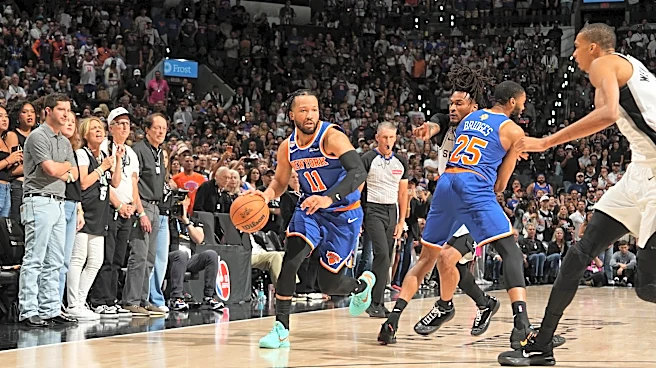










I must admit, the way this series has gone, I felt pretty certain heading into the fourth that San Antonio was going to lose this game. Simply put, the Spurs showed time and again that they could play well enough to hold a lead against the Knicks late in the game, but inevitably that edge would wither away in the face of missed opportunities, mistakes, and poor composure. In short, these contests against New York really do seem to have come down to the advantage earned through experience, as the Knicks consistently
exhibited an ability to outperform San Antonio at the most critical times.
Despite it’s disappointing ending, we would be remiss to overlook how amazing this season has been. Back in October, the Spurs were expected to be a fringe playoff team that would be thrilled to get past the play-in and go down fighting in the first round. Instead, they won 62 games and marched through a series of tough Western Conference opponents. Replicating that feat next year won’t be easy, but the core of this team is still well within the age range in which substantial year-over-year improvements are the norm, so we have every reason to believe that next year’s squad will be even more impressive. In the meantime, let’s review our last box score of the season:
Note: Now that we’ve moved into the postseason, the reference period used for grading changes from the set of regular season games since 2012-2013 to the set of postseason games since 2012-2013. Unless otherwise noted below, this set DOES include play-in games. As of the end of June 13 2026, this group include 1,206 games.

Factors that decided the game
- This was yet another game in which many key battles were essentially draws. For example, New York edged out the Spurs in defensive rebounds (+2), but San Antonio had a +1 edge on the offensive glass. Similarly, the Knicks had one more turnover than the Spurs, but San Antonio’s edge in points off of turnovers was just +3 (certainly an advantage, but unlikely to swing a game).
- Shooting volume and efficiency from the field was similarly balanced. The Spurs did have a key edge in overall FG% (+2.74 percentage points), which would normally provide a sizeable advantage in terms of winning. Though San Antonio did make two more field goals than New York, both teams had exactly the same performance from distance (12-of-37), and the broader context is that neither team shot well from the field.
- Because points from the field were so scarce, the free throw line played a dominant role in this game, and unfortunately this was the one area where the Knicks clearly outplayed San Antonio. In addition to having a FTA margin of +9 (part of which can be explained by fouling at the very end of the game), New York enjoyed a FT% differential of +8.27 percentage points. As a result, they outscored the Spurs by eight from the charity stripe, which ultimately proved decisive.
Rare Box Score Stats
- It is EXCEPTIONALLY rare in the modern NBA for a team to win a postseason contest with the dismal shooting efficiency that New York achieved last night. In fact, there has been only ONE other postseason game since 2012-2013 in which the winning team logged FG%, 3P%, and FT% values at least as bad as 35.63%, 32.43%, and 71.43%, respectively. That other occasion was a May 11, 2013 game in which Indiana beat the Knicks 81-72 in the Eastern Conference Semis.
- Of course, New York was able to win with these terrible percentages because the Spurs were even less efficient. In fact, since 2012-2013, just three teams have lost by no more than four points while recording FG%, 3P%, and FT% values at least as bad as 38.37%, 32.43%, and 63.16%, respectively. On average during this period, a postseason loser with a shooting percentage line that bad in all dimensions loses by about 21 points.
- Although both teams were woefully inefficient from the field, I must grudgingly admit that Jalen Brunson was exceptional, as he scored 45 points on very good efficiency and accounted for nearly half of his team’s points. In fact, since 1996-1997, only 18 other players have put together a playoff performance in which they scored at least 47.87% of their team’s points.
What are Team Graded Box Scores?
Very briefly, these box scores grade winner-loser differentials for basic box score statistics, with the grade being based on the winning team’s differential relative to other NBA winners during a defined reference period. Think of it like a report card for understanding how a given winner performed relative to other winners. The reference period used runs from the start of the 2012-2013 season to the latest date of play, including only games in the same season category (i.e., regular season and playoff games are not compared to each other).
Data Source: The underlying data used to create these box scores was collected from Basketball Reference. In all cases, the data are collected the morning after the game is played. Although rare, postgame statistical revisions after data collection do occur and may affect the results after the fact.