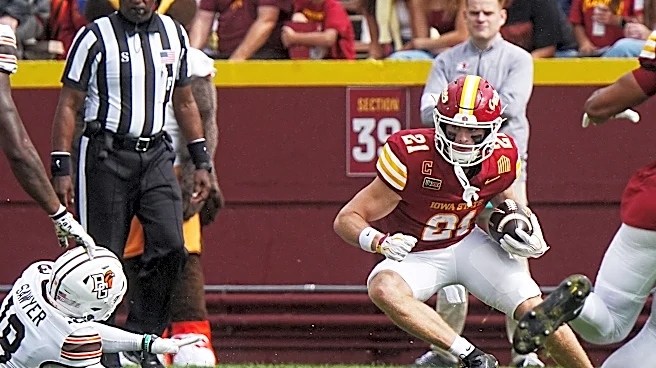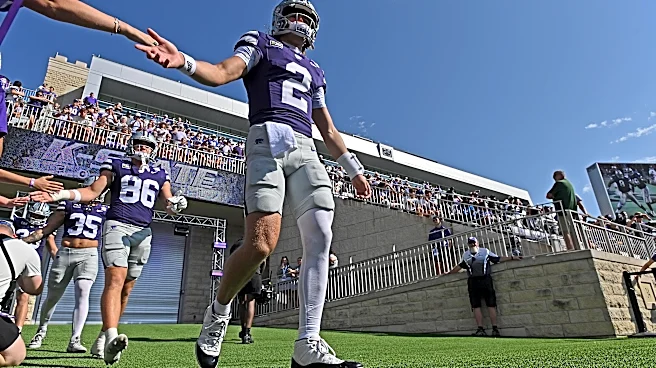


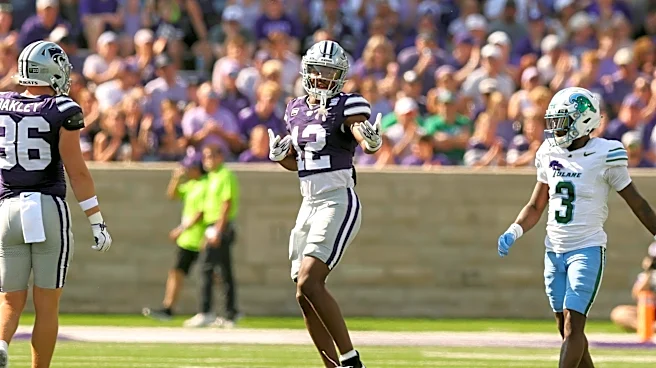
It took the offense a half to get fully in gear. Tulane sold out to stop the run on defense and managed to contain Kansas State’s running backs. Coach Klein and Gleason countered with Avery Johnson in the quarterback run game, and the rest, as they say, was history.
Tulane put the ball in Avery’s hands and dared him to win the game.
Avery won the game.
Quarterback
*Starters in Bold
Avery Johnson: Snaps – 65 – Comp – 21/28 (75%) – Yds – 227 – Td – 0 – Int – 0 – Rushes – 12 – Yds – 152 – TDs – 2
Grade: A
This was the
perfect bounce-back game for Avery after being bitten by the interception bug last week. He was efficient in the passing game and electric as a runner. This is Avery in his final form. He makes the right reads in the passing game, hits the occasional deep ball, and gives defensive coordinators nightmares with his legs. I don’t think a single pass was in jeopardy of getting picked off against Tulane. He was putting the ball on the numbers, and his receivers and tight ends were coming back to the ball and pinning defenders on their backs. He did an excellent job of delivering accurate passes that led Jaron Tibbs into space on crossing routes instead of making him stop and absorb a big hit from the trailing defender.
Tulane decided that Kansas State’s running backs weren’t going to beat them inside the tackles, which allowed Avery to pull the ball on the zone read and use his speed to get to the edge. Once he was in the open field, he tried to take it the distance instead of looking for the nearest sideline. I wrote an entire article last season about Johnson sliding down short of easy first downs. On Saturday, he was diving for first downs and running with conviction while, at the same time, avoiding unnecessary hits.
For my money, this was his best overall game at Kansas State. If the Wildcats can consistently get performances like this from Avery moving forward (certainly not a given), the road to the Big 12 Championship looks significantly wider.
Running Back
- Rodney Fields: Snaps – 39 – Rushes – 10 – Yds – 18 (1.8 YPC) – Td – 0 – Rec – 1 – Yds – 0
- Joe Jackson: Snaps – 28 – Rushes – 9 – Yds – 24 (2.7 YPC)
- Jay Harris: Snaps – 2 – Rushes – 2 – Yds – 2 (1 YPC) – Tds – 2
Grade: C+
As I mentioned above, Tulane decided to focus on shutting down Kansas State’s triumvirate of backs after they dominated the Wildcats first two games of the season. Consider that part of the game plan successful: the running backs couldn’t find any space between the tackles, and the Green Wave defense didn’t let Fields or Jackson bounce anything wide.
What Tulane couldn’t account for was Coach Klein and Gleason using Avery’s running ability on the perimeter as the ultimate counter to their stingy interior defense. Fields and Jackson have established themselves inside, which keeps the linebackers tucked in and lets Avery get the edge. If the linebackers decide to spread out and get a head start on Avery running wide, the running backs find space to gash the defense on the interior.
That’s called synergy, baby!
I was impressed with Tulane’s tackling all game. On more than one occasion, Fields was an open-field tackle away from breaking out, but the Green Wave defender always found a way to get him on the ground. The same goes with Jackson; on the rare occasion when he made someone miss or bounced off the initial tackle, another defender was immediately on top of him before he could get going again.
Shout-out to Jay Harris for cashing in both his goal-line attempts for touchdowns. After watching multiple teams struggle to get the ball in the endzone from inside the 5-yard line, Harris’s physical running style and feel for short-yardage situations are a real asset.
Wide Receiver
- Josh Manning: Snaps – 52 – Targets – 1 – Rec – 0
- Jaron Tibbs: Snaps – 62 – Targets – 12 – Rec – 9 – Yds – 114
- Brandon White: Snaps – 24 – Targets – 2 – Rec – 1 – Yds – 4
- Derrick Salley Jr.: Snaps – 8 – Targets – 0
- Izaiah Williams: Snaps – 5 – Targets – 0
Grade: B
Last week was the Josh Manning game. Tulane watched that tape and focused their coverage on Manning, which made this the Jaron Tibbs game. I was a little concerned about the number of targets Manning received last week, not because he wasn’t open, but because I didn’t want Avery to get locked into throwing it to his receiver of choice. Last season, on big downs, Avery was looking at Jace almost exclusively. My concerns, like most of my concerns, proved unfounded.
Tibbs pulled down 9 receptions, and 7 of those went for first downs. He’s not much of a run-after-the-catch receiver, but the former high school basketball star from Indiana uses his ability to box out defenders and attack the ball with his hands. He made a living going across the field, keeping defenders on his back and giving Avery a big, safe target. That’s a good way to take interceptions off the table. The only blemish on Tibb’s resume on Saturday was a dropped pass on first down, but he followed that up by making the block that sprung Avery’s first big run of the game on the subsequent play.
After the Washington State game, I mentioned that one of the reasons the tight ends weren’t getting many targets was that the wide receivers were getting targets. The inverse was true this week. Outside of Tibbs, the rest of the receiving group was targeted 3 times, with Brandon White making the only catch for 4 yards.
Which brings me to the tight ends…
Tight End
- Garrett Oakley: Snaps – 53 – Targets – 5 – Rec – 4 – Yds – 27
- Linkon Cure: Snaps – 30 – Targets – 3 – Rec – 3 – Yds – 23
- Will Anciaux: Snaps – 22 – Targets – 4 – Rec – 3 – Yds – 59
Grade: B+
This was a tight end-heavy game plan from the Wildcat offensive brain trust. Slot receiver Brandon White and Garrett Oakley played around the same number of snaps against Washington State; Oakley was on the field significantly more than White in this game. The tight ends were targeted 3 times, with a single reception by Will Anciaux, against the Cougars; they were targeted 12 times against Tulane.
Oakley, Anciaux, and Cure combined for 4 first-down receptions. Oakley set up shop in the short zone directly in front of Avery, giving him a reliable outlet. Anciaux had the two longest receptions by getting lost in the wash in the play-action game as the supposed “blocking” tight end, and the staff got creative in the redzone with Cure with a shovel pass that came perilously close to the first touchdown of Linkon’s career. Using him as a Swiss Army knife instead of a more traditional downfield tight end might be how Coach Klein unlocks the highest-rated recruit in Kansas State history.
I like the Wildcats’ wide receivers; I love their diverse collection of tight ends. Either way, Avery can’t go wrong.
Offensive Line
Left Tackle
Ryan Howard: Snaps – 65
Left Guard
- Charlie Adams: Snaps – 29
- Tanner Morely: Snaps – 36
Center
Dylan Villarouel: Snaps – 65
Right Guard
- Keiton Jones: Snaps – 22
- Chase Duarte: Snaps – 43
Right Tackle
Gus Hawkins: Snaps – 65
Grade: A-
In terms of personnel, it looks like offensive line coach Mike Schmidt is intent on letting his tackles and center go the distance while liberally subbing his guards. That makes sense to me because the Wildcats love pulling the guards in their gap-scheme run game. Tanner Morley continues to work his way back and eclipsed Charlie Adams in snaps for the first time on Saturday. It wasn’t a great game from Morley, but it’s been a while since the former Colorado State captain has put in a full shift after going down with a season-ending injury in the fourth game in 2025. He’s still knocking off some rust and should continue to improve and give this line some extra bite.
At right guard, San Diego State transfer Chase Duarte continues to earn more snaps. Keiton Jones started the game, but Duarte played the starters’ share of the snaps. Jones is the better run blocker, but Duarte has been better in pass protection and isn’t a bad run blocker in his own right. It’s nice to have options, and Coach Schmidt appears to have 4 players he’s comfortable with at guard. I wouldn’t be surprised if both Morely and Duarte are official starters in the near future.
Don’t forget, freshman Oliver Miller was a revelation in fall camp before going down with an injury. At one point, he was penciled in as either the starting left tackle or left guard, and his return should only help bolster the depth at tackle and guard.
In terms of grades, I struggled with this one, but I’m rolling with Coach Klein’s “all rushing yards are created equal” theory and not docking points for the running back struggles. Tulane was flying to the ball and firing their safeties on pretty much every inside run to the backs. They got hats around the ball, and any small gap that the line was able to chisel out was immediately filled.
Coach Klein and Gleason exploited Tulane’s aggressive run defense by having Avery pull the ball and essentially run quarterback counter off the back side once it was clear Tulane was overcommitting to the play side, leaving the back door wide open. I would have liked a little more push at the point of attack, but the Green Wave were determined to make someone other than the Wildcat running backs beat them. They picked their poison, and it had them in the game at halftime.
As I mentioned above, while there wasn’t much running room available between the tackles, the offensive line hunkered down and got the job done on the goal line.
Meanwhile, the pass protection was impeccable. According to PFF, Avery was hurried 3 times and pressured 3 times, while not taking a hit in the pocket all game. Ryan Howard has planted his flag at left tackle, and although the sample size is only 3 games, it certainly appears that he’s the long-term solution at the position. On the other side of the line, Gus Hawkins was also solid. He got dinged for a hurry and pressure, but there was egregious. Johnson had a clean pocket when it mattered.
On the interior, Morely struggled in pass protection and was dinged with a hurry and pressure by PFF. I’m going to chalk that up to rust, but it’s something to monitor moving forward. Center Dylan Villarouel was also charged with a hurry and pressure, but had 32 pass-blocking opportunities, compared to Morely’s 19. It’s hard to be mad at the pass protection in a game where the line didn’t give up a sack.