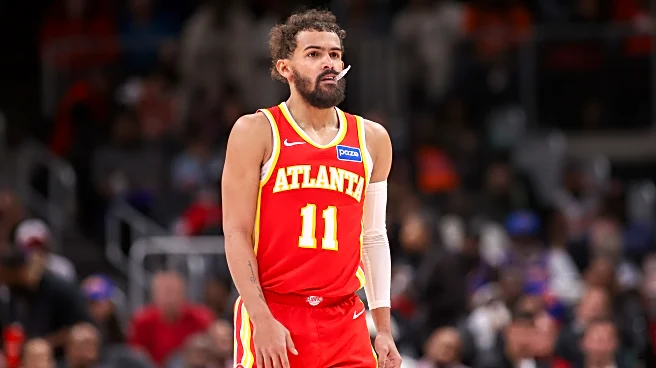

The Hawks decided to pull the trigger on the first significant trade of 2026. Atlanta sent Trae Young to the Washington Wizards for C.J. McCollum and Corey Kispert, ending their relationship with Young after
a tumultuous seven and a half seasons.
The trade return is underwhelming for a player who’s been an All-Star four times, was the assists leader last season, and is in his prime. The reasons for that are many, but it’s safe to say the Hawks, who don’t control their own draft pick this year or next, thought it would make them better.
Why should Spurs fans care what happens to Young and the Hawks? Because the team holds swap rights to Atlanta’s 2026 pick and owns their 2027 pick from the Dejounte Murray trade. With that in mind, let’s take a closer look at what the trade means for the Spurs.
The Hawks should still be bad, unless this is only the first big move
Atlanta likely thinks this is an addition by subtraction situation, and there are reasons to believe they are right. For as good as Young is as a passer, his offensive game is far from perfect. His 35 percent career average as a three-point shooter is not terrible considering the degree of difficulty of some of his shots, but, at the same time, Young’s style of play is what led to so many hard shots. He’s an incredibly ball-dominant player who, for reference, has attempted the same amount of catch-and-shoot looks per game as Carter Bryant has while playing 20 more minutes. He has a deadly floater but is not a prolific finisher at the rim, and he’s one of the worst defensive players in the league.
With Jalen Johnson emerging as a star on offense and Nickeil Alexander-Walker having a breakout year, it’s understandable for the Hawks to move on from a player who can put up numbers and lead a good offense in a heliocentric attack but doesn’t seem to fit well in a different role. Adding McCollum, a solid veteran who can still fill it up, and a shooter like Kispert should allow Quin Snyder to establish a more equal opportunity system with a lot of ball movement, as he prefers. Atlanta won’t likely get into the top 10 in offensive rating, but shouldn’t drop too far from 18th, where they currently sit, and if things go well, could move up a few spots.
The problem is on the other end. Atlanta should see some improvement without Young, even though McCollum and Kispert are far from defensive aces, but the roster is still missing a reliable rim protector and two-way wings. Dyson Daniels forgot how to shoot. Johnson has not progressed defensively, in part because of the major role he’s playing on offense. Kristaps Porzingis can anchor a defense, but he has struggled to stay on the court.
The Young trade on its own shouldn’t propel the Hawks up the standings. If another big move is coming to shore up a defense that ranks 16th in the league, like the rumored Anthony Davis trade, Atlanta might find a balance, at least in the short term. Otherwise, the roster seems too flawed for them to make a run at anything other than the play-in.
The market for small guards is cold, which could hurt the Spurs down the line
Such a bad return for Young would have been unimaginable a few years back. He’s always been a polarizing player, but he was a charismatic star who put up some impressive numbers, hit big shots, and could handle a massive offensive role, albeit not as well as guys like prime James Harden or Luka Doncic. The expiring contract of 34-year-old C.J. McCollum and an aggressively ordinary wing shooter would have been considered a laughably poor haul for such a player. In today’s NBA, it’s still not a good trade by the Hawks, but it seems to be in line with how the league values Young’s archetype.
Small guards who can’t switch and don’t fight hard on defense are a huge weakness. Teams hunt down matchups with those types aggressively and ruthlessly, and it takes the rest of the team executing perfectly for it not to be a major issue. If the defensively-challenged small guard is also ball-dominant, he better be absolutely elite on offense, like Jalen Brunson, to be worth the trouble. It’s partially the reason why there wasn’t a better offer on the table for Young and why guys like Ja Morant and the bigger but clueless LaMelo Ball don’t seem to have much of a market. Switchability and versatility are requirements for non-top-level creators.
Since the Spurs are not trying to trade De’Aaron Fox, that’s not a problem for them. Even if they were considering it, Fox’s combination of athleticism, active defense, and willingness to share the ball would separate him from Young. If the league continues to go in this direction, however, it could be an issue down the line if San Antonio decides to move on from him and hand over the keys to Dylan Harper.
There’s absolutely no reason to panic about this. Fox is just 28, fits well with the current core, and didn’t take that much to acquire, so even if the Spurs do eventually trade him in a couple of years (which is far from a given), they wouldn’t need a massive haul to feel like they came out on top in the aggregate. But how the league views offensive-minded guards with limited switchability should be something to monitor, since there’s one in San Antonio.