






At last, a true fullback has returned to the Las Vegas Raiders’ lineup.
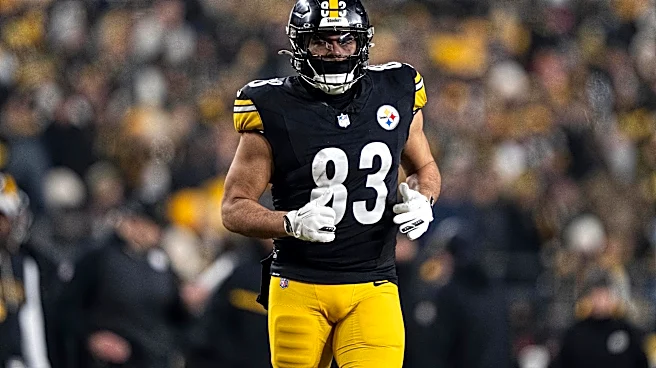
After two seasons without one on the roster, head coach Klint Kubiak and general manager John Spytek wasted little time by landing one in free agency: Former Pittsburg Steeler Connor Heyward. By bringing back a position group that’s going extinct in the NFL — roughly 11 to 15 teams even have a true fullback on the roster nowadays — the Silver & Black bring are set to return to traditionalist roots in Heyward.
Not having one in 2024
and 2025 altered the run game the respective seasons. And to showcase Kubiak wasn’t merely using hackneyed “coach speak” when mentioning the importance of a fullback to his offense, Heyward — a tight end/fullback hybrid during his stint with the Steelers — was announced by the Raiders as a fullback and given the No. 34, normally reserved for backs in the offensive backfield.
The primary reasons why a fullback is integral to Kubiak’s offense include:
- Outside zone pathfinder: Uniform horizontal movement from the offensive line is at the forefront, but behind that group is a physical fullback that lead blocks, engages defenders, and clears the way for the running back to do damage.
- Deception and mismatches: With a penchant to run a variety of plays from similar looking formations, Kubiak loves the cat and mouse game between himself and the defensive play caller on the other sideline or in the booth. With a fullback in the backfield and/or using pre-snap motion, the ability to hone in on tendencies is tough as it could be either a run or pass.
- Play Action: With an effective run game, defenses are forced to respond and commit more resources to stymie the ground game. A fullback in the backfield makes it appear another run is coming and a heavy box is required to combat it. Only for tight ends, wide receivers, running backs and even the fullback running a pattern for receptions.
At 6-feet and 230 pounds, the 27-year-old Heyward is built for both lead blocking and pass catching duties. The position versatility he showcased in his four years in Pittsburgh aligns with what Kubiak intends to do in Las Vegas. Hence why it’s a spot that’s Heyward’s to lose.
But who is the backup fullback?
As our Tristen Kuhn noted above, there’s another versatile option already on the roster in undrafted free agent Patrick Gurd.
At 6-foot-4 and 250 pounds, the 24-year-old is listed as a tight end but served as a blocking fullback during his six-year collegiate career (four at Ohio State (2020-24) and one final season at Cincinnati in 2025). He’s a lot taller and bulkier than Heyward and both the Buckeyes and Bearcats deployed him as the lead blocker in front of the running back in short-yardage and heavy formations.
How to surmise that blocking was Gurd’s collegiate calling card? He caught five passes for 61 yards in the 38 career games he played — three catches and 46 yards coming this past season with Cincinnati.
While I have the opposite opinion as Kuhn — Heyward is locked in and he’d have to be completely ineffective to get waxed — a standout training camp from Gurd can merit attention as a practice squad add if Heyward remains entrenched. Not only is the veteran expected to be a contributor on offense, he’s a special teams maven as a sure tackler and that’ll likely give him the Heyward the edge over Gurd.
Outside of the undrafted rookie, experience as a traditional fullback is light on Las Vegas’ roster.
Tight ends Brock Bowers and Michael Mayer have spent time lining up at the fullback spot but were rarely asked to be consistent lead blockers. That’s due to both being quality pass catchers and having either of them in the backfield meant they were going to either motion out or run routes in the backfield to challenge and test linebackers and safeties in coverage. This of course isn’t to say Bowers and Mayer are awful blockers — quite the contrary.
Of the two, however, it’d be most likely Mayer getting snaps at fullback if Heyward become unavailable. He’s the bulkier at 6-foot-4 and 256 pounds and has the stronger blocking chops over Bowers (6-foot-4, 235 pounds). Also, Bowers is expected to led the Raiders in targets and receptions in Kubiak’s offense.
Then there’s the outside-the-box options as a backup fullback — those these will read like “break glass in case of emergency” types.
Defensive tackle J.J. Pegues has the bulk (6-foot-2 and 325 pounds) and backfield experience from Mississippi to be an intriguing experiment of sorts. Current LSU head coach (and former Raiders lead man) Lane Kiffin was apt to use the beefy defensive tackle in the backfield as a short-yardage, goal line back during his stint as boss at Ole Miss (21 carries for 69 yards and seven touchdowns in 2024). And Pegues ran fullback and tight end drills at the 2024 NFL Scouting Combine.
The Raiders’ sixth-round pick in the 2025 draft isn’t the lone defender that would be an intriguing option.
If the Silver & Black truly want to go heavy and jumbo, there’s nary a player bigger than defensive tackle Laki Tasi (6-foot-6 and 373 pounds). The 22-year-old International Pathway Program player (who originally signed with the Raiders in April of 2025 is still finding his footing in the league but at his size and athleticism, he’d be such a massive lead blocker that defenses wouldn’t be able to see the running back behind him — especially if it’s Ashton Jeanty who stands 5-foot-8 and 208 pounds.
Again, the two names above are worst-case-scenario types but Kubiak is big on versatility when it comes to his roster. And considering Heyward has played in all 17 games in his four years in the NFL so far (68 games total), a backup may be a moot point. But injuries can happen, at any time, and fortunately for the Raiders, they do have in-house options (and free agency) when it comes to “next man up” at fullback.