



After the Los Angeles Rams drafted tight end Terrance Ferguson in the second round of the NFL draft, fans didn’t get the immediate gratification that they would have liked. The rookie didn’t play a single snap in Week 1 and was hardly used outside of special teams through the first month of the season. In fact, he was completely inactive in Weeks 3 and 4.
In a sense, the lack of early playing time followed how the Rams typically handle young players who they don’t feel are ready. They have a history
of bringing rookies along slowly outside of a few exceptions. Ferguson also missed two weeks of training camp and needed to get integrated into the offense.
Gradually the snap counts and usage for Ferguson started going up. Starting in Week 7 when the Rams began utilizing more 13 personnel, Ferguson had three consecutive games with a reception. He’s also been targeted at least once in nine of the last 10 games.
Since Week 7, Ferguson leads all tight ends in yards per reception and in average depth of target. In a sense, Ferguson has become the Rams’ deep threat, especially in 13 personnel. Ferguson’s average depth of target is 18.4 yards. The gap between Ferguson and Mike Gesicki in second with an average depth of target of 11 yards is the same as Gesicki and Elijah Higgins in 43rd.
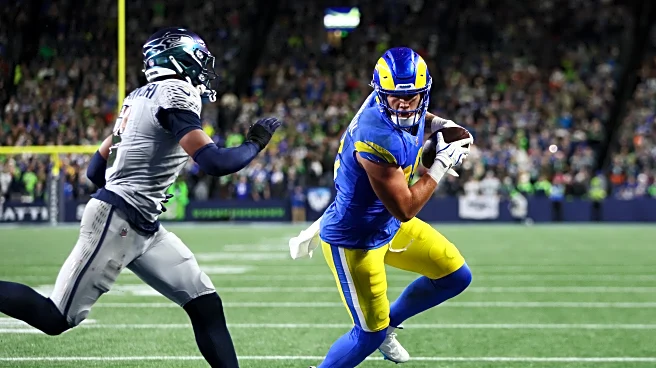
He’s too fast for most linebackers and moves like a wide receiver. In the second quarter, the rookie tight end breezed past safety Xavier Watts for a 27-yard catch. His six receptions of 25 or more yards are tied for the third-most among tight ends in the NFL this season. Adding to that, his six catches of at least 25 yards are the most by a Rams rookie tight end in the last 35 years.
The Rams are using Ferguson more and it still feels like they are only scratching the surface. Last week, they still targeted Colby Parkinson up the sideline and the pass was dropped. At this point, that should strictly be Ferguson in that spot. Ferguson has mostly been a deep threat and been used on a vertical plane while excelling in that role. He ranks eighth among tight ends in air yards and is first in yards per reception.
For much of the season, it felt as if Ferguson and Stafford weren’t quite on the same page. Stafford missed an open Ferguson a few times as he worked into the offense. It was similar earlier in the season with Davante Adams. However, once those two clicked, they became one of the more unstoppable duos in the red zone. This isn’t to say that Ferguson is headed on that same trajectory, but it’s certainly a good sign that he and Stafford are connecting more.
After having six receptions on 15 targets through Week 14, Ferguson has caught five of eight targets over the past two weeks. Ferguson’s touchdown last week was actually directly from the Seahawks’ playbook the week before when Sam Darnold found AJ Barner.
After slowly working Ferguson in, he is firmly the TE2 behind Colby Parkinson. The rookie has out-snapped Davis Allen in each of the last four games. A potential complication would be if Tyler Higbee returns and therefore takes snaps from Ferguson. Ideally, Ferguson would still be the TE2 behind Parkinson while Higbee rotates with Allen. Outside of being a threat in the passing game, Ferguson also adds to the run game as he has been the fourth-best run blocking TE since Week 7 via PFF.
It feels as if the Rams are finally gaining some trust and confidence with Ferguson which is a good thing. They need to use him more. In 2021, it was rookie Ernest Jones at linebacker that was an ‘x-factor’ for the Rams in the playoffs. In 1999, it was Torry Holt that led the team in receptions during the postseason.
Despite a slow start to his career, Ferguson is finding his form and it’s just in time for the playoffs. It wouldn’t be surprising to see Ferguson make a key play in a big moment when it matters over the next month.