



As all of us know, pitching was the Cubs’ downfall this year.
Not in the postseason’s two games, really — those games were largely lost because the offense stopped hitting.
Right now I’m going to share this chart yet again because, well, it points out the problem in stark numbers.
The Cubs had one of the worst pitching staffs in all of Major League Baseball in 2026. As you can see, they lapped the field offensively. If they’d had an even league-average pitching staff they likely
win 100 games and we’d still be watching Cubs postseason games today.
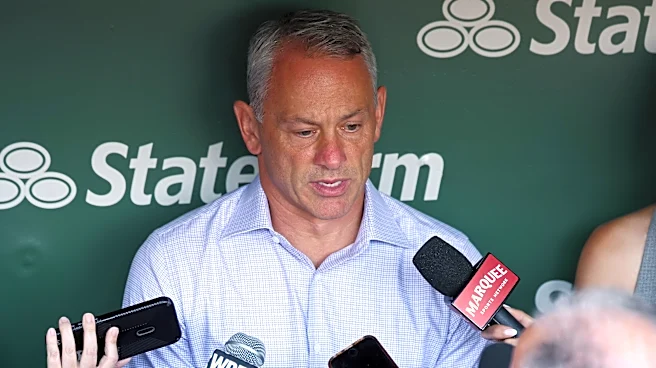
Cubs President of Baeball Operations Jed Hoyer, in his season-ending presser, acknowledged part of this problem:
About the Cubs bullpen, Hoyer said: “I did a poor job on the bullpen this year, full stop.”
The thing is, that’s not the only issue with the Cubs pitching this year. The starting rotation, as I detailed in yesterday’s article praising Craig Counsell for doing as much as he possibly could with it, was also pretty terrible.
And so the pitching issues don’t end with the bullpen, and that calls into question the entire way Chicago Cubs pitching is put together.
I wrote an entire article on that topic here in early September. That article mostly focused on what the Cubs could do going forward the rest of the season. What I left out, and what I want to focus on now, is how Cubs pitching is put together.
You have likely noticed the long streams of pitchers throwing 98, 99, 100 miles per hour or more coming out of most other teams’ minor league systems. The Cubs don’t have that. This year’s bullpen included just two guys who can do that, and one of them (Ryan Zeferjahn) wasn’t even in the organization until the trade deadline. The other, Daniel Palencia, spent much of the 2026 season on the injured list.
Meanwhile, other teams — I’m looking at you in particular, Brewers — seem to have an endless line of guys who can throw triple digits, beginning with Jacob Misiorowski, but also including multiple guys in their bullpen.
To me, that’s an indictment of two parts of the Cubs organization. First is pitcher development. They just don’t seem to have the right infrastructure to even take guys that they do have, who can throw this hard, and make them into good MLB pitchers.
As Josh wrote in his Arizona Fall League preview, the Cubs have a guy like this right now on the Mesa Solar Sox roster. Jhon Cabral was signed after the Marlins let him go, because:
Cabral is a fireballer who can hit 100 miles per hour with regularity. He also has no idea where the ball is going, which is why the Marlins released him. In the 82.2 innings he’s thrown in his minor league career, he’s struck out 82 and walked 121. But it’s hard to give up on triple digits.
I have my doubts as to whether the Cubs have the right pitching infrastructure to fix this. They had a guy like this in the AFL last year, too, JP Wheat, who wound up walking 16 of the 37 batters he faced in AFL play. He wasn’t much better at South Bend this year, with a 30.1 percent walk rate.
An even better example is Trevor Megill, who the Cubs acquired in the 2019 Rule 5 Draft. Megill pitched in 28 games for the Cubs in 2021, posting an 8.37 ERA, but striking out 30 in 23.2 innings. Gotta be something there, right? Well, the Cubs didn’t think so because they exposed him to waivers. The Twins claimed him and he pitched for them in 2022, and eventually they traded him to the Brewers for a minor leaguer.
As you know, the Brewers helped Megill figure something out and he’s posted 81 saves for them over the past three seasons, and he just doesn’t walk guys (7.5 percent walk rate in 155 innings from 2024-26).
Now what kind of secret sauce do the Brewers have? It’s clear they know something about pitching development, because they “fixed” Megill, and also graduated Misiorowski, Abner Uribe and Logan Henderson from their minor league system over the last couple of years.
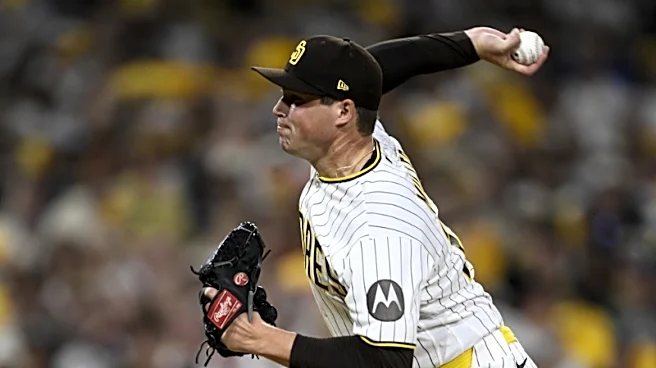
Another example is Jeremiah Estrada, who had good velocity but not good results in parts of two years with the Cubs. He was let go on waivers after the 2023 season and was claimed by the Padres. Here’s how the Padres “fixed” Estrada:
Ruben Niebla, Estrada’s new pitching coach, wanted to see him throw in hopes of identifying a pitch that might complement his dynamic-yet-overused four-seam fastball.
They tried cutters, curveballs, changeups and sliders, continually altering the grips on most of them, and then Estrada unveiled the pitch that would change the trajectory of his entire career: a split-changeup, one he developed out of desperation and now sheepishly calls a “chitter.” He held it with an altered version of what’s called a “Vulcan” grip, lodging the baseball between his middle and ring fingers, and Niebla didn’t think he could command it. Then he threw it. It traveled in the mid-80s with hellacious sink and arm-side run. The first remark came from the catcher:
“Holy s—.”
Then Estrada threw another one.
“I was like, ‘Oh god,'” Niebla said. “I looked at the numbers, the characteristics, and I was like, ‘That’s actually not bad. Do it again.'”
What was initially supposed to be a 15-pitch bullpen session stretched out to about 70. By the end of it, Niebla became convinced that Estrada, 25, had identified the type of secondary offering he had spent his entire career searching for.
“He said, ‘OK, your splitter’s your f—ing pitch,” Estrada recalled. “It felt good because I worked hard for that pitch. I made that pitch.”
Now why couldn’t the Cubs have done that? Why aren’t they doing that with other pitchers in their system? Am I saying Jed Hoyer needs to dump Tommy Hottovy and the rest of the Cubs pitching infrastructure and start over? Yeah, probably so. Whatever Hottovy and Tyler Zombro are doing just isn’t working. For example, look what they did to Edward Cabrera’s pitch mix. Here’s what Cabrera threw in 2025 with the Marlins:
 Baseball Savant" />
That produced the best year of Cabrera’s career — most starts, most innings, best bWAR. Now look at the mix he threw for the Cubs this year:
 Baseball Savant" />
More changeups and curveballs this year and fewer sliders, and the changeup, which was supposedly Cabrera’s signature pitch, showed a drop in velocity. Did this lead to poor performance? Did it lead to more blisters, which put him out for several weeks? I don’t know the answers, but the question is: Why change something that was working?
Some of you are going to say that the way to start to fix Cubs pitching is “Sign Tarik Skubal.” Which, okay, but… who’s to say that they wouldn’t mess him up like they apparently have with some other pitchers? Sure, sign and trade for good pitchers … but also, the infrastructure needs to be overhauled.
The other part of the Cubs organization that needs to change is scouting. Hoyer absolutely needs to get a budget line back for scouting and either hire back the scouts who were let go in the recent purge, or get new ones, or both. Hoyer’s front office has become known for relying only on analytics to evaluate players. Now, let me say right now that there is absolutely nothing wrong with evaluation through analytics. They are a necessary part of modern baseball. But sometimes, there’s nothing wrong with a good scouting evaluation from a pair of human eyes. Scouting is the reason, for example, that the Cubs traded for Jake Arrieta, who had posted a 7.23 ERA in Baltimore in five starts in 2013. A Cubs scout saw something in Arrieta and helped convince Theo Epstein to make that deal. I’m pretty sure you remember how that worked out.
The bottom line here is that something’s not working with Cubs pitching, and it might be that they have to tear things down and start over. Your move, Jed Hoyer.