


NFL teams build their roster in numerous ways. First, selecting college players via the draft. Secondly, signing free agents during the free agency period. Thirdly, trades for players with other clubs. In fourth place, is clubs can claim players off the waiver wire. Another method is by signing players who participated in another pro football league whose contract has expired.
Lastly, the signing of football players who are currently unemployed and don’t have any college eligibility remaining. After
the NFL draft, there are hundreds of college players who weren’t selected and can be signed to a roster. After each NFL season, there are also hundreds of players whose contracts have expired and were not re-signed by their respective teams, and subsequently are labeled as “free agents.” This could also be your dentist who was a college star and now has decided he wants to play pro ball, or the kid a scout found kicking 60-yard field goals over in Europe.
RELATED: CARDINALS FANS WANT A PASS RUSHER
These individuals are of-age and are available. These types of athletes can be signed at any time, whereas the first four types have their own parameters and rules regarding the signing of a player contract.

College football teams are built by a simple resolution: Coaching staffs make offers to a list of players they have earmarked as those they want on their football team. Those players then make the decision of which scholarship offer to accept. In the end, it is the high school athlete who makes the definitive decision.
Not so for the NFL. As stated, there are restrictions for roster building. Teams can’t simply call up a college athlete, offer him a contract, and then write him a big check and sign him. That is done through the NFL draft.
But it wasn’t always this process. To be factual, there wasn’t a process in place at all.
A new league
Originally, the league was formed in 1920 and called the “American Professional Football Association” (APFA) and began with 19 teams. In 1922, the APFA changed its name to the “National Football League.”
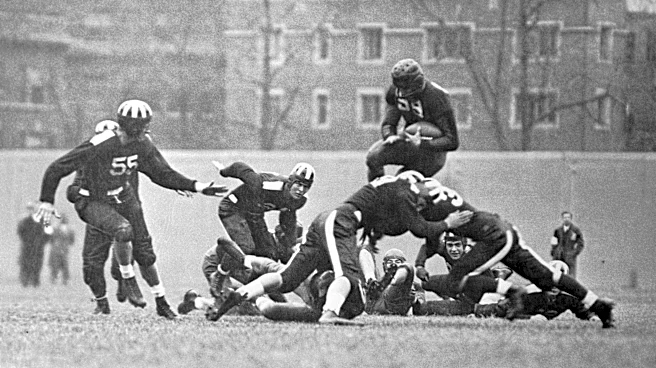
Almost every member club was a medium or small-town team. Teams were mostly made up of athletic club members and also included some college football players, but were mainly butchers, firefighters, coal miners, construction workers, and other rugged blue-collar workers.

And because these men played for a team such as Toledo (OH), Decatur (IL), or Rock Island (NY), these men lived in those cities, usually for most of their lives. They represented their area on the gridiron and were proud of their city. But as the years rolled along, some teams began to recruit college football players instead of using the police officer that patrolled the streets of their town. These players knew the game.
As years rolled along, the teams that weren’t doing well began to use this same strategy. The mill worker or the carpenter just couldn’t compete with the guys who played for Illinois, Penn State, Yale, or Brown. It came to the point where all NFL clubs were using former college players.
And that is how NFL teams were constructed. Just like college teams that approached high schoolers with scholarships, the pro clubs met up with college players with contract offers.
The issue
The medium-sized city teams began to use more college players, but also a roster of men who lived and worked in their city. So, a team located in Muncie, Indiana, still used construction workers as its roster core. Slowly, the landscape of the small to medium cities was disappearing.
But there was a problem. Actually, a huge concern.

Every year, the same teams played for the championship: New York Giants, Chicago Bears, Green Bay Packers, Boston/Washington Redskins, and Portsmouth Spartans/Detroit Lions. These pro football teams played their home games in baseball stadiums because of the large seating capacity. These same five clubs all had big stadiums to fill and needed big college names to bring in the crowds. And it seemed like every year, one of these five would either be competing for the division title, winning the NFL crown, or playing for it.
These teams could offer larger contracts to the elite college players every year because their home gates were always good. They made money, and so, could offer more. The other clubs in the league ended up with the bottom third of the incoming college football talent.
An idea
Each year, the objective of every NFL team was to break even or make any amount of profit. Just the way it was. Keeping afloat was a huge goal. The Philadelphia Eagles were owned by a sportsman named Bert Bell. He became frustrated that all the great college players would only sign with a handful of teams, whereas squads like his own could only hire the marginal athletes and basically the leftovers that never heard from the upper five clubs.

Yet another issue was that two or more teams would get into bidding wars with each other for the same player. And of course, franchises like Bell’s Eagles were perennial bottom-dwellers and were almost always outbid. Every year, it seemed that the rich got richer and the poor became poorer with the roster as well as at the box office. Bell felt that the current system was broken.
His breaking point was when he offered a player a $6,500 deal and then was outbid. The Eagles had limited financial resources. Signing that fullback would have shot his entire college talent endowment.
Bell realized that teams ended up overpaying for college talent, with the sheer capacity to get into bidding wars with each other. And the lesser teams had no chance at the top talent. He had an idea, and made up his mind that the league needed parity, otherwise, the lesser teams would – and have – folded because of bad attendance with poor talent.
At the NFL owners’ meeting in 1935, Bell decided to make a suggestion to change how teams accumulated their rosters. His idea was that at the end of each season, a list would be compiled of all eligible college seniors and that a selection process would take place in reverse order of the previous year’s standings.
Five league teams that made money, had the largest crowds, and signed the best college football talent annually would be the most affected if a system like this were to be instigated and take place every year.
Achieve competitive balance
In Bell’s biography, “On Any Given Sunday: A Life of Bert Bell,” he writes that he informed the other owners:
“I’ve always had a theory that pro football is like a chain. The league is no stronger than its weakest link, and I’ve been a weak link for so long that I should know,” as his book states. “Few teams control the championships. Because they are successful, they keep attracting the best college players in the open market, which makes them more successful.”

Of course, the prosperous franchises had the most to lose if such an arrangement were to be instigated and take place every year. After all, these few teams were getting all the best talent, drawing large crowds to every game, playing in the most title games, and being crowned league champions frequently.
The two men viewed as some of the NFL’s greatest influencers as owners, George Halas of the Bears, and Tim Mara of the Giants, were for the idea right off. This was a huge surprise. Both men stated at the owner’s meeting that they realized fans came to see spirited games, and when one roster was never competitive, the contest tended to become one-sided and boring.
Both Halas and Mara knew that folks came out to see a competition and should get what they paid for. Hopefully, parity would redeem itself as better attendance for the entire league, which would also increase each game’s visitors’ share. This was discussed, and in the end, the other owners agreed. The first such event would not be put off, but would take place several months later, early in 1936.
While the NFL headquarters were located in Columbus, Ohio, on February 8, 1936, the first NFL college draft took place at the Ritz-Carlton Hotel in Philadelphia.
First event
Oddly enough, when Bell made his presentation to the other owners, the word “draft” was never mentioned in Bell’s tender.
To be completely accurate, its official name is the “Annual Player Selection Meeting.”
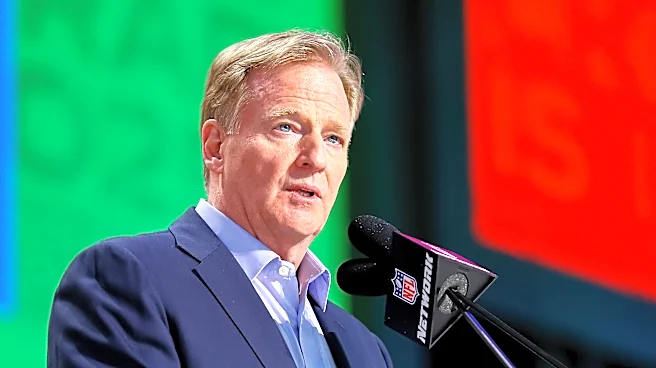
Even today, although “NFL Draft” is plastered everywhere, as soon as TV coverage begins, you will notice that the main host will introduce the event as “Welcome to the annual player selection meeting.”
At the conclusion of the 1935 season, the Lions won the Western Division with a 7-3-2 record while the Giants took the Eastern Division, going 9-3-0, just one game over the Packers and two games above the Bears. Back then, only division winners went to the playoffs, and went straight to the NFL Championship Game.

The Eagles finished 2-9-0, the Redskins went 2-8-1, the Pirates 4-8-0, and the Dodgers ended up 5-6-1. At season’s end, all of the owners convene for a meeting, which is the assembly where Bell brought forth his draft idea.
This meant that Bell’s Philadelphia club would select first. The teams were aligned from worst to first, as Bell envisioned. A list of 90 potential college players was compiled from which to choose. It was decided that nine rounds would be held.
1935 was the first year for the Heisman Trophy, then called the “Downtown Athletic Club Trophy.” All-American halfback Jay Berwanger of the University of Chicago was the first trophy winner as the nation’s best college player. Bell thought that meant quite a bit and was excited to choose him with the first overall pick. All Bell could think about was how the people of Philadelphia would come out on Sundays to see college football’s best player.
That first draft lasted nine rounds with 81 players selected. Some interesting notes:
- Offensive end Paul “Bear” Bryant was selected in the fourth round (31st overall) by the Dodgers
- The Giants took future Hall of Fame fullback Tuffy Leemans in the second round
- Four future Hall of Famers would be selected in this maiden draft: OT Joe Stydahar (Bears), E Wayne Millner (Redskins), OG Dan Fortmann (Bears), and Leemans (Giants).
What was strange was the fact that the Bears, Redskins, and Giants used the first NFL draft to increase their roster strength, while the other teams that selected early didn’t improve much the following season. In 1936, the Eagles, Pirates, Cardinals, and Dodgers all ended up below .500, with Philly going 1-11-0. The 1936 NFL Championship Game was between the Packers and Redskins, so nothing really changed.
Berwanger demanded $1,000 a game and never played an NFL game. He went into the business world and after World War II sold his rubber company for $30 million. In fact, none of the nine players the Eagles selected in that inaugural draft signed to play in Philly.
Future drafts
The NFL draft jumped to 12 rounds in 1937 and then to 22 rounds the following year. From 1943 to 1948, a whopping 32 rounds transpired each season. Every year in the 1950s, the draft settled on 30 rounds. From 1960 to 1966, it dropped again to 20 rounds.

When the NFL and the American Football League agreed to a merger, they embarked on a 17-round common draft beginning after the conclusion of the 1966 season. Later, the rounds dropped again to 12, then eight, and finally to the present system of seven rounds.
Back in the day, because the NFL offices were either located for the most part in Philadelphia or New York City, the draft was held at some fancy hotel in those cities. From 1965 to 2014, the draft was always in New York. Beginning in 2015, it was decided that the occurrence had gotten pretty big and that perhaps it could be a local event shared with each club. This one decision ended up impacting each host city’s economic impact with hotels, restaurants, and downtown businesses in general, bringing in hundreds of thousands of fans from every team.
The first NFL draft in 1936 had lasting impressions on the league. But it is also spread to other sports. The NFL was the first to implement a player dispersal system in professional sports.
It would take years before the other professional sports followed suit, but each major league developed its own form of selection process eventually, and it is a standard today with any new startup league. The motive is simple: provide parity within the league. Without this one activity, teams would become stacked, and public interest would undoubtedly wane.
The ability for any team to improve year after year is critical to the league’s very survival. And the catalyst has been the Annual Player Selection Meeting, um, the NFL draft.