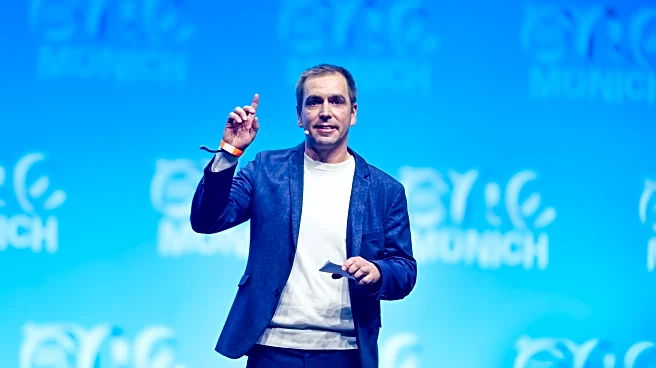




Former Bayern Munich and German national star Philipp Lahm is a man of many talents — and writing is one of them.
No, he has not lowered himself to pen a guest edition of the Daily Schmankerl or Weekend Warm-up, but he did show off his chops in a piece written for The Athletic, which took aim at the failures of Germany’s developmental system:
A lot is lost, especially in the transition from youth to professional football. Clubs invest millions in their academies and train seven days a week, but give
their talented players little to no playing time. The path to the top is not professionally supported. And there is a general lack of a clear approach. As a result, a lot of potential goes untapped.
The lack of a consistent strategy or formal approach is something that Lahm believe is crippling Germany’s ability to produce top-tier stars:
Success in football comes when young players are trained in a system over many years. This requires a consistent approach from the under-14s to the under-19s, basic rules, and uniform training methods. It requires clubs not only to support their youth players but also to provide them with educational care.
There must be experts to identify the two or three special players at each age group. During a player’s education, a coach must be able to recognise when to intervene in sessions and know how to explain technical disciplines and show players where space exists, but they must also allow mistakes to be made.
Another roadblock in the system involves the lack of playing time for some top prospects. Some jump to make big moves too early, while others are getting caught up in a numbers game for clubs, who might need to prioritize veteran players who can help them win now:
And the boys must also play. Talent develops in competition. Openness should therefore become mandatory. I would like to see every Bundesliga club set targets for the playing time of young homegrown players. A professional squad should not be larger than 23 players, and at least three places should be reserved for homegrown talent. This gives everyone the feeling of being needed. It also increases the responsibility of the sporting management. This means they need to make transparent decisions. Every year, three players should be tested to see if they can contribute to success. If no one ever does, a youth academy is pointless.
Lahm then touched on some of the methods that made Bayern Munich so successful during his youth period:
My time in the junior team was between 1995 and 2003. Everyone in Germany knows the names of the other graduates from that period: Bastian Schweinsteiger, Markus Feulner, Zvjezdan Misimovic, Owen Hargreaves, Piotr Trochowski, Thomas Muller, Michael Rensing, Andreas Ottl, Christian Lell, Georg Niedermayer, and Mats Hummels.
From the under-16s onwards, the club imposed internal restrictions on how many young players from outside Munich and Bavaria it would bring into the squad. This reduced turnover and rotation from one age group to the next, allowing all players plenty of time to develop.
Without exception, they became Bundesliga professionals, even though not all of them had outstanding talent. Even as teenagers, they were easily identifiable. Every club knew what it was getting from one of those players. Bayern won the German championship twice with the under-17s and three times with the under-19s. Such a level of success has never been managed again — the history of that junior team is unique in Germany. I draw a lot from my experience in the junior team, such as the principles I apply now in my consulting work at Stuttgart; it had a profound influence on me.
Finally, Lahm dove into how he would change the system:
If I were to change something in German football, I would introduce a binding training concept everywhere that would remain in place regardless of changes in coaching staff. It would define the rules under which youth teams play, the roles that exist, and the technical and tactical requirements that apply. In addition, I would like to see more experienced coaches who remain in their roles for longer.
There are undoubtedly many young, well-trained coaches in Germany who are committed to their work, but they change jobs or clubs too often, mostly because they are pushing to get to the next level. A 15-year-old player needs continuity, though. He needs people who stay and support him through difficult phases.
It sure sounds like Lahm is positioning himself to take a run at a leadership position in Germany’s football infrastructure. The ideas appear to be sound, but can they be broadly put in place — especially in situations where what is best for a young, developing player, might conflict what is best for a club?
If Lahm eventually lands in a leadership position in Germany, maybe we will find out the answer to that question.
If you are looking for more Bayern Munich and German national team coverage, check out the latest episodes of Bavarian Podcast Works, which you can get on Acast, Spotify, Apple, or any leading podcast distributor…
Join the conversation!
Sign up for a user account and get:
- New, improved notifications system!
- Fewer ads
- Create community posts
- Comment on articles, community posts
- Rec comments, community posts