




 here’s what it says. “NOT for the Young — the Nervous — the Scarey. If You Get Nightmares and Tantrums - Stay Away! But If You Can Enjoy Thrills, Chills, and Spine Tingling Sensations While Your Hair Stands On End . . . See This Picture”
| LMPC via Getty Images" data-portal-copyright="LMPC via Getty Images" />
here’s what it says. “NOT for the Young — the Nervous — the Scarey. If You Get Nightmares and Tantrums - Stay Away! But If You Can Enjoy Thrills, Chills, and Spine Tingling Sensations While Your Hair Stands On End . . . See This Picture”
| LMPC via Getty Images" data-portal-copyright="LMPC via Getty Images" />
Here’s the link for tonight’s movie. Click your clicks at 7:30!
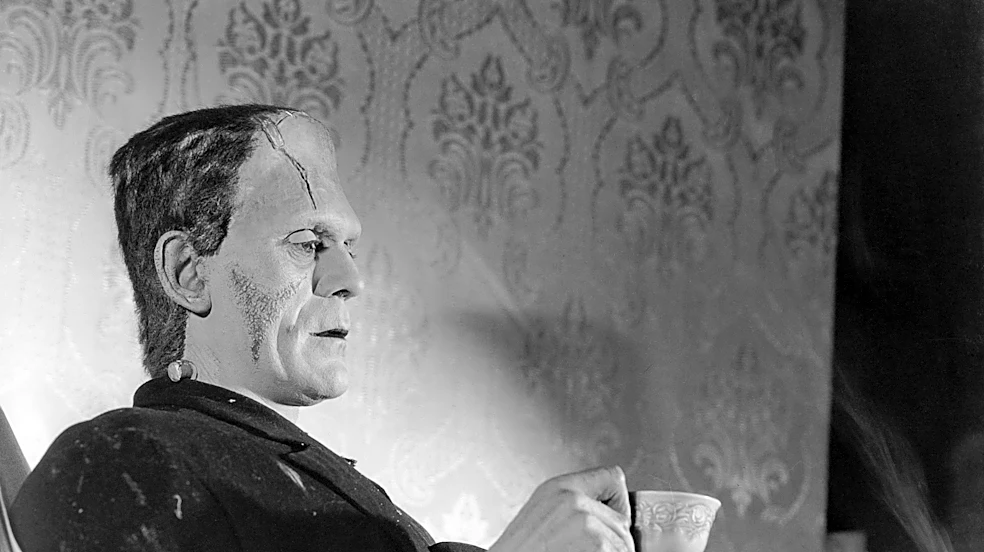
So, imagine you’re Boris Karloff. Working actor at Universal — kind of one of the lesser studios, but a job’s a job. You’re in the cafeteria one day, wearing your nicest suit, and this dapper English gentleman comes over and asks if he can have a chat. You say, sure. The nice English fellow says he’s a director, and he thinks you’d be perfect to play one of the most hideous monsters in literary history.
According to Karloff’s daughter,
her dad was thrilled at the offer, since it would be his first starring role. But he was a teeny bit offended; he thought he was looking pretty good that day, not like a terrifying corpse creature.
That’s how Karloff got the part for 1931’s Frankenstein. Which, along with that year’s Dracula, was a smash hit, and Universal turned out several more horror classics over the next few years, like The Mummy (with Karloff again), and The Invisible Man, also directed by James Whale, who did the Frankenstein movies. Whale wasn’t eager to do a sequel to Frankenstein, he didn’t want to get stuck with the label of “horror director.” But once the studio told him he could do basically anything he wanted, Whale agreed to go back to the lab slab.
There’s an OK 1998 movie, Gods and Monsters, in which an older Whale (Ian McKellen) and his hunky gardener (Brendan Fraser) are talking about Bride of Frankenstein, and Fraser asks why the movie has so much funny stuff in it. Isn’t it supposed to be horror? McKellen replies, who says a horror movie can’t be funny, too? (I think Whale’s The Old Dark House is a hoot.)
So Whale plus writers John L. Barleston, Edmund Pearson, and William Hurlbut (I REALLY want a pitcher with that name) concocted some pretty silly stuff, indeed. Like the mad Dr. Preterious who keeps mini-humans in jars, and is played by the fabulous Ernst Thesiger. Or the wild hairdo given the Bride. Or the notion that Frankenstein’s monster returns to begin with! Since he died in the original film. This might have been the first movie to pull the now-familiar “oh, actually, the monster / Freddie / Jason DIDN’T die, after all” trick.
There’s an interesting framing device at the start. It’s based on a famous 1816 visit made by poet Percy Shelley and his lover Mary Wollstonecraft Godwin to the vacation home of lauded poet Lord Byron. It was too cold and rainy to go anywhere, so Byron proposed they each write a ghost story. The 18-year-old Mary (soon to be Mary Shelley) wrote the beginnings of the novel that would become Frankenstein.
Now, in the novel (I haven’t read it), the Creature itself is extremely intelligent and verbal (some readers complain that it won’t shut up). So how did we get from that to the 1931 movie, where the creature only utters various groans? You can blame… the theater.
So says Finnish writer Janne Wass, and he would know — his website, scifist.net, intends to review EVERY science fiction movie EVER released, in EVERY country, in order. Wass began by writing about silent sci-fi, and is now up to 1959. If a movie is based on a book, Wass ALWAYS reads the book. He’s an investigative reporter in his real job, and brings those skills to movie writing. (This guy is my hero! He’ll write 4,600 words on a 1958 Indian knockoff of The Invisible Man, that’s in the Tamil language and is NOT subtitled — and Wass does not speak Tamil. He’ll soldier on anyways. That’s dedication to a bit, folks.)
Wass tells us that after the novel Frankenstein became an immediate success, theatrical versions soon popped up. The first was 1823’s Presumption; or, the Fate of Frankenstein, by one Richard Brinsley Peake. Only seven years after the original, you’ve got the monster changed into a “mute brute,” and Frankenstein intoning, “it lives! It lives!” Wass says that some of the changes were made because the original novel was seen as an attack on religion, and some were made because of, well, theatrical zoning laws. Certain theaters did Shakespeare and grand drama; the theater showing Presumption was licensed to do “musical farces and ballad operas,” so the darker speeches voiced by the creature all had to go. The story needed to be lightened up! And you bet, there WERE songs in it.
Multiple talented people worked on this, including prop maker Kenneth Strickfayden, who recycled some of his lab props from the original and added new ones (he’d do the same for Young Frankenstein too, 40 years later!). And makeup expert Frank Pierce, who basically everybody hated except Boris Karloff — Karloff got along with everybody. If you saw the movie Ed Wood, you might have thought that Bela Lugosi didn’t like Karloff; nope, Karloff charmed him too. Lugosi did resent that Karloff got better pay, and Karloff thought the studios treated Lugosi unfairly. But there was nothing he could do about it.
In addition to Karloff and Colin Clive reprising their roles from the first movie, you’ve got the additions of Una O’ Connor as a screaming local — Una O’ Connor is GREAT at this. (She’s great at it in The Invisible Man, too.) And Mrs. Charles Laughton, one Elsa Lanchester, as both Mary Wollenstonecraft Shelley and as the Bride. Lanchester based her hissing on swans — those birds can be NASTY, folks. Her throat got sore from doing it.
A friend of mine has a pretty big crush on Lanchester, and I can see why:

In addition to being beautiful in a unique, offbeat way (and a very gifted performer), Lanchester was a kind and tolerant soul; she only learned several years after their marriage that Charles Laughton was primarily gay. She was crushed — she really wanted children — but she stayed married to him for the rest of his life.
This would be the last horror film for director James Whale, and his last very successful film, period; he’d retire in 1942 after making several unquestionable classics. Karloff, of course, would go on to have a long career, capped by his wonderful vocal performance in The Grinch Who Stole Christmas. He’d suffer some lifelong back pain from the endurance feat he put into his appearances as the Creature, but he was always grateful for the fame and work it got him later. Even if he WAS kinda insulted that Whale thought he was freaky-lookin’ in the cafeteria.
So click your clicks and start the show at 7:30! Unless you get Nightmares and Tantrums.
Here’s the upcoming schedule:
October 23: Beetlejuice. If you say Michael Keaton’s name three times fast, he becomes Batghoul. With Geena Davis, Alec Baldwin, Winona Ryder, and Catherine O’Hara, who is just the best. Plus Keaton is the best, too. It’s on Archive, so if you want to download it in advance, feel free to do so.
October 30: Little Shop of Horrors. Before Howard Ashman / Alan Mencken wrote the songs for several popular Disney films, they did this musical version of a 1960 Roger Corman cheapie flick. There’s a Murder Plant, and it is voiced by Levi Stubbs, and he is beyond awesome. He’s SO good. (And the songs are good, too.)
Remember, start the show at 7:30 at this link! See ya then!