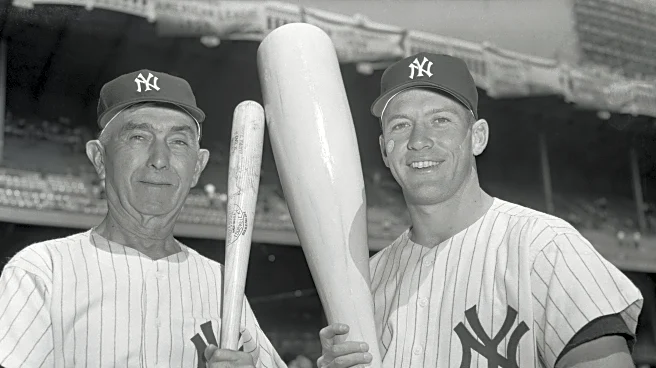


When you see someone dubbed with the nickname “Home Run” and then compare that to their career total of 96 homers, you might think that was an ironic title. Maybe it was a joke like when a big guy gets nicknamed “Tiny.” However for his time Frank “Home Run Baker” was a prolific slugger, leading the league in homers on four occasions. It’s just that his era was directly before and then overlapping a certain Babe Ruth, who proceeded to blow Baker and everyone else’s tallies out of the water.
However,
Baker was very rightly a star of his era and was eventually inducted into the Hall of Fame, for his work with the Yankees and the then-Philadelphia Athletics. Today is also his birthday, so let’s look back on the man dubbed “Home Run.”
John Franklin “Home Run” Baker
Born: March 13, 1886 (Trappe, MD)
Died: June 28, 1963 (Easton, MD)
Yankees Tenure: 1916-19, 1921-22
Baker was born in 1886 in a town on Maryland’s Eastern Shore, not far from the Chesapeake Bay. He was born into a farming family, and spent many years of his youth working the farm. Doing all that hard work on the farm helped Baker develop into a muscular young man, who first started to make waves on the baseball field while playing for his high school.
In high school, Baker was a pitcher and an outfielder, and caught some scouts’ eyes. He was signed by a local semipro team, where he was moved to third base, which would become the only defensive position he would ever play in the major leagues.
After a couple seasons playing semipro ball, Baker received a tryout with the then-minor league Baltimore Orioles of the Eastern League in 1907. While a run with Baltimore wasn’t on the card, Baker did sign professionally for 1908, joining the Reading Pretzels of the Tri-State League. Putting up a .299 batting average and a .417 slugging percentage, Baker was noticed by Philadelphia Athletics legendary manager Connie Mack. With Hall of Famer Jimmy Collins nearing the end of his career, Mack was looking for a young third baseman to take his place, and gave Baker a try, purchasing his contract from Reading in September. In eight games at the end of 1908, Baker hit just well enough for Mack to not only keep him around, but to install him as the regular third baseman for the A’s in 1909.
In Philadelphia, Baker would become a star and one of the key cogs in the A’s dynasty of the early years of the World Series. In seven seasons from 1908-14, he put up 40.9 fWAR and 42.2 rWAR, including a 1912 season that was worth 9.1 and 9.3 respectively. He led the league in home runs every year from 1911-14. It’s just that, again, the highest of those totals was 12 as it was the Deadball Era. The A’s won four AL pennants in that time and won the World Series title in 1910, 1911, and 1913. In all three of those victories, Baker OPSed over 1.000 for the series. Had the World Series MVP Award existed then, he would’ve had an especially good argument in ’11, as he hit a couple crucial home runs (the real spark for his amusing-in-hindsight nickname), including one in their clinching Game 6 win that ended up providing the series-winning runs.
After a World Series loss in 1914, Mack began to sell off several of the pieces from the previous championship teams. While he attempted to keep hold of Baker, the slugger was looking for a pay raise, having been one of the heroes of the A’s recent successes. However on the other side of the negotiating table was the notoriously stringy Mack. Both sides were also quite stubborn and stuck to their guns. In the end neither side budged, and Baker ended up sitting out the entire 1915 season. Eventually, AL president Ban Johnson put some pressure on Mack to try and resolve the situation of one of the league’s stars, which ended with Baker being sold to the Yankees ahead of the 1916 season.
In New York, Baker hit the ground running, putting up a 130 wRC+ in 1916, even with having sat out the entire previous season. He continued to be a very steady bat for them over the next several seasons, as the Yankees turned from a cellar dweller in the early 1910s to a contender by the end of the decade.

Tragedy struck in 1920, as during that offseason, Baker’s wife passed away after a scarlet fever outbreak. Devastated, Baker sat out the entire season, which was also Babe Ruth’s first in the Bronx. Towards the end of that year, he eventually began to get the itch again, and eventually rejoined the team for the 1921 season.
However this time, taking an entire season off led to some rust. The now 35-year old Baker was a below average hitter for the first time in his career, although he did help the team to their first ever AL pennant in 1921. Despite his previous postseason heroics, Baker struggled this time around, recording just two hits as they lost to the Giants. He returned to the Yankees the following year, but in more of a bench role. He again helped the Yankees to the World Series, but got just one at-bat in another series loss.
After that season, Baker decided to hang it up, just narrowly missing the Yankees finally getting over the hump in 1923. Still, he had been a major part of the team building up to get in position to win the championship. Over his six seasons in New York, he put up 19.2 fWAR and 20.6 rWAR. Following his playing career, he returned to his native Maryland and spent some time as a minor-league manager, including giving a pro debut to future Hall of Famer Jimmie Foxx and helping connect him with Mack, his old A’s skipper. He was later voted into the Hall himself, by the Veterans Committee in 1955. He eventually passed away in 1963.
It’s somewhat funny that someone got the nickname “Home Run” immediately before there was a huge jump in homers, making his record look paltry. Make no mistake though, for his era, Home Run Baker was absolutely a feared slugger.
See more of the “Yankees Birthday of the Day” series here.