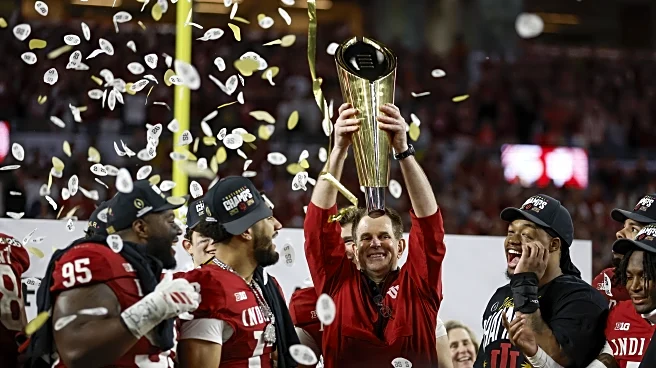




If you would have told me two years ago that Ohio State could learn a thing or two from Indiana, I would’ve absolutely assumed you were talking about the basketball team. Instead, Curt Cignetti has brought the Hoosiers to the top of the college football world, winning a national title in a perfect 16-0 campaign — and even beating the Buckeyes along the way.
Under Cignetti, Indiana has turned into a well-oiled machine on the gridiron. The head coach and his staff have done an excellent job of evaluating
talent in the transfer portal, putting together a detailed game plan on both sides of the ball, and getting each and every player on the roster to buy into the system and execute at the highest level.
At the end of the day, you can’t do anything other than tip your cap. The 2025 Hoosiers finished off one of the most impressive seasons we have ever seen. A program that had won three bowl games ever in its history — and none since 1991 — rattled off three-straight against Alabama, Oregon and Miami to win the College Football Playoff.
Ohio State isn’t exactly in the same spot as Indiana. The Buckeyes have claimed nine national championships, winning 24 bowl games along the way. Head-to-head, Ohio State is 80-13-5 against Indiana all-time. These are obviously the new-and-improved Hoosiers, but the two schools could not be more different on paper historically.
That said, Cignetti’s group outclassed Ryan Day and company this past season, and there are some things that Ohio State can learn from Indiana’s storybook run.
1. Special teams matter
Indiana defeated Miami in the national title by a margin of six points, 27-21. Of the Hoosiers’ 27 points, 13 were scored by the special teams unit, which included a game-changing blocked punt for a touchdown midway through the third quarter in addition to a pair of made field goals (from 34 and 35 yards).
The Hurricanes, meanwhile, left three points off the board with a missed 50-yard field goal, and of course got their punt blocked for a touchdown.
Another way of putting it: Special teams was the difference in the game.
In the Big Ten Championship Game, Indiana made a pair of field goals from 29 and 32 yards. Ohio State missed a field goal from 27 yards. The Hoosiers won the game by three points, 13-10.
Again: Special teams was the difference in the game.
Shortly after Ohio State’s season-ending loss to Miami, I wrote that Ryan Day doesn’t care about special teams. The Buckeyes have not taken the unit seriously at any point during Day’s seven-year tenure, and it has cost them on numerous occasions in some of their biggest games.
The Hoosiers have proved that not only should your special teams not be a liability, but it can become a massive asset for your team.
That blocked punt against Miami was no fluke; Indiana blocked four punts this season, and they blocked EIGHT total in two seasons under Cignetti. Hoosier kicker Nico Radicic went 18-of-19 on field goal attempts this year, including a perfect 4-of-4 on kicks over 40 yards. Even punter Mitch McCarthy has multiple 50-yard-plus boots under his belt, with a 55-yarder against the Hurricanes.
Special teams matter, and while Ohio State was out there hoping and praying that their kicker could maybe make a 30-yard field goal and the punter on his best day could possibly kick one 40 yards, Indiana’s special teams was winning them football games.
This wasn’t even something that was specific only to Indiana. It felt like every other team in the College Football Playoff was nailing 50-plus yarders with ease throughout the postseason. While it likely wouldn’t have mattered, Ohio State missed its only field goal attempt of the CFP — a 49-yard try that everyone in the stadium knew had zero chance of going in.
The Buckeyes are seemingly on the right track, though.
Ohio State added Baylor kicker Connor Hawkins in the transfer portal, with Hawkins nailing 3-of-4 tries from more than 50 yards this past season and a perfect 10-of-10 mark from inside 40 yards. After ranking 79th nationally in average punt yardage in 2025, the Buckeyes have also added Houston Christian punter Brady Young to compete for the starting job in 2026.
Hopefully this is one lesson they have already learned — it only took them several major losses to figure it out.
2. Coaching > talent composite
The most talented teams in college football are often the ones that find themselves playing for championships at the end of the season.
Of the top five programs in the 247Sports Talent Composite for 2025, all but one (Texas) made the College Football Playoff. Among the 10 P4 schools to make the field, nine of them ranked in the top-30 on the Talent Composite, with seven of them ranking among the top-15.
Then there was Indiana, all the way down the list at No. 72.
The Hoosiers’ roster did not contain a single five-star prospect, and only seven of their players were even four-star recruits coming out of high school. For comparisons sake, Ohio State’s roster boasted 11 former five-stars and 56 four-stars. Indiana’s blue-chip ratio was just 8% — the first team ever to win a championship at less than 50% — compared to 73% for the Buckeyes.
When the two teams met on the field in Indianapolis, none of that mattered. Indiana was indisputably the more well-coached team when they defeated Ohio State, and was the nation’s best coached team right down to the final game.
That starts with Cignetti at the top, who has won at every stop he’s made, but he has also surrounded himself with proven, experienced coaches across his staff that helped to get the most out of his team. In addition, it is a group of guys that have worked alongside Cignetti for a long time across multiple programs.
Hoosiers defensive coordinator Bryant Haines first linked up with Cignetti as an S&C/defensive line coach at Indiana University of Pennsylvania. He made a quick pitstop to coach linebackers at UC Davis before re-joining Cignetti at Elon. Haines followed Cignetti to James Madison as a LB/co-DC before taking on the full-time DC role in 2022. Haines has worked in the same role at Indiana for the last two years.
Offensive coordinator Mike Shanahan was wide receivers coach for three seasons at IUP and Elon under Cignetti. Shanahan tacked on a role as recruiting coordinator when the duo moved on to James Madison in 2019, and later became JMU’s offensive coordinator in 2021. Shanahan remained Cignetti’s OC at Indiana each of the last two seasons.
There are more guys like that across this Hoosiers staff. Special teams coordinator and tight ends coach Grant Cain has been with Cignetti for the past seven years. Running backs coach John Miller has been with Cignetti for six seasons.
In addition to the guys who have worked with Cignetti forever, he also brought in coaches with tons of experience.
Offensive line coach Bob Bostad has 27 years of experience, including stops in the NFL (Buccaneers, Titans) and other P4 programs (Minnesota, Wisconsin). Defensive backs coach Ola Adams has 16 years of experience, coaching at a handful of FCS programs plus a year each with the Denver Broncos and at Penn State.
The list goes on and on. As a whole, Cignetti’s staff is oozing with both familiarity and experience, and that showed itself on the field with how well prepared Indiana looked in each game.
Now compare that to Ohio State’s staff this past season — especially on the offensive side of the ball, where the Buckeyes had the majority of their issues.
Offensive coordinator Brian Hartline was an excellent recruiter, but had zero experience as an offensive coordinator and play-caller. Offensive line coach Tyler Bowen was a tight ends coach at Virginia Tech prior to Ohio State, and had not coached offensive line since 2017. Keenan Bailey was promoted from quality control coach to tight ends in 2023, then promoted to co-OC in 2025 with no other coaching experience.
Outside of Carlos Locklyn, who Ohio State brought in from Oregon before the 2024 season, virtually nobody on the Buckeyes’ staff possessed the necessary experience to coach at this level. Ryan Day was sorely missing the presence of someone like Chip Kelly, who brought with him outside knowledge and coaching experience.
Without Kelly, there was nowhere for Day to turn for help, and the offense sputtered behind a supremely under-qualified offensive coaching staff.
Curt Cignetti’s staff, meanwhile, was a well-oiled machine full of experienced coaches that all meshed together like puzzle pieces. That, and not a roster made up of five-star talent, was the key to the Hoosiers’ success.
3. Scared money don’t make money
When you have the type of athletes that Ohio State has on the field, there is no benefit to playing conservative. The Buckeyes should have been one of the most aggressive teams in the country with guys like Jeremiah Smith, Carnell Tate and Bo Jackson atop their skill core, plus a defense you could trust to pick up the slack when needed.
Instead, when it came down to it in the Big Ten Championship Game against Indiana, Ohio State elected to play it safe — and got burned.
Twice against the Hoosiers did the Buckeyes attempt field goals from inside Indiana’s 12-yard line.
The first came early in the second quarter. Ohio State hit on a huge chunk play to Jeremiah Smith for 52 yards, and a late hit on Julian Sayin tacked on another 11 yards to give the Buckeyes the ball at the Indiana 11-yard line. Back-to-back runs of two yards set up third-and-6 and the 7-yard line. From there, Sayin was sacked for a loss of four to set up fourth-and-10.
The Buckeyes certainly could have rolled the dice, at worst still holding a 7-3 lead and pinning Indiana deep in its own territory. Instead, Ohio State elected to settle for the 30-yard field goal, which Jayden Fielding shockingly made, but left points off the board from so close to the end zone.
The second, and obviously more detrimental of the two, came late in the fourth quarter.
Ohio State marched all the way down the field from its own 10-yard line down to the Indiana 18-yard line. Jackson’s first down run netted eight yards, followed by a one-yard run and an incomplete pass on a bafflingly stupid play-call with the only route being run by the Buckeyes’ fourth-best tight end in the end zone.
Faced with a fourth-and-1 from the Hoosiers’ 9-yard line and a knowingly un-clutch kicker, Ohio State shied away from being able to get a single yard and instead trotted Fielding out there. He missed the 27-yard attempt, and as a result the Buckeyes lost the game.
Ohio State had managed 81 yards on the drive, but was too scared to try and get one more and go for the win. This came one drive after they did attempt to go for it on fourth-and-1 inside the Indiana 5-yard line, and would have gotten it easily had Sayin’s knee not touched early on an attempted QB sneak.
Compare that with how Indiana approached a similar situation in the National Championship Game.
Leading 17-14 with less than 10 minutes remaining in the game, Indiana was faced with a fourth-and-4 from Miami’s 12-yard line. Cignetti could have elected to take the chip shot field goal and put his team up by six points, but instead he trusted his best offensive players to go out there and try to put the game away.
On fourth down, Fernando Mendoza took off on a QB draw, juking a defender and rumbling his way towards the end zone, diving across the line for a touchdown that will live on in college football lore for all eternity. Instead of leading by six, Indiana now held a two-score lead at 24-14 with a little more than nine minutes remaining.
When the chips were down, Cignetti put the ball in the hands of his best players and let them decide the outcome. When Ohio State was given a chance to win a Big Ten title, they let one of the worst players on the roster dictate the result.
Playing conservatively is almost never the answer, especially at a program with the level of talent that Ohio State has year in and year out. When the game is on the line, your best players should have the football in their hands.
That isn’t to say that you should be going for it on every fourth down, but when the option is Sayin/Jackson/Smith or your terrible special teams unit in a do-or-die situation, the choice should be easy.