


This offseason has felt a little different for the Colts. Not necessarily because of the individual moves themselves, but because of what those moves suggest about the direction of the team.
Normally when a team signs players or restructures contracts, it feels like normal roster building. A couple depth signings here, an extension there, maybe a splash move if the opportunity presents itself. The Colts have operated that way for most of Chris Ballard’s tenure. They’ve typically preferred patience,
building through the draft, and avoiding the kind of contracts that can cripple a roster years down the road.
But this offseason doesn’t feel like a patient, long-term build. It feels like a team that is clearly building for one specific season.
2026.
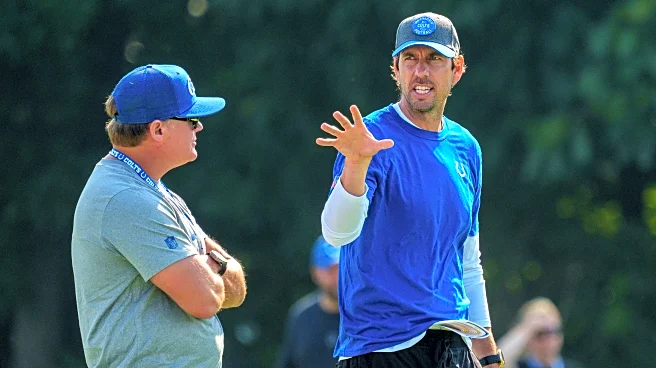
Chris Ballard and Shane Steichen are not entering this year with unlimited runway. Another season hovering around .500 and missing the playoffs certainly ends their time in Indianapolis. Even making the playoffs might not be enough if the Colts sneak in and then get bounced immediately in a non-competitive game.
At some point the “we’re building something” phase has to turn into actual results.
So when you step back and look at the decisions the Colts have made so far this offseason, they start to make a lot more sense through that lens. The front office isn’t operating with a five-year horizon right now. They’re trying to assemble the best possible roster for this coming season, even if that means pushing financial consequences into future years.
Of course, this is obvious. Ballard is building a team to save his job, but what he’s forgetting will hurt him if he somehow manages to keep it past 2026.
Contracts are being structured to keep the cap manageable today. Money is being pushed into 2027 and 2028. Depth is being added quickly to plug obvious holes. This isn’t the careful, methodical team-building approach Ballard has talked about for years.
And once you look at the offseason through that lens, the biggest move of all makes a lot more sense.
Daniel Jones.
Once the Colts decided they were bringing Jones back, the rest of the offseason essentially flowed from that decision. And while the contract structure they used helps keep the cap hit manageable for 2026, the deal still leaves a bit of a strange feeling.
In theory, the Colts had other options at quarterback.
Tua Tagovailoa could have been acquired for around $1.5 million. Kyler Murray might be available for under $7 million. Geno Smith was another potential option at roughly $3.3 million. The Colts even could have traded for Mac Jones and paid roughly $4 million for the season.
None of those options would have been perfect solutions. But they all likely would have been cheaper than committing roughly $44 million per year to Daniel Jones.
Instead, the Colts doubled down on the quarterback who played well for roughly two months in Shane Steichen’s system last season.
To be fair, that stretch clearly meant a lot inside the building. For the first time in a while, the Colts’ offense actually looked comfortable. The ball came out accurately on time, the system flowed the way it was supposed to, and Jones seemed to understand exactly what Steichen was asking him to do.
For a franchise that has spent years searching for stability at quarterback since Andrew Luck retired, that kind of stretch probably felt meaningful.
But it’s also hard to ignore the context.
Jones was coming off an Achilles injury, which should naturally limit his market to some degree. Yet the Colts moved quickly and paid him like a team that believed multiple suitors were waiting behind them.
That’s where the whole situation starts to feel like the Colts were negotiating against themselves.
The contract was structured creatively to reduce the immediate cap hit for 2026, which allows the team to build the roster around him this year. But that flexibility comes with consequences down the road. Jones is scheduled to carry a massive cap hit of roughly $46 million in 2027 and around $26 million in 2028, which is technically a void year.
If the Colts want to keep him beyond that point, they would need to renegotiate the deal or extend him again.
In other words, the Colts created cap space for today by pushing a lot of the financial weight into tomorrow. They’ve also been doing that with a lot of other players, so those 2027 and 2028 cap hits are getting pretty big already.
The best way to describe it is like high cholesterol. It’s manageable for now, but if it’s ignored for too long, it eventually becomes a real problem.
That fits perfectly with the overall theme of this offseason. The Colts are not really building for 2027 or 2028 right now.
They’re building for December and January of 2027.
Of course, the entire gamble only works if Jones is actually healthy.
Jones has said he expects to be ready by training camp. If he returns by August 1st, that would put his recovery timeline at roughly 235 days after surgery, just over eight months. That’s ambitious!
It’s not impossible, but Achilles recoveries are notoriously unpredictable. If Jones comes back on schedule and looks like the same quarterback he was during that stretch last season, the deal becomes much easier to justify. But if the recovery drags on or his mobility never quite returns, the contract could become uncomfortable very quickly.
The other major piece of the offseason was keeping Alec Pierce.
We don’t have the full details of Pierce’s contract yet, but it’s safe to assume the Colts also backloaded his contract significantly. Pierce strikes me as a receiver who probably should command somewhere in the $23–25 million per year range, but got 28M.
Still, keeping him was extremely important for this team, so the overpay was justifiable.
Pierce was the Colts’ best receiver last season. His ability to stretch the field vertically forces defenses to play differently. With Pierce on the outside, Josh Downs working underneath, and Tyler Warren emerging as another legitimate weapon, the Colts have three receiving options that can stress defenses in different ways.
That kind of continuity matters, especially when you’re committing to the same quarterback and offensive system.
The path to keeping Pierce, however, was unnecessarily complicated.
Earlier in the month, Ballard used the transition tag on Daniel Jones instead of Alec Pierce. That decision briefly reduced the chances of keeping both players and created a window where Pierce could have realistically tested the open market.
In the end, the Colts got the outcome they wanted. Pierce is back, and the offense retains the core group of weapons that made it functional last season.
But the process leading up to that result was far messier than it needed to be.
And like several other decisions this offseason, it felt like a move driven more by urgency than long-term planning.
Beyond those two headline moves, the Colts quietly made a series of depth additions along the defensive line.
Michael Clemons, Colby Wooden, Derrick Nnadi, and Arden Key might not be headline-grabbing names, but collectively they address what was arguably the team’s thinnest position group.
The idea seems fairly clear. Instead of relying on one superstar pass rusher, the Colts appear to be building a deeper rotation of capable defensive linemen.
Seattle won a Super Bowl with that type of formula. New England built a team last year with no names in the front 7 and went to a Super Bowl on the backs of those players. Constant waves of fresh defensive linemen can wear down offensive lines over the course of a game.
Right now, the Colts potentially have six or seven playable defensive linemen between Buckner, Stewart, Latu, Clemons, Wooden, Nnadi, and Key.
The goal from here is probably to find one more legitimate pass rusher to complement Latu and add another rotational piece if needed.
Not every move this offseason made perfect sense though.
Letting Nick Cross walk was puzzling.
If Cross simply didn’t want to return, that ends the discussion. But if there was any interest in keeping him, the contract he signed with Washington — two years for up to $14 million — feels extremely reasonable.
Now the Colts have another hole at safety that they’ll need to fill.
Braden Smith’s deal with Houston was another situation where the price simply became too high. I had him pegged as a player who should command roughly $7–9 million per year, so seeing him land closer to $12 million annually was a bit surprising.
Even so, the Colts still need a legitimate option to compete with Jalen Travis at right tackle.
The offensive line depth overall is not particularly strong right now, which becomes concerning if injuries start piling up during the season.
Normally, a team could address a lot of roster holes through the draft.
But the Colts don’t have the luxury of a full slate of picks this year. Their first selection doesn’t come until pick 47, which makes it significantly harder to find immediate-impact starters.
And Ballard’s recent draft track record doesn’t exactly inspire confidence.
The last three second-round picks were JT Tuimoloau, Adonai Mitchell, and JuJu Brents. Two of those players are already off the roster, and Tuimoloau has struggled to become a meaningful contributor.
That doesn’t mean the Colts can’t find good players this year.
But expecting the draft class to immediately solve several roster holes might be optimistic.
Right now, the Colts still have some clear needs.
Defensively, they could use another starting-caliber edge rusher, both off-ball linebacker spots need attention, and there’s a hole at safety.
Offensively, the team still needs another wide receiver to replace Michael Pittman Jr., better depth along the offensive line, and ideally a reliable backup running back.
That’s roughly six positions that still need to be addressed if the Colts want to realistically look like a playoff-caliber roster.
So where does that leave the team overall?
Honestly, somewhere in the middle.
If Daniel Jones comes back healthy and plays the way he did during that stretch last season, the offense should be functional. With Pierce, Downs, Warren, and Jonathan Taylor, there are enough weapons for the system to work.
If the offensive line holds up and the defensive line rotation produces consistent pressure, the Colts could absolutely win the division and position themselves for a favorable playoff matchup.
But the margin for error is extremely thin.
If Jones isn’t healthy, or if his play regresses, everything else becomes irrelevant very quickly.
The Colts are not a roster that can overcome poor quarterback play.
And that’s ultimately what makes this entire offseason feel so interesting.
Chris Ballard is building this roster with urgency. Contracts are backloaded. Cap space is being borrowed from the future.
It feels like a front office trying to assemble one good roster before the clock runs out.
Whether that gamble pays off will depend almost entirely on one thing:
Daniel Jones.