

NBA history spans 80 seasons, and as CelticsBlog readers well know, the Boston Celtics have won a league-high 18 championships. This month, we are recapping each of those title years.
Bird vs. Magic – Showtime vs. well, a team that wasn’t cool enough to have a nickname for its style of play. Boston vs. LA. Old vs. New. Gold and purple vs. green and white.
It was the 80s and the Lakers were the 80s in basketball form.
They played in the “Fabulous Forum” on a court that was trimmed in gold. Their head
coach, Pat Riley, was a fashion plate as well as a competent strategist who had delivered a championship in his first year on the bench.
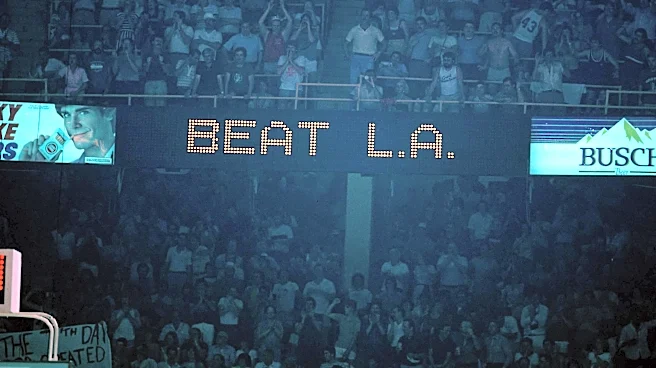
They had a player who more than lived up to his ‘Magic’ nickname. They had celebrities sitting courtside. They came from a city where it never rained and where winter was more theoretical than real. This was the city where dreams became reality, or at least as real as movies could make them. It was a city that was known, around the world, by just two letters: L.A.
Their star, with his infectious grin, had already made good in the NCAAs, defeating Larry Bird in the Final Four, and he’d won a pair of championships in the NBA as well.
At literally the other end of the country were the Celtics.
If the Lakers were the 80s personified, then the Celtics were the foundation and the first few floors of NBA history. They were run by Red Auerbach, who had been a fixture in the league from its inception. He had won fourteen championships by this point in time—nine as a coach and five as a general manager. They wore uniforms that were barely distinguishable from the ones that the team was wearing when Red was hired to coach them more than thirty years earlier. Their arena was a relic—a cramped relic painted mostly yellow, without air conditioning, with seats that were jammed together and placed behind columns and every one of them had been occupied for every single game the Celtics played for the past three seasons.
The Celtics played on a parquet court that had been trod by the league’s legends going back to the first year after World War II. It was a scarred and uneven surface that matched the tough and gritty character of the arena built around it.
The Celtics played in Boston—a crowded city where the past was present everywhere, where landmarks from the beginning of the nation were part of the fabric of everyday life, a city somehow nicknamed ‘Beantown.’ It had everything that L.A. lacked—history, tradition, cultural institutions—and it was hopelessly, helplessly uncool.
The 1984 Finals were a culture clash as well as a basketball contest.
Boston was coached by K.C. Jones. Jones, who had played for Red Auerbach in the 1950s and 1960s, had been on the bench as an assistant with the Lakers when Pat Riley played for them in the early 1970s, and had already coached a team into the Finals—the Washington Bullets (now Wizards) in 1975.
Jones was on the bench because the Celtics had more or less quit on Bill Fitch the year before. “I admit it,” M.L. Carr would tell Jackie MacMullin in her tale of Magic and Bird, When the Game was Ours, “Our goal in 1983 wasn’t to win a championship. It was to get rid of Fitch.”
While it’s unlikely, in hindsight, that the Celtics could have stopped the ‘fo-fo-fo’ Sixers, the way the Celtics gave up on the season incensed Larry Bird, who realized that once a year was gone it wasn’t coming back: “We could have won in ’83, but we didn’t because of all the [expletive] with Bill Fitch. Then we could have won it in ’85, but we didn’t because of more [expletive]. There are two years, right there, where we were young and together and healthy, and we didn’t capitalize on it. Looking back, it just kills you.”
The Celtics, who had made a poor showing in both the regular season and the playoffs the year before, had a new point guard to go along with a new coach.
As good as Nate “Tiny” Archibald had been, there was a problem with him implied by his nickname. “Tiny” was barely more than six feet tall, and he had struggled mightily to contain Andrew Toney, the “Boston Strangler,” and off in the distance was Magic Johnson, a 6’-9” point guard whose size allowed him to play the position in a manner that has never really been seen before or since.
Red had traded for Quinn Buckner in 1982, but he realized that an even more capable player was needed.
Enter Dennis Johnson.
Dennis Johnson was yet another Auerbach heist. He had been labeled a ‘cancer’ by Phoenix Suns coach John MacLeod.
Desperate to rid themselves of him, and thinking that they were getting a real steal from Auerbach because they were actually going to get a serviceable big in Rick Robey in exchange for a player they really didn’t want, three-time Executive of the Year Jerry Colangelo let himself get fleeced by the master.
Rick Robey was good, but DJ’s years with Boston put him in the Hall of Fame.
Red didn’t see a malcontent, he saw a guy driven to win on a team that wasn’t. DJ had scrapped his way up from playing junior college ball and working a factory job into a Finals MVP award. He was an excellent two-way player who could defend as well as he could dunk in his early years in the league. He had bounced back from an atrocious showing in the 1978 Finals to being the linchpin of the Sonics’ 1979 title winning team.
And he had the size and the mentality to body up against Magic.
The Regular Season
The Celtics started off relatively slowly. On November 22, they were just 9-5 and coming off a four game losing streak, but they proceeded to rip off a 29-4 record over the next 33 games. They finished the season with a 62-20 record identical to that of their previous championship winning season in 1981. This was easily the best record in the NBA—the next closest team was Los Angeles, who were 8 games behind the Celtics.
The Celtics weren’t exactly a grit and grind team, no team was in the go-go 80s, but they played the game with more deliberation than most, finishing the season with a below average pace of 99.7 possessions per game, good for just 15th in a 23 team league. Nonetheless, their net rating was 6.5 points to the good per 100 possessions, which was the best in the league. As with so many of Red’s teams, Boston’s defense was the real story. The Celtics could score as well as anybody, but they were very good at keeping their opponents from scoring.
Larry Bird finally cracked through and won the MVP award. He led the team in scoring and assists and dang near led the team in rebounds as well. His free throw percentage, 88.8%, was the best in the league. After him, five more Celtics averaged double figures, with Kevin McHale winning the league’s inaugural Sixth Man of the Year award behind 18.4 points per game and a team-high 55.7% field goal percentage.
Bird’s MVP award broke a near stranglehold on the honor that had been held by centers. Since the award’s inception, it had only gone to three players who played other positions: Bob Cousy, Oscar Robertson and Julius Erving. Since then, it has only been awarded to centers on seven occasions.
This was the first of three consecutive MVP awards for Larry Legend—a feat that only he, Bill Russell, and Wilt Chamberlain can claim.
Eastern Playoffs

The NBA expanded the playoffs for the 1983/84 season. Now the first round was a best-of-five affair and there were no byes granted to the top teams in the league.
Thus Boston would need to win three playoff series just to get to the Finals.
Their first opponent was the Washington Bullets. The Bullets had the worst record of any playoff team at 35-47. In reality, letting a team with a record this poor into the playoffs wasn’t exactly unexpected. The NBA was a 23 team league with a 16 team playoff. Three teams with losing records made the playoffs in 1984 and a fourth, Phoenix, sat at .500 on the nose with a 41-41 record.
Regardless of record, the Bullets put up quite a fight. After a relatively easy eight point win in game one, the Celtics won two games by three points and lost a game by three as well.
Bird averaged 22.8 points, 7.5 rebounds, 7.8 assists and two steals per game for the series, but he was arguably outplayed by Jeff Ruland, the Bullets’ center, who torched the Celtics for 24 points per game to go with 12.8 rebounds and 7.8 assists. Ruland had made the All-Star team that year and was having his best season. Ruland’s career, like Bill Walton’s would be derailed by chronic and nearly debilitating foot problems, but for a while, he was a genuine star for the Bullets—and a tough, tough player. Also making himself a pest during the series was fourth year player Rick Mahorn. Mahorn would make himself more of a pest for the Celtics as the 1980s wore on.
Mahorn and Ruland were known as the “Beef Brothers” for their rather physical style of play; at least that’s what Bullets fans called them. Longtime Celtics radio announcer Johnny Most had different nicknames for them: McFilthy and McNasty. CelticsBlog contributor Mike Dynon, who’s been following the team since the 1960s, said that they were “Pistons lite, before the Bad Boys,” adding, “Ruland and Mahorn would hit people and then look at them in a ‘what are you going to do about it’ way.”
The Celtics’ series against the Bullets was a physical contest. It was a series that Dan Shaughnessy said was filled with “meanness, malice, and good old fashioned mud-slinging and name calling.”
In the closeout game, the Celtics were sitting on a 16 point lead in the third quarter when Parish picked up his fourth and fifth fouls in less than a minute. This keyed a 9-0 Bullets run. Parish, who was doing his best to contain Ruland, and who had looked rather pedestrian during the series, fouled out with just over two and a half minutes to go and the Celtics up by ten. The Bullets put in a solid effort to come back, scoring six points in a row, but two free throws by DJ gave the Celtics the margin they needed, 92-86, with less than a minute on the clock. A flurry of intentional fouls inflated the final score to 99-96.
When the buzzer sounded, the Celtics were the winners, but the series wasn’t over—at least not for Gerald Henderson and his Bullets counterpart, Frank Johnson. The two got into a fight that saw them wrestling around on the floor as the rest of the Celtics and Bullets mostly tried to separate them. Mostly they were trying to separate them, “I had no idea what was going on out there,” Ruland said after the game, “I was just sorry I couldn’t get one punch in just for the fun of it.” Cedric Maxwell alleged that Frank—or someone on the Bullets—bit Gerald, “I want to know how Gerald Henderson could have a human bite on him.”
No one was suspended and no one was fined. Times have changed.
The Bullets were a rough and tumble team and they gave as good as they got for four games against the Celtics.
In the next round, the Celtics faced the New York Knicks.
The Knickerbockers were at the tail end of a brief bout of competence. They had finished above .500 three times in four years, a feat that they hadn’t accomplished since their championship winning seasons over a decade earlier. The team would tank their way into Patrick Ewing the following season, but for 1983/84, they were a tough matchup for Boston.
The series was pure chalk, with the home team winning every game. The Celtics probably should have put the Knicks away before it came down to a winner-take-all contest at Boston. They won their games by an average margin of 17.75 points, but Madison Square Garden seemed to have some store of Kryptonite on hand, as the Celtics lost those contests by a combined 15 points.
The series was a bizarre affair, considering that a seven game contest usually means a number of close games along the way. Instead, five of the seven games were won wire-to-wire, and there were only four lead changes during 336 minutes of cumulative play.
The star for the Knicks was Bernard King, whose Hall-of-Fame career probably could have been even more spectacular if not for a gruesome injury incurred while trying to block a dunk in a meaningless game against the Kansas City Kings in 1985. King broke his femur and wrecked his knee and was never quite the same. For the series, King’s stat line was 29.1/4.9/3.3 in points, rebounds and assists.
Larry Bird, on the other hand, was transcendent. He averaged 30.4 points per game, just edging out King’s 29.1 average; Bird also netted 10.6 rebounds per game which, again, topped both teams. He led both teams in steals at 2.7 per game, and his 50 assists for the series were the most of any player as well. He led all players in field goal percentage at 58.5%, and singlehandedly ensured that the Celtics would live to fight another day.
This was Larry at his peak.
In game seven, Bird recorded a triple double with 39 points, 12 rebounds and 10 assists and a perfect 12-12 performance from the free throw line.
Defeating the Knicks set the table for an Eastern Conference Finals that proved anticlimactic.
The Celtics were up against the Bucks, who had soundly trounced them the year before—of course, this was also the year that the Celtics were in open rebellion against Bill Fitch, so the Bucks might have brought the wrong ideas into the contest. The Celtics, on the other hand, were determined to make sure they buried the past.
The series was over in five games.
Once again, Bird led all players—on both teams—in points, rebounds, assists and (almost) steals. On that last stat, he was tied with the Bucks’ Sidney Moncrief, a fellow Hall-of-Famer.
Boston’s average margin of victory across four wins was 13.5; none of the contests were particularly close, including the Bucks’ sole win in game four.
This set up the showdown that everyone had been waiting five years for.
The Finals

The Lakers had already won—and lost—against the Sixers, and the Celtics had taken a championship from the Rockets the year that the Lakers quit on Paul Westhead, but Bird and Magic had not, as yet, squared off for all the marbles.
L.A. was coached by Pat Riley, in his third year, and had the league’s second best record at 54-28. They had six future Hall-of-Famers on their roster, although two of them, James Worthy and Jamaal Wilkes, were at the beginning and end of their respective careers.
Game One
Game one went to the Lakers in frustratingly undramatic fashion. They simply came into the Garden, took control of the game as though they were playing a junior league squad, and forced the Celtics to play ball the way they wanted to play it. Los Angeles had a 12 point lead after the first quarter and never really looked back. Kareem, who had almost beat the Celtics all by himself ten years earlier, picked up as though no time had passed at all and rattled off 32 points on 12 of 17 shooting from the field and 8 of 9 shooting from the line. The Lakers’ second year player, James Worthy, scored 20 points, and the team shot 51.8% from the field.
Game Two
Game two went to Boston in a contest that featured extra basketball for everyone. Boston came out hot and won the first quarter 36-26, but the Lakers clawed their way back. Their deficit after three quarters was just three points, and they made that up and then some in the fourth period. They had a two point lead when McHale was fouled and sent to the line. With a chance to tie, he missed both free throws and the home team looked like they were headed into a 2-0 hole. There were 20 seconds left on the clock. The Lakers called a timeout. Magic inbounded the ball to James Worthy.
And then James Worthy passed the ball to Gerald Henderson. Henderson sprinted down the court and laid in a game-tying basket with thirteen seconds to go.
The Celtics locked down every single Laker during the subsequent possession.
Los Angeles held the ball for the rest of regulation.
They never got a shot off.
In overtime, things once again looked bad for the Celtics. The Lakers had a three point lead when Kareem’s normally flawless sky hook went off the mark. Bird (who else?) corralled the rebound and sent an outlet pass down the court to Gerald Henderson who made a traditional three point play count for another tie.
With the Celtics down 121-120 and fourteen seconds on the clock, Scott Wedman buried a 13 foot jumper for the lead. At the other end of the court, Parish stole the ball from Bob McAdoo and the Celtics hung on to win.
Game Three
The series shifted from Boston to L.A., from a city steeped in tradition to a city that, despite being over 250 years old, is somehow always new.
The Lakers were in their element here. This was their home and they were comfortable.
After a close first quarter, the Lakers proceeded to curb stomp the Celtics. They ran Boston out of the Forum behind seven double-digit scorers, including five of their six future Hall-of-Famers and Kurt Rambis, who went a perfect seven for seven from the field.
The Lakers had a 2-1 lead on the Celtics, but to be honest, it really felt like a 3-0 lead. The Celtics had barely squeaked out a victory in game two, and it looked like the future of the league belonged, exclusively, to Los Angeles. Sure the Celtics were good and Bird was extraordinary, but, well, it seemed that they just didn’t have ‘it,’ whatever ‘it’ was.
Game Four

There are games and then there are games.
Boston found themselves in a ten point hole at halftime of game four and looked like they were completely out of it. If the Lakers held onto their lead, they would be sitting on a 3-1 advantage, with three opportunities to close out a team that owed its sole victory primarily to a Gerald Henderson steal.
But there’s something to be said for the tenacity the Celtics showed in that game two win, because they brought it out again in game four. In fact, tenacity is what defined the Celtics in this series.
For starters, Boston finally managed to slow the game down in the third quarter—in dramatic fashion.
After six quarters of letting the Lakers play the game the way they wanted it played, after six quarters that they had lost by a combined 43 points, something snapped.
K.C. Jones told the team “No more layups.”
And Kevin McHale took the instruction about as literally as anyone could take it.
About halfway through the third quarter Kurt Rambis broke free off a Boston miss, with the Lakers holding onto a six point lead, 76-70.
He had just left his feet on the way to the basket when Kevin McHale took him out.
McHale grimaced and awkwardly extended his left arm catching Rambis in the neck and shoulder. Kurt’s momentum sent him flying onto his back somewhere near the baseline.
By the time Rambis hit the court it wasn’t just the tenor of the game that had changed. The whole series changed. The Lakers, who had cruised to two easy victories, would lose three of the next four contests.
McHale stayed in the game. In fact, he wasn’t even called for a technical, despite a brawl nearly erupting in the aftermath of the foul.
The Celtics won the balance of the third quarter by four points, and headed into the fourth quarter down two. They weren’t going to cruise to a comeback victory, and cruising to a comeback just wasn’t their style. The Celtics were going to take every point they scored from the Lakers by force and by desire.
The Celtics were going to win game four because they wanted to win the game more than the Lakers did, and it was as simple as that.
The Lakers were trying to protect a five point lead off a pair of Magic free throws with less than a minute to go when the Celtics, who never led during regulation, closed the gap. They reduced the lead to two on a traditional three-point play that came after Parish caught his own offensive rebound and put it back in the midst of a rugby scrum under the basket. The Lakers did their best to dribble out the clock but ultimately settled for a Michael Cooper two from deep that bounced off the rim and into the hands of Parish, but not before Kareem shoved Bird. It was the sixth foul on the Lakers center, and it sent the league’s best free throw shooter to the line. The first free throw hit nothing but net. The second one rattled around a bit and then dropped through. The game was tied.
On the Lakers’ subsequent possession, Jones put Parish on Worthy, a move that paid off when Magic, being hounded practically off the court by DJ made what should have been a routine pass down the sideline to Worthy. Parish stuck an arm into the passing lane, deflected the pass and then wrapped it up with four seconds on the clock. A long three by Bird and a putback by McHale both caromed off the back of the rim and the game headed to overtime.
DJ scored Boston’s first four points in the extra period—but the Celtics were struggling to contain second year player James Worthy, already well on the way to earning his “Big Game James” nickname. Worthy scored nine of the Lakers’ twelve points in the overtime session. When he made a hoop and the harm count late in the overtime period, he gave the Lakers their last lead of the game at 123-121. Bird proceeded to tie the game up with 1:19 to go. Magic had a chance to put the Lakers up two, off a foul by DJ, but missed both free throws. Bird came out of the Boston timeout that followed and gave the Celtics the lead on a turnaround jumper. With ten seconds to go, Worthy was fouled by McHale, and after he missed his first free throw, Cedric Maxwell walked across the lane in front of James with his hands to his throat signifying ‘choke.’
DJ made two free throws and then M.L. Carr stole Worthy’s inbound pass and dunked the ball emphatically, giving the Celtics a four point lead. When the dust settled, the Celtics had beaten the Lakers 129-125, but more than that, they had seized control of the series.

Game Five
The Celtics ran away with game five. The Lakers played the Celtics close in the stifling heat of Boston Garden for the first two quarters, but couldn’t keep up with Boston as the game wore on. The Lakers were outscored 33-24 in the third quarter and 33-26 in the fourth; the final score was 121-103 Boston. The Celtics finally shot the ball better than L.A., hitting at 51.9% compared to a 42.9% clip from the Lakers. Worthy was the only Laker to crack 20 points. On the other end of the court, Larry Bird led all scorers with 34 points and bested both teams with 17 rebounds as well.
The Celtics, who had been left for dead after game three were in the driver’s seat with a 3-2 series lead.
Game Six
The Lakers salvaged game six off a furious fourth quarter comeback. The Celtics had played their brand of basketball for, basically, eight and a half straight quarters, going back to the midpoint of the third quarter of game four, but they let up on the Lakers in the fourth quarter of game six. Los Angeles came into the quarter down four and proceeded to outscore Boston 36-21, for an eleven point victory, 119-108. Kareem put in 30 points, 10 rebounds and 5 assists, against 28 points, 14 rebounds and 8 assists from Bird.
Some Lakers fans might have seized onto this aberration as proof that, perhaps, the tide had shifted back in favor of the purple and gold.
If so, game seven would prove to be a colossal disappointment for them.
Game Seven
The Lakers and Celtics were knotted at 30 all after one, but the Celtics had a six point lead by halftime, and after the third quarter the Lakers were down thirteen. The Celtics held on to win the game—and the title—by a final margin of 111-102.
Los Angeles fouled the Celtics 32 times—in a 48 minute game—and sent the Celtics to the line 51 times, where the Celtics shot a lights-out 84%. Both DJ and Bird were perfect from the line.
In fact, the Celtics outscored the Lakers by 25 points from the charity stripe. This more than made up for another bad shooting performance from the Celtics, who really only had one game during the series where they shot at a rate that even approached their regular season levels.
Was there a conspiracy afoot? Hardly. The game was called with a tight whistle—Gerald Henderson picked up three fouls in the first four minutes of the game.
Boston adjusted. L.A. did not.
Larry Bird won a well-earned Finals MVP to go with his regular season title.
For the series, the Legend led all players in points, rebounds and steals. Magic, to no one’s surprise, led both teams in assists.
In the 1984 Finals, Larry was on the court with nine other future Hall-of-Famers, and he out-performed every one of them.

Turning Point
There really were two turning points in this series. The first was Gerald Henderson’s steal and layup that forced overtime in game two. Without it, the Lakers probably cruise to an easy championship victory, or, at best, the Celtics do no better than make things interesting for a game or two.
But Henderson’s steal didn’t really stop L.A., as they clobbered Boston in the next game.
The second turning point came when McHale rather emphatically kept Rambis from grabbing an easy two. From that point on, Boston took over the series.
In the thirteen and a half quarters that followed the Rambis clothesline, LA had one where they looked like the team that was on the verge of a 3-1 lead at halftime of game four. It was all Boston the rest of the way.
Boston had taken the first round of this new rivalry with Los Angeles. The Lakers, however, would be back. Bad health and bad luck would rob this rivalry of much of the sizzle this series promised, but for 1984, at least, Boston had carried the day.

Stop by Monday for the greatest team of all time